
Zoe Hu: Beyond the Horizon

BM: Hi Zoe, thanks so much for chatting with me today. Can you start by telling me what attracted you to a career in design?
ZH: Thanks for having me! At the core of why I chose to go into design was a drive to be creative. I couldn’t imagine doing a job where every day was more or less the same. I find a lot of fulfillment in being creative, and I’ve always found it easier to express myself visually than through any other medium.
BM: Was studying design at a tertiary level always part of the plan, or did you have other things in mind when you left high school?
ZH: Yeah, that was pretty much always the plan. I’m actually from Auckland and I wanted to spread my wings a bit so I applied to universities in Melbourne and Sydney. I remember putting something like engineering as a second option but in the end, I knew in my heart that I had to do something creative.
BM: What was your course at Monash? Is this where you formed an interest in animation?
ZH: My course was the Bachelor of Communication Design and I definitely formed my interest in animation there. It began with a small project using Adobe After Effects in second year, and then in third year I really dived in and explored a lot of different animation techniques, including flat 2D, collage style, hand drawn and stop motion.
BM: Not all graphic designers are animators (and vice versa) – do you think this special interest and skill set has given you an edge in terms of your career development?
ZH: One hundred per cent! As the world is becoming increasingly digitised, the demand for motion design is growing rapidly. And the combination of design and motion skills is highly desirable, as it means you can approach either discipline with knowledge from the other.
BM: How did you approach finding a job in the field once you graduated?
ZH: I was way too anxious to wait around for job ads to appear so I took a proactive approach and cold-emailed every studio I could find in Melbourne, Sydney and Auckland. I’d heard (and it’s true) that most roles get filled through networks/word-of-mouth, so I figured surely at least one of these studios would have had a role open up recently. In the end this approach was fairly fruitful, and yielded eight interviews and two offers!
BM: Very fruitful! Can you tell me a little more about your first couple of years out of university?
ZH: My first job was at Clear, a small studio of five people in Fitzroy. Our clients were mainly in the arts and culture, architecture and property sectors and the work itself was very wide ranging. From print to digital to wayfinding and placemaking, I got to try a little bit of everything, so in that way it was a great place to start my career. After a couple of years I realised that my interests lay more in websites and animation than books and signage, so I started looking for a more digital heavy role.

Image: Denada brand communications, Love + Money. All images courtesy Zoe Hu.
BM: Tell me about your current role…
ZH: I’m currently a senior designer at Love + Money, a digital agency. We work with clients of all sizes and from lots of different industries, from ice cream to socks to construction to stock trading. In any given week, I’ll probably work on three different projects. Each day is different – I might be sprinting on a brand identity one day, creating pixel perfect website components the next day and animating digital ads the day after that. Animation is pretty key to what I do – beyond animating Instagram posts, it’s also used in concepting brands, presenting ideas to clients, mocking up UI interactions and more.
Our strength partially lies in the collaboration between the design and development – or ‘dev’ – teams. It’s not that common (in Australia at least) to have an in-house dev team, but we think it’s super important if you want to be at the forefront of digital design. We like to bring the devs in at an early stage in the design process so they can tell us what will and won’t work, and also pitch their own ideas.
We were originally based in Melbourne but since going remote we’ve had team members in Sydney, New Zealand, Japan, Europe and the US. I work from home mostly, but about once a week I head into our Melbourne office to work and hang out with the Melbourne people. We use a tool called Figma for 99 per cent of what we do, which is crucial for us to be able to work collaboratively while apart.
BM: And you balance this with teaching in design at Monash too, is that right? What’s it like being back?
ZH: It’s been cool coming back to teach, a real full circle moment! I had some really good teachers when I was studying and I wanted to be that person for someone else. There are too many names to mention but I’ll give a shoutout to Jenny Grigg, Wendy Ellerton, Warren Taylor and of course Ned Culic (who gave me free reign to animate in his illustration class). Teaching is definitely a skill unto itself, so overall it’s been challenging but rewarding.
BM: You’ve worked with some pretty big clients, including Museums Victoria, IMAX and even created music videos for bands. Tell me about some of your favourite projects to date…
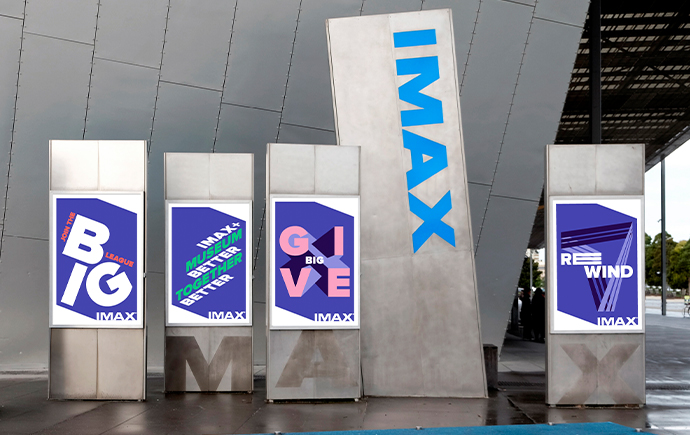
Image: IMAX marketing and communications, Clear Design. All images courtesy Zoe Hu.
ZH: IMAX is a highlight for sure, though I worked on it almost straight out of university so I feel like I peaked pretty early, haha! IMAX Melbourne had turned 20 years old and we created a really fun campaign to celebrate it. We used a lot of animation in the campaign, featuring on socials and digital screens, as well as on their enormous five-storey-tall cinematic screen (the largest in the world)! It was the first time IMAX Melbourne had used animation as part of their local brand and they were so excited by the campaign that we went on to do a brand refresh.
Another more recent highlight is Denada, an Australian company that makes sugar-free ice cream. We did a campaign for them when the pandemic was finally winding down and everyone felt heaps of pressure to go out and travel and party and otherwise make up for two lost years. The campaign idea was ‘Do Nada’, which is obviously a play on their name but also a call to action, to stop stressing out about summer and just chill. I’m also proud of other projects we’ve done with Denada, like their website and their choc pop packaging.
BM: What are some of the biggest challenges you’ve faced in your career to date?
ZH: The biggest challenge I’ve faced is more of a personal issue but I think it’s something a lot of people struggle with — and that’s self-confidence and self-worth. I like to say I’m a recovering perfectionist, because while perfectionism may have helped me in some ways, it’s super unhealthy and unsustainable. I used to have a lot more anxiety around design and I always felt like I wasn’t good enough or doing enough. Related to that, I felt very self-conscious about being an introvert – for example, I was anxious in meetings because I was so aware that I wasn’t speaking up as much as other people and I thought that meant I wasn’t pulling my weight. In reality, being an introvert means I just need a different (quieter!) environment to do my best work, and it’s okay to be different from the extrovert norm. Therapy has helped a lot with all of this, 10/10 would recommend.
BM: You’re also involved with the Australian Graphic Design Association (AGDA), is that right? Can you tell me a bit about this organisation and your role?
ZH: AGDA is the peak body for the design industry, there’s a different chapter in each state and it’s almost entirely volunteer run. AGDA hosts lots of events every year and I first got involved in 2019 because it sounded fun and seemed like a good way to meet new people. I helped set up international speaker events and I got to see the talks for free!
BM: How can design students get involved with AGDA?
ZH: You can become a student member and get discounts on events, awards entries and access to things like the folio review. If you’re keen to get stuck in and volunteer, follow AGDA Victoria on Instagram where they do callouts for helpers. If you want to learn more about AGDA or just meet other like-minded designers, I highly recommend coming to the monthly After Hours meetups!
BM: Any advice for budding designers?
ZH: I think a lot of designers (new and experienced) struggle with imposter syndrome, i.e. not feeling qualified for the job. For me, the worst part is at the start of a new project when I’m faced with a blank page – it’s almost like I forget how to do everything. Also when I was a student, I remember being worried that one day I’d just run out of ideas! My advice is to trust the process and take things one step at a time, creativity will usually start to flow once you start researching and mood-boarding.