
Orientation Day’s thought-provoking tote design
The tote design is an aerial map of Naarm and asks you to consider where you are placed in that picture. It stands as a reminder that you walk on the Kulin Nations’ Country and it is the perfect accessory to encourage discussion on a very important topic.

Kirrakee Watson's design on the 2023 Orientation Day tote bag
Kirrakee Watson is a Tanganekald, Meintangk and Boendik woman and designer of this year’s Orientation Day tote bag for Monash Art, Design and Architecture (MADA). The tote design is an aerial map of Naarm and asks you to consider where you are placed in that picture. It stands as a reminder that you walk on the Kulin Nations’ Country and it is the perfect accessory to encourage discussion on a very important topic. The bags will be handed out to newly commencing students at Monash Art, Design and Architecture during O-Week and will contain stationary as well as a range of helpful resources as they start their Monash student journey.
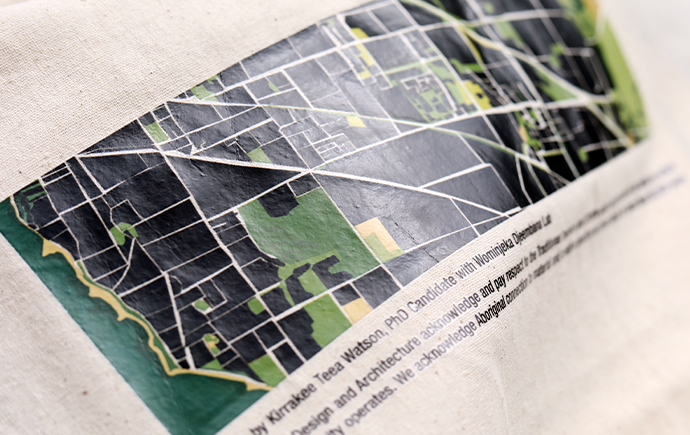
“I think having a thought-provoking design done by a First Nations student is a great way to engage the non-indigenous students of the University and get them to consider the Country they are studying on; not just the colonial places or colonial structures, but the Country that always was and always will be,” says Kirrakee.
Kirrakee has worked within the architectural profession in a variety of functions, including on Aboriginal community housing across Australia. She has a Master of Architecture and is currently working on her PhD through MADA, applying a decolonising, methodological framework and Indigenous positionality. Her PhD research will provide a critical Indigenous perspective of the disposition of global, Eurocentric architectures - products of colonial regimes, alongside Indigenous architectures and place. Her research aims to highlight the ongoing need to affirm the self-determination of First Nations Peoples to survive the myth of terra-nullius.
“Although Country has been covered through colonial place-making, these places are not empty of Aboriginal people, and our connection to Country is still powerful. The cityscape since time immemorial will always remain the unceded lands of the Kulin Nations.”