
Monash team design innovative solutions to reduce waste entering the Citarum River
The Citarum River, in the Bandung region of West Java, Indonesia, is recognised as one of the world’s most polluted rivers. Every day 20,000 tonnes of solid waste are discharged into the river.
To address this, Monash University’s Citarum Action Research Program (CARP) – a transdisciplinary research project that sits in Monash Art, Design and Architecture and the Monash Sustainable Development Institute (MSDI) – is working with local communities and the global research community to co-design innovative new infrastructure, behaviour programs, business models, and institutions to reduce waste entering the river environment and to develop circular solutions that recycle, remanufacture and reuse.
Visiting the waste pilot facility in Padamukti
Last month, members of CARP team and industry partners travelled to Indonesia to visit the waste pilot facility in Padamukti (TPS-3R) after two months of operation to finalise design improvements.
The waste pilot facility, which has been delivered and evaluated by CARP, has been designed to help address the open dumping and incineration practised at the village.
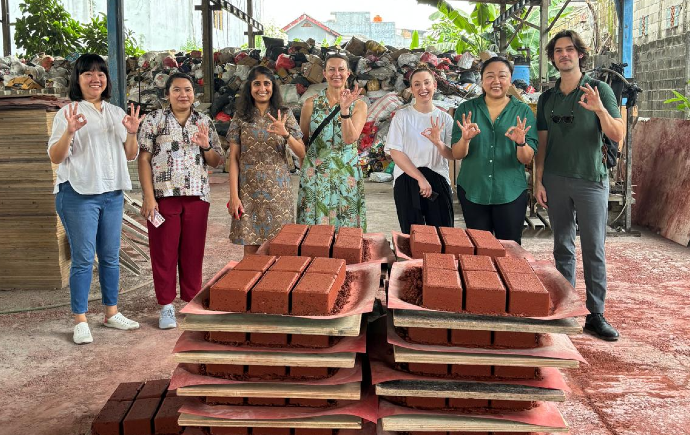
TPS-3R project site visit at Padamukti
What makes the CARP waste facility different?
TPS-3R is a waste facility provided by national government that includes basic infrastructure and waste processing equipment, as well as a waste incinerator. These facilities often under-perform or are abandoned because of poor governance processes, inability to cover operating costs, and the challenge of handling and creating value from mixed waste.
Taking a circular approach, the infrastructure in Padamuki designed by CARP works differently. It takes a community-based waste-to-resource approach. Addressing barriers to a sustainable operation, the waste pilot intergrates technology, governance and waste practices that enable recycling, as well as being able to generate new revenue streams for the community through the sale of waste materials and products.
The CARP team from Monash, along with Yaksa Pelestari Bumi Berkelanjutan (YPBB), Universitas Indonesia (UI) and ProBSF, finalised site improvements and met with Government officials from the Bandung Regency and the Sub-District Solokan Jeruk and West Java Province. It is expected that over the coming weeks, the amount of food waste processing will be increased at the facility and new equipment will be installed.
Exploring additional sustainable waste management solutions in the region
While in Indonesia, the CARP team met with NGOs and small industry that are also working closely with communities in West Java to address the challenge of unmanaged waste.
The team visited Rebricks, which has developed products for construction that focus on low-value, flexible plastic waste, providing further knowledge of waste recycling strategies and manufacturing processes for sites such as TPS-3Rs.
They also met with the Resilient Development Initiative to learn more about their expertise and visited the Bening Saguling Foundation and the Waste4Change and Riverrecycle TPS-3R site. Here the team was able to experience another TPS-3R operation that encompasses a circular economy approach. It does this by focusing on the community-based collection and processing of waste from nearby river systems, collecting food waste which is processed by a Black Soldier Fly facility, and the connects to a poultry farm where the revenue from eggs provides a sustainable business model.
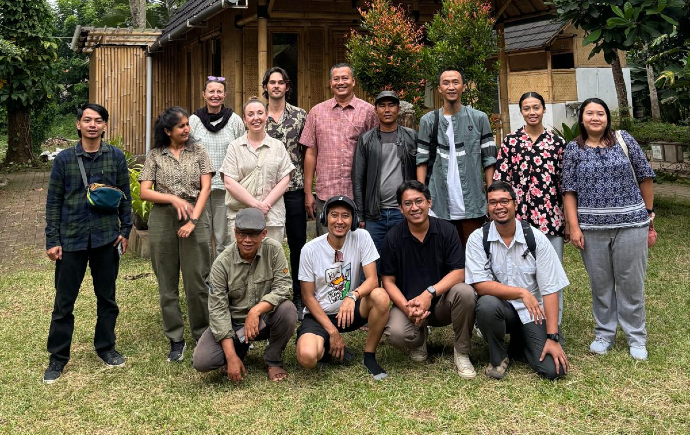
Visit to Bening Saguling Foundation and site for Waste4Change and Riverrecycle TPS-3R
This is the beginning of the next stage of the ambitious CARP project which will include further growth of the TPS-3R site and the beginnings of a behaviour change campaign, to fully encompass a circular approach to waste management that will help restore river and land ecosystems for these communities along the Citarum River.