
Designing sustainable, accessible tram stops for a more inclusive Melbourne

A new generation of Melbourne tram stops could soon transform the city’s streetscape, thanks to a pioneering design initiative led by the Institute of Railway Technology (IRT) and supported by Monash Art, Design and Architecture (MADA)’s Mobility Design Lab (MDL). This sits within a broader initiative between IRT, Yarra Trams and industry partners including PACT Group, GT Recycling, DKSH Australia and Integrated Recycling.
At the core of the initiative is the ‘Hollow Stop’—a modular, lightweight tram platform made from recycled plastic, designed to be more cost-effective, accessible, and adaptable than Melbourne’s current concrete tram stops.
Funded through the Circular Economy Research & Development Fund, delivered by Sustainability Victoria under the Victorian Government’s circular economy policy Recycling Victoria: a new economy, the project builds on IRT’s materials innovation and MDL’s human-centred industrial design expertise.
“Our role at the Mobility Design Lab has been to visualise how recycled plastic components can be shaped into a tram stop that not only meets accessibility standards but improves the experience for all users,” says Associate Professor Selby Coxon, Co-Director of MDL.
“This is about mitigating the problems of existing kerbside boarding as well as providing a smarter, more sustainable solution.”
Melbourne’s tram network is the largest in the world and over 100 years old. Many of its existing tram stops are inaccessible to people using wheelchairs or prams, and can be vulnerable to flooding. Concrete stops are expensive to build, slow to construct, and difficult to adapt or relocate as the city evolves.
The Hollow Stop addresses these challenges with modular, prefabricated units made from recycled plastic. Their ‘hollow’ internal structure makes them lightweight, easy to assemble and capable of draining water efficiently to prevent flooding. Despite their weight-saving design, the components are durable and strong enough to support a range of vehicle traffic.
“We’ve designed the platform to rise gently from the kerbside up to tram door level, making boarding much easier,” explains Coxon. “And because it’s trafficable, vehicles can drive over it safely when the tram isn’t present.”
Over two years, MDL tested form and assembly using 3D printed modelling. The result is a scalable platform system that can be adapted to different site conditions—essential for a legacy network like Melbourne’s.
Industrial Design PhD candidate Xiaoyou You, based in MDL, contributed to the prototyping phase by 3D printing scaled tram stop and tram models. Her research into sustainable vehicle design and mobility systems aligns with the Lab’s broader mission to reimagine urban transport through collaborative, interdisciplinary design.
Each Hollow Stop comprises a series of interlocking modules, each around 3 metres long. Unlike concrete platforms, they can be installed quickly and at a fraction of the cost—with per-unit prices reducing as production scales.
“This solution has the potential to drastically lower the barriers to modernising Melbourne’s tram network,” says A/Prof Coxon.
The project has already generated strong interest overseas. “When we presented the Hollow Stop with IRT at the 4th Annual Rail Decarbonisation and Resilience Conference 2025, it was met with great enthusiasm,” he says. “It’s not just about sustainability—it’s about creating infrastructure that works better for people.”
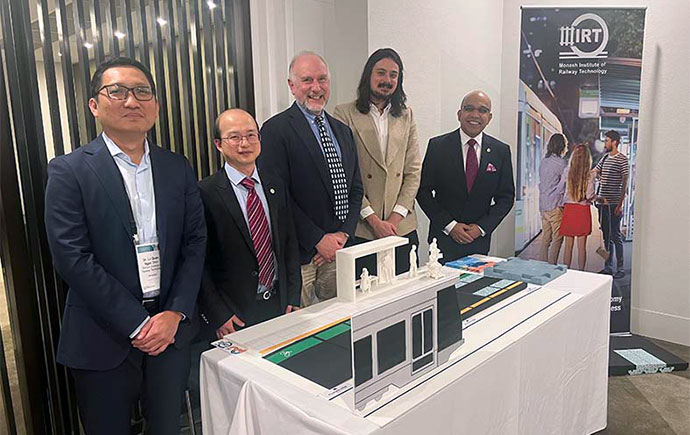
Dr Ngoc Tran, Senior Materials Scientist, IRT, Dr Cong Qiu, Senior Materials and Track Engineer, IRT, A/Prof Selby Coxon, Co-Director of MDL, Nick Daly, Head of Innovation, Yarra Trams, Prof Ravi Ravitharan, Director of IRT
With support from Yarra Trams and the Victorian Government, the Hollow Stop could soon move from prototype to production—replacing ageing tram platforms and shaping the next phase of Melbourne’s transport future.
MDL has worked on multiple projects with Yarra Trams and is a regular collaborator with the Institute of Railway Technology. “This is a uniquely Melbourne solution,” A/Prof Coxon adds. “It’s designed here, for our network, with our needs in mind. It’s modular, accessible, cost-effective—and it points the way to a more inclusive, better-designed city.”
For more information on the partnership here: https://www.monash.edu/news/articles/circular-economy-on-track-melbourne-tram-stop-platforms-could-soon-be-made-from-recycled-plastic-materials