
Redefining the concept of home at the Venice Architecture Biennale
 Home installation
 The 2025 Venice Architecture Biennale marks a historic moment for Australia as the country’s first all Indigenous-led pavilion, Home, addresses the theme - ‘Intelligens. Natural. Artificial’, bringing Indigenous knowledge systems, cultural practice and design to the world stage. The project challenges architecture’s singular worldview, encouraging diverse perspectives.
Bradley Kerr, Quandamooka man, architect and lecturer at Monash Architecture, is part of the Creative Sphere of First Nations architects, designers and practitioners behind this groundbreaking exhibition. Working with Creative Director Jack Gillmer-Lilley on the architectural component of the exhibition, Bradley’s contribution to Home extends beyond design; he has been instrumental in fostering a space for visitors to explore themes of belonging, memory, and identity through art and architecture.
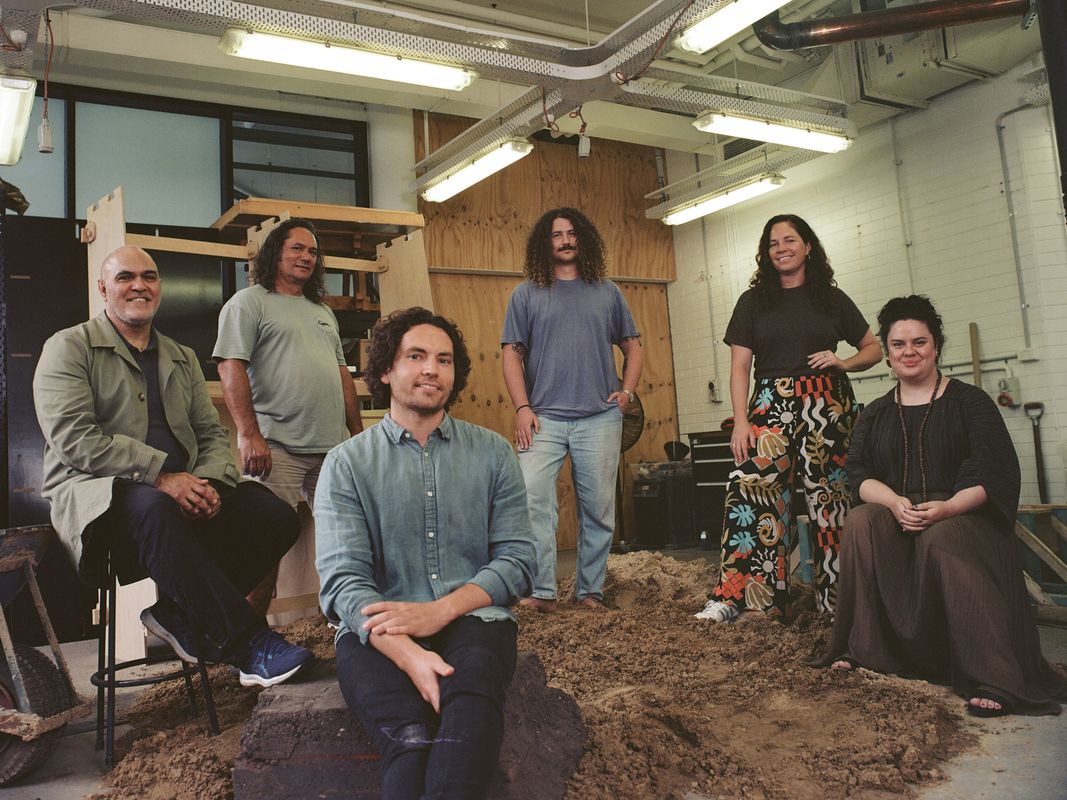 Creative directors and creative sphere members: Michael Mossman, Clarence Slockee, Jack Gillmer-Lilley, Bradley Kerr, Elle Davidson and Emily McDaniel. (left to right) Image: Maclay Heriot
 The immersive Home installation features a molded earth hearth at its centre, surrounded by a ceremonial ground filled with sand and a gypsum-water plaster perimeter. It includes 52 custom panels where water and gypsum will be poured. Visitors are invited to participate in the exhibition, to hold the artefacts, join in conversation, and to leave their footprints in the sand, or a trace in ochre or clay.
“We hope that visitors to the exhibition feel like they are participants and they can leave their mark,” says Bradley.
Home positions Indigenous knowledge as a critical design methodology, where the process of connecting with Country, through conversation and two-way knowledge sharing, is of equal importance to the tangible outcome.
Throughout the Biennale’s run time, Indigenous Australians will visit the pavilion for storytelling (yarns).
“I hope to see many more Indigenous leaders visiting and engaging with the space at Venice this year. We want everyone to feel comfortable in the knowledge that they have contributed to the space.”
Inspiring and encouraging future generations of architects
One of the aspirations of Home is to encourage future generations of architects to embrace a culturally and environmentally sustainable approach to the built environment.
“Everything we use is local and can be returned to earth once the exhibition is over,” says Bradley.
The Creative Sphere also invited emerging architectural practitioners to play an important role in the development of Home, through a multi-university collaborative learning experience entitled “Home: Country as Creative Process” in which 125 students from 11 universities across Australia participated, including from Monash University.
Monash Master of Architecture students undertook a studio unit led by Bradley, focusing on Country as an influence on material and creative processes relating to architectural practice, expanding their understanding of Australian First Nations cultural practices. They experimented, explored and observed how different materials can empower visual and communicative impact, culminating in the creation of a ‘Living Belonging’, an artefact or object that represents their personal idea of home.
The Living Belongings created by three Monash Architecture students, Shantel Gilmore, Melika Hatami and Emma Matthews, have been selected to be incorporated in the Home Pavilion.
For many architecture students, the shift to creating an artwork rather than a built structure is both liberating and deeply reflective.
“The process behind designing a building and creating an artwork are very similar,” Melika explains.
 Melika Hatami and her work Echoes of Home
“Any building we design as architects is an artwork on a larger scale. What I really enjoyed about this experience was the freedom. It was about pure expression rather than adhering to codes and briefs.”
Bradley’s mentorship was key in fostering this approach.
“Architects focus on the big picture, but Bradley takes a micro-scale approach, questioning and simplifying creatively. He values process over the end product, examining every detail,” says Emma.
“As students we have the opportunity to design with Country; more than just the land itself, the people, the skies, everything that has been before and everything that is to come. We as architects are constantly building on Country and have a responsibility to care for it,” she added.
 Emma Matthews and her artefact
 For all three students, participating in the unit and getting the opportunity to exhibit at the Venice Architecture Biennale is both a privilege and a moment of personal fulfillment.
“It’s an incredible honour to be selected and to have my work on display at Venice, which is globally recognised, is quite surreal,” said Shantel.
 Shantel Gilmore and her artefact
 “I hope to visit the Biennale with my family when it opens,” Emma added.
As the 2025 Venice Architecture Biennale opens its doors to the world in May, Bradley hopes for a shift in architectural discourse, one that embraces personal narratives, cultural identity, and the ever-evolving meaning of ‘home.’
“We are providing Australia's interpretation of the theme, which is about letting other people be part of the exhibition and essentially, part of the story of what home means,” Bradley concludes.