
Designing for the Deep
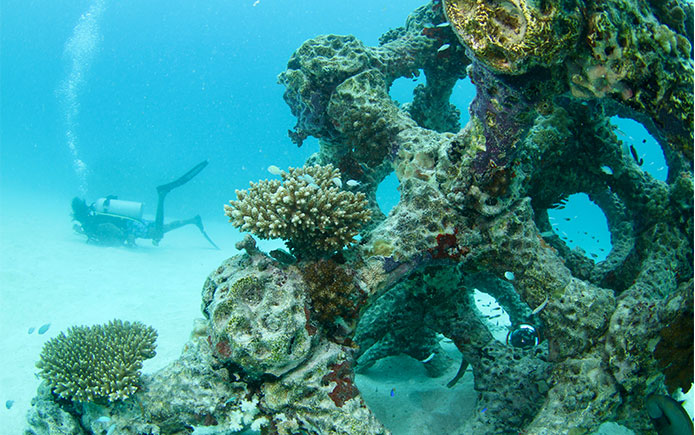
Image courtesy of Alex Goad.
For a long time, imagining what a career in design could look like might’ve involved conjuring up wealthy or experimental clients, professional portfolios, well designed studio spaces and well-dressed colleagues. It might’ve involved designing vehicles, furniture, electronics, software, graphics, experiences or interiors. Regardless of the discipline, design careers have typically been imagined and oriented around identifying problems and using design to solve them. Design solves problems – or so they say.
We are now living with the intensifying environmental consequences of over 200 years of industrial and economic expansion. Since the Industrial Revolution (c. 1760) the concentration of Co2 in our atmosphere from burning fossil fuels has increased exponentially, causing the temperatures and acidity of our oceans to rise. These changes contribute to more frequent and more intense weather events – flooding, fires, storms, drought – which in turn contribute to more frequent and intense social, economic and health problems – climate refugees, disrupted supply chains, pandemics. Hotter and more acidic seas also threaten multi-species populations by triggering habitat changes at a pace that some lifeforms are unable to adapt to while others thrive. Add the impacts of industrial fishing, pollution and fertiliser-enriched soil runoff, and we see the ecological balance tipping around the world. Locally, it can be observed in booming sea urchin populations decimating native kelp forests in Tasmania and Port Phillip Bay in Victoria, devastating fish kills in the Menindee Lakes and Darling River of New South Wales, and mass coral bleaching in the Great Barrier Reef off the coast of Queensland.
So much design problem solving has been geared toward supporting and benefiting from perpetual industrial and economic growth. Interrogating what and whose problems are foregrounded, and how they are being ‘solved’ by design, is growing more urgent every day. When we imagine what design can and should look like now and into the future, these questions become critical.
For Alex Goad, an avid SCUBA diver, industrial designer and researcher, witnessing the devastation of underwater ecosystems firsthand galvanised his vision for what design can and should be. Combining his passion for diving with his industrial design studies at Monash, Goad conceived of the Modular Artificial Reef Structure (MARS) as his honours project. MARS is a specially designed substrate for coral to grow on, and forms part of an international effort to rehabilitate damaged coral reefs around the world. Coral reefs don’t only protect marine life, they also protect coastlines against erosion and storm damage and offer a source of income, medicine and food for local and global populations. Widespread damage to coral reefs has significant ecological, social, and financial implications. MARS is a system of 3D printed textured forms cast in ceramic, designed to encourage coral growth and provide habitat and protection for different species and coastlines.

Image courtesy of Alex Goad.
Underwater coral nurseries or farms contribute to reef restoration by transplanting cuttings from healthy corals to substrates in more hospitable waters. The cuttings are cared for and monitored by divers until they reach a level of maturity that allows them to be transplanted back into damaged reef systems, where they can generate new colonies of healthy and potentially more hardy corals. Traditional substrates include concrete and steel, which are heavy and require industrial machinery and specialist staff to install, or lighter-weight materials like rope and coral trees that have a shorter lifespan and are susceptible to storm damage. For some island and coastal communities experiencing reef degradation the cost, equipment and expertise required to install traditional heavy-duty substrates can be prohibitive.
Recognising this functional and operational barrier, Goad set out to design a system that optimised material performance, minimised carbon footprint and enabled community-led installation and management. Each cast ceramic unit locks together like Lego bricks to create modular organic structures strong enough to endure underwater conditions and light enough to be installed by hand. The cellular structure Goad developed allows local divers to install the system and create different configuration to fit the unique conditions and organisms of their site. MARS can also be manufactured locally using 3D printing and ceramic casting techniques, reducing freight and creating opportunities for locally led and managed restoration projects.
After graduating, Goad pursued MARS professionally, founding the Reef Design Lab (RDL) as a multidisciplinary studio of designers, engineers, architects and fabricators based in Victoria. RDL takes a collaborative approach to research, design, production and community implementation. Forming research and industry partnerships make it possible for RDL to work with experts in marine ecology, fabrication and reef restoration from around the world. In 2018, MARS was installed with a coral farm program on Summer Island in the Maldives, where RDL and the reef restoration team are testing the effectiveness of the design against traditional methods. Goad experimented with many different forms, materials, surface textures and assembly methods to strike a balance between the sustainable, hospitable and functional. RDL continues to test, iterate and expand this responsive design approach in a range of underwater systems tailored to different locations and conditions. In 2022, the Dell Eco Reef was installed along the Clifton Springs Foreshore in partnership with the City of Geelong. Individual forms are cast in a low carbon concrete mix with locally-sourced shell aggregate, which encourages the growth of local mussels and oysters. The shape and textures of the forms are designed to sit on the seafloor and provide wave attenuation, habitat enhancement and a new attraction for snorkelling.
Goad is committed to sharing and testing his work in unexpected places. Above the waterline, MARS and other RDL projects have been exhibited and collected by major cultural institutions including MoMA in New York, the Design Museum in Helsinki, and the National Gallery of Victoria in Melbourne. Presenting work in the cultural space offers a platform to engage with hearts and minds, raise awareness and hopefully inspire others to contemplate the positive impacts design can have on complex ecological issues.
The problems Goad orients his practice towards are simultaneously local and global, emotional and operational. Contributing to global reef restoration and improving the health and biodiversity of oceans and waterways also requires attention to mitigating the negative impacts of his own practice. It’s no good addressing one localised problem while compounding others, which is the bind that a lot of ‘problem solving’ design finds itself in. Goad brings a holistic sensitivity to navigating this by paying attention to processes – the way the work is done – rather than simply focusing on outputs or performance. The implications of specified materials, manufacturing, freight, labour and installation methods are also taken into careful consideration.
The hustle remains, but it looks a bit different to more traditional design practices. The processes are collaborative, iterative, critically reflexive and responsive to lived experiences and tangible research. Goad recognises his design is not about silver bullets or catch-all ‘solutions’ but contributions – the ongoing development and exchange of ideas, skills, insights, labour and energy, with global communities addressing global problems.
Alex Goad is an industrial designer and founder of Reef Design Lab. He graduated from Monash Art, Design and Architecture with a Bachelor of Industrial Design (Honours) in 2013.
Myfanwy Doughty is an independent curator, writer and PhD candidate at Monash University’s Emerging Technologies Research Lab.