
Kelvin Tsang: Beyond the Horizon
 Image: Installation view of the 2022 NGV Architecture Commission: Temple of Boom designed by Adam Newman and Kelvin Tsang, NGV International, Melbourne, 22 November 2022 – August 2023. Courtesy Kelvin Tsang. Photography: Sean Fennessy.
 BE: Hi Kelvin! Can you tell me a little bit about yourself and your architectural practice?
KT: I'm an architectural graduate and currently the design lead and technical director at NWMN, a small architectural practice based in Brunswick, Melbourne. We operate in the residential and commercial building sectors, however many of our projects are additions and alterations to existing houses.
Before working at NWMN, I worked in the store development team at Bunnings, as a draftsperson. Since graduating, I have also taught as a studio assistant for Foundational Studio as part of the Bachelor of Architectural Design at Monash Art, Design and Architecture.
What features and ideologies define your work?
KT: As many of the projects we undertake are renovations, NWMN's primary design and building principle is based on adaptability and regeneration through conscious engagement with local ecologies. From a sustainability perspective, each project involves an element of salvage and reuse so that existing materials and conditions are given a second life, minimising waste as much as possible. These approaches reflect a broader belief in how our roles and responsibilities as architects should expand in response to the global climate condition we face today.
This ideology also threads into my personal design research with a fellow Monash alum, Patrick Tran, and our participation in architectural design competitions. Outside of professional practice, competitions have become a platform for Patrick and I to explore our interest in using narrative-driven architectural design and image production to promote conversations about architecture's role for positive change.
What did you study at Monash, and when did you graduate?
KT: I graduated with a Master of Architecture in 2021. Before commencing the architecture course at Monash in 2015, I received an Advanced Diploma of Building Design at Melbourne Polytechnic.
The shift from building design to architecture was based on my desire to explore other design approaches and applications so that I could become a better design practitioner. While building design provided the necessary skills for drafting on a technical level, Monash’s Master of Architecture enabled me to develop design methodologies and research skills.
Can you tell me a bit about your transition from student to professional life?
KT: After graduating with a Master of Architecture, I continued to work at NWMN, a position I held since joining as a third-year student in 2017. So, the transition from student to professional was relatively smooth. I had learned from past experience the difficulties in finding a job only after graduating from a course – after graduating from the building design course, I struggled for six months job searching and faced challenges in staying motivated.
Because of my background in building design and drafting experience, I built up a set of technical skills critical to construction documentation in the design industry. The other skills I developed through Monash, such as physical model-making and architectural visualisations, were essential for our work at NWMN.
What drew you to NWMN?
KT: I was drawn to NWMN for two reasons. The first was the chance to work with Adam Newman, a former tutor at Monash Art, Design and Architecture. During my time as a student, I found Adam to be an exceptionally knowledgeable tutor in the technical and theoretical aspects of the architectural profession. I knew that we could work well together given my technical background, while still learning a great deal from him as a mentor. The second reason is that NWMN is a small architecture practice – it is essentially a two-person studio.
What has working at a small practice meant for you as a graduate architect?
KT: Compared to my experience working at a larger office with teams of planners and designers, NWMN has offered me the opportunity to stretch my skills as a design practitioner because I am actively engaged in the practice as a whole. My responsibilities encompass the whole process of carrying out a project from start to finish, from schematic design to construction completion. So, this includes making physical models for client presentations, design visualisations, construction documentation and contract admin.
Tell me about your experience teaching at Monash. Has it influenced your architectural practice?
KT: I began teaching the semester after graduation, in mid-2021. Teaching in a studio-based environment is an incredibly valuable experience. The social aspects of delivering quality feedback depend on engaging with students’ ideas in conversations through words, paper and pen. The experience has given me a new perspective and approach to interacting with clients and consultants, as well as Adam.
What projects are you currently working on?
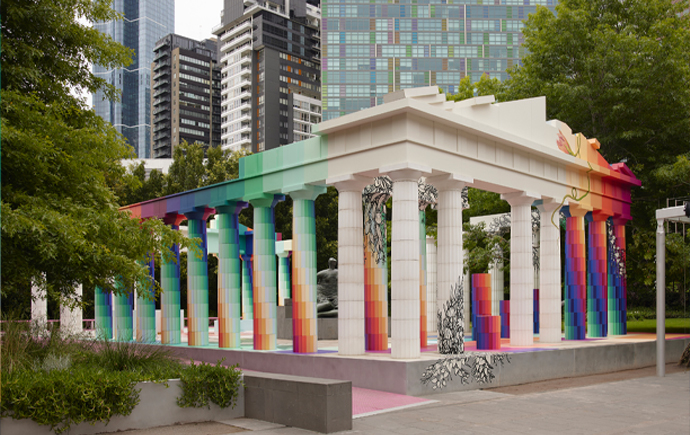
Image: Installation view of the 2022 NGV Architecture Commission: Temple of Boom designed by Adam Newman and Kelvin Tsang, NGV International, Melbourne, 22 November 2022 – August 2023. Courtesy Kelvin Tsang. Photography: Sean Fennessy.
KT: At any given time, we have at least four projects in progress at NWMN, one of which is a residential house in Coburg nearing construction completion. Our evolving design for the 2022 NGV Architecture Commission, Temple of Boom, has recently opened to the public. The design process is an iterative, ongoing collaboration with local artists and the community.
As a side project with fellow alumn Patrick Tran, I am currently exploring – through research and practice – how to translate the theoretical architectural design concepts and techniques we have developed into more pragmatic solutions in construction. We aim to find a niche from which to build an architectural practice.
Can you tell me a little bit more about your collaboration with Adam on Temple of Boom…
KT: Temple of Boom is a reimagining of the Parthenon on the Acropolis in Athens, adorned with overlapping urban art and murals by local Melbourne-based artists. The design is intended to be a place of engagement for the public to experience art, music and performance.
Temple of Boom is an ambiguous, provocative discourse open to interpretations. Functioning as a homage to the original Parthenon, the design adopts the global icon's symbol of democracy, human civilisation and notions of architectural perfection embedded in its classical form. It is one of the most copied buildings in the world; a complex symbol loaded with historicity and cultural influence and therefore has resonance with people the world over. We encourage viewers to consider what it means when this 2500-year-old potent symbol is placed on Wurundjeri Woi Wurrung Country, and in new contexts.
The urban art aspect of Temple of Boom is also a contemporary interpretation of the highly ornate and vibrant colours that embellished the Parthenon during the Classical period in Ancient Greece. By collaborating with local artists and inviting them to interpret the space and form of the commission design, the project is also rooted in the Melbourne identity and context.
Another aspect of the commission is its architectural accretion. Temple of Boom is the first NGV architectural commission to retain and build on the previous year's commission, Taylor Knights' Pond[er]. In lieu of the tabula rasa (clean slate) model, the project promotes notions of an architectural palimpsest, where buildings are adapted and regenerated to minimise or even eliminate waste. In doingthis, we’re bringing forward dialogues about sustainability and responsible material ecologies.
How did this proposal come about? What did the application process involve?
KT: Temple of Boom had its inception during one of the various lockdowns. As a result of the lockdowns, the art, music and performance industries struggled to stay afloat. One of our primary intentions was to create a space of engagement to help revitalise the arts, as well as a place of celebration. And the Parthenon was a natural inspiration for the project because of its inherent civic qualities as a global icon.
As part of the commission's project brief, we developed the design over three stages, each judged by a jury before passing to the next. The overall design development process is similar to the typical approach in professional practice: a project is carried out from concept to construction. One of the more unique aspects of the process is having the opportunity to seek out and engage with consultants, manufacturers and artists we usually wouldn't in residential projects. It was a very collaborative process.
What impact has Temple of Boom had so far?
KT: Since Temple of Boom was announced as the 2022 NGV Architecture Commission, we have been more active and engaged in social media and promotion than ever before. We have certainly garnered more attention within the profession, and hopefully Temple of Boom will promote more dialogue and interest in the underpinnings of our architectural practice.
Since its opening, I am thrilled to see it being used as a space for engagement and expression at the NGV. On Friday nights, Temple of Boom comes alive with the energy and excitement of visitors. The urban art and murals created by local artists add a vibrant and dynamic layer to the design and visitors can’t help but be drawn in by the bold colours and intricate details. The space is also used as a venue for music and performances, adding to the overall atmosphere and creating a truly immersive experience.
One of the things that I am most pleased with is how visitors are actively engaging with the artwork and architecture of Temple of Boom. They are taking the time to explore the space, to contemplate the meaning and significance of the design, and to make connections between past and present. We are seeing visitors of all ages and backgrounds engaging with the space and having meaningful conversations about the design and its place in the world. This is reinforced by the many cultural activities it hosts, including events in collaboration with the Hellenic Museum, who are dedicated to promoting Greek art, history and culture.
It’s been rewarding to see Temple of Boom being used as a platform for local artists to showcase their work and to have their perspectives and voices heard. This is a powerful way to connect the local community through design and to make it truly relevant and meaningful to the people of Melbourne.
Do you have any advice for undergraduate architecture students?
KT: I am not going to lie, studying architecture was not easy. You will have moments when you are on top of everything, and then you will have moments when a design block can obfuscate motivations. Over the years, I’ve learned to let myself make mistakes in the design process, creating opportunities for exploration. So, I suggest using a pen when sketching so that you’re not tempted to erase mistakes but rather build upon them as part of the creative process.
Another thing I came to realise is the importance of trusting those around you, mainly tutors and fellow students. The rapport I’ve built with the teachers and friends has unfolded in unexpected ways in my professional journey since graduating, such as a collaboration with a former tutor, Dr Eduardo Kairuz, earlier this year. I credit the symbiotic working relationships I have with Adam and Patrick to the engaging interactions that were fostered at Monash Art, Design and Architecture.
This interview was conducted by Brianne Edebohls as part of an internship with Monash Art, Design and Architecture. Breanna is a Bachelor of Media Communications and Masters of International Relations and Journalism student at Monash University.