
Education
The Faculty of MNHS aims to develop health students’ lifelong learning in Indigenous health equity studies. The student body within MNHS represents a spectrum in lifelong learning in Indigenous health equity with some students having more exposure than others. Educators are also diverse in their skills in teaching Indigenous health equity studies.
Over the last decade the Faculty of MNHS has developed a stronger programmatic approach to Indigenous health equity education. We know through research that students gain stronger learning from a program of in depth modular education than lesser depth teachings scattered across curriculum. We aim to scaffold student learning with a series of in depth modules or units and associated teaching activities to build a foundation for student lifelong learning while studying at Monash.
Education governance
Providing oversight for the program is the Indigenous Health Equity Education Committee which is a sub-committee of the MNHS Education Committee. Led by the Gukwonderuk Indigenous Health Workforces Centre, the committee membership is made up of course representatives from across the faculty. A strong focus of the committee is to ensure a shared responsibility model between Indigenous and non-Indigenous educators.
The key functions of the Committee and its membership are to:
- review and offer feedback on key curriculum documents and activities
- allow representatives from health disciplines to report back and seek input from their discipline on curriculum development
- operate as an oversight committee for research relevant to Indigenous Health Curriculum
- incorporate Indigenous health learning and teaching into health professions courses
- report on course accreditation progress in relation to Indigenous Health Curriculum
- engage with Indigenous student recruitment and engagement
Curriculum framework
The MNHS Faculty Education Committee has adopted the Aboriginal and Torres Strait Islander Health Curriculum Framework to guide curriculum development across the Faculty. The framework allows regulation authorities to assess the curricula. The Framework includes five learning domains (respect, reflection, communication, advocacy and safety and quality) and three levels (novice, intermediate and entry to practice).
Competency based education
The Faculty applies competency based education to deliver Indigenous health equity education studies to build a significant foundation for lifelong learning in this area.
- Use of the Aboriginal and Torres Strait Islander Health Curriculum Framework of competency outcomes
- A sequencing of competency outcomes
- Flexible education for learners to achieve outcomes
- Tailoring teaching to competencies
- Programmatic assessment
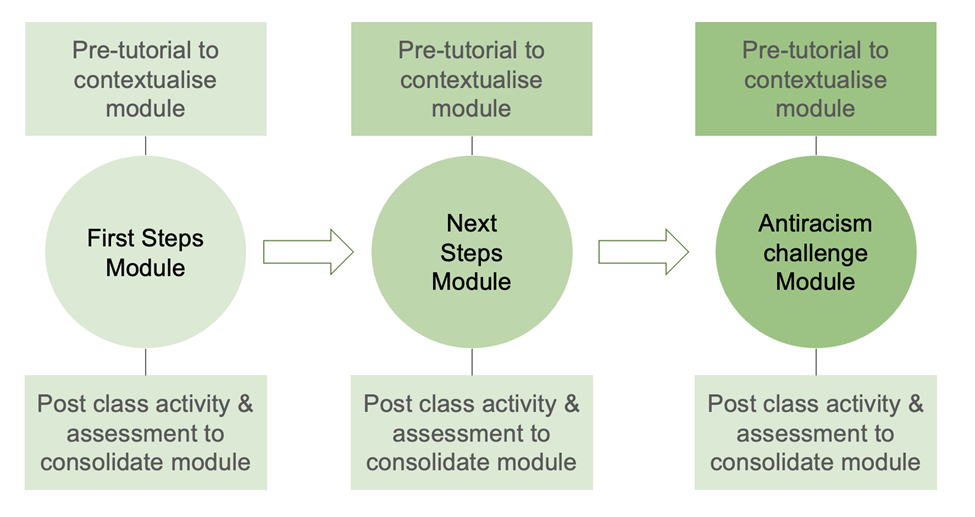 Figure: Program of education
A shared responsibility model
In MNHS Indigenous health equity is everyone’s business. Creating equity requires a whole university approach and this way of working, also helps prevent cultural load for Indigenous staff and community members. In MNHS Indigenous health equity curriculum is governed by Indigenous people via the Indigenous Health Equity Education Committee for quality purposes but is not necessarily always delivered by Indigenous people. The shared responsibility model demarcates boundaries for who is responsible for enacting different aspects of the MNHS Indigenous health equity education program.
Six credit point units
Some MNHS courses have opted to include six credit point units in the program of Indigenous health equity education. The units typically replace the Advocates in Indigenous Health First Steps module.