
Bachelor of Paramedicine

This degree prepares students for employment as paramedics. Paramedics provide health care for individuals experiencing a vast array of emergency and health related events in the community. Paramedics initiate care and determine the appropriate referral of patients to enable their continuing healthcare needs. A paramedic is also required to liaise with a range of professionals to facilitate appropriate healthcare needs of persons in the community.
Paramedics must be able to think clearly, act quickly, possess a calm manner and have the ability to reassure patients and handle stressful situations. They must have personal integrity and be able to work with people from many different backgrounds. A paramedic responds to both emergency and non-emergency healthcare and transport needs. A paramedic is also required to be able to respond to major incidents in a range of settings within a multidisciplinary emergency healthcare system.
Paramedics are predominantly employed by government ambulance services while a range of opportunities continue to develop in the non-emergency patient transport sector and a wide range of industry-based employers.
The Bachelor of Paramedicine is a three-year full-time or six-year part-time degree that provides the educational foundation required for beginning practice as a paramedic. The course is based at Peninsula campus.
This demanding and vocationally oriented course will supply you with the skills to assess life-threatening situations, provide emergency care and potentially save lives.
You will learn about the role of paramedics in the community and undertake practical and highly focused studies in trauma conditions, respiratory conditions, cardiovascular conditions, mental health conditions, complex medical conditions and maternal and neonatal health. You will also gain core knowledge of anatomy, physiology and pharmacotherapy, as well as the role of paramedics in practice, research, education and leadership.
On completion of the Bachelor of Paramedicine, you will have the knowledge and practical advanced life support skills that are required to assess and care for patients with out-of-hospital acute emergencies and chronic conditions. You will have acquired the clinical reasoning and decision-making skills required to assess and treat a wide variety of patients in various settings. You will also gain a professional knowledge of the Australian health care system, health across the lifespan, disease prevention, health promotion, research methods and principles of evidence-based practice as they relate to paramedic practice.
-
Discover Monash Paramedicine Seminar
-
 Clinical placements
View
Clinical placements
View

All students will need to complete supervised clinical placements with Ambulance Victoria and with other health agencies. Please note that travel will be involved, as all students must undertake placements in rural or regional areas with Ambulance Victoria. Students are responsible for travel, accommodation and living expenses.
Before undertaking placements students must:
- complete a National Police Records Check
- hold a valid Working with Children Check
- comply with the Faculty of Medicine, Nursing and Health Sciences Immunisation Policy. For further information please see Mandatory Compliance Policy.
Note: full immunisation compliance is required prior to completing the Medical & Fitness Assessment
- pass a medical and fitness assessment
- have the required specific placement uniform (Ambulance Victoria / other health agencies)
Failure to hold satisfactory checks or meet the immunisation / medical & fitness / uniform requirements may result in students being unable to complete their course.
Prospective students should also note that graduates need to have a full (unrestricted) driving licence to be employed by some ambulance services.
Medical & Fitness Assessment
Students must pass a prescribed medical and fitness assessment with an agency appointed by Ambulance Victoria. This is a prerequisite for participation in clinical placements with Ambulance Victoria. Students who receive an offer of a place in the course need to undertake this assessment early in Semester 1.
The health and fitness assessment process involves a review of medical history and physical fitness. You need to carefully consider your full medical history and ask questions early. A medical issue that you may otherwise assume is not an issue, may prevent you meeting the medical history test. Similarly the fitness test involves a thorough physical examination and includes a fitness test that may require you to undertake fitness preparation.
Further details regarding the medical and fitness test including costs will be provided at the enrolment session for this course.
Monash does not accept responsibility for students who enrol but cannot complete the course due to an inability to meet the medical and fitness tests imposed by Ambulance Victoria.
Details of the physical assessment can be downloaded from here: AV Physical Capacity Testing Protocols Pre Employment Candidate Pack
If you have any questions or concerns about your medical history or physical health and fitness, you must call Ambulance Victoria Medical Services Provider on telephone 1800 240 395 to obtain information and advice prior to accepting this offer.
Uniform requirements
Students enrolled in the Bachelor Paramedicine must purchase specified uniforms to be worn on placements and whilst participating in practical classes. All prices listed are subject to change from year to year and may vary depending on location of purchase.
A clinical uniform for placement with Ambulance Victoria consists of Cargo pants $135, Monash polo $60, Boots $160-220, Wet weather jacket $150, and Monash high visibility vest $50. A clinical uniform for placements with non-ambulance health agencies is also required. This consists of a Monash polo $60 and black dress pants $60.
All items are available from the Monash bookshop. Other equipment may also be required.
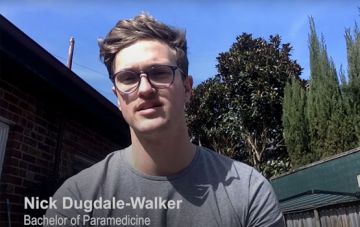
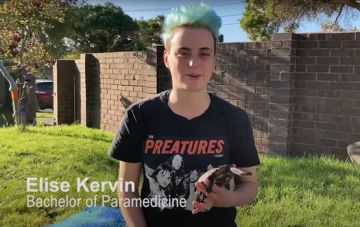
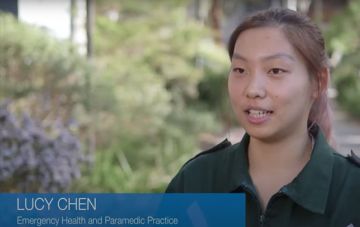
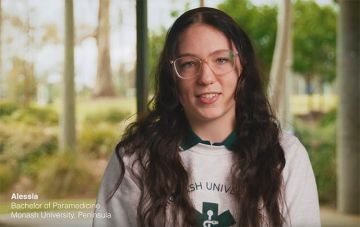
 Meet our current paramedicine students
View
Meet our current paramedicine students
View

Ashley
 Bachelor of Paramedicine
Deciding to move from Tasmania to study this course at Monash University, has been one of the most rewarding decisions of my life. The course has exceeded my expectations. It is run by highly trained staff who are qualified paramedics, even up to MICA level, enabling them to share personal experiences and give a real insight into what being a paramedic is all about.
The wide variety of opportunities to learn; with lectures, tutorials, practical classes, laboratory classes, online resources and clinical placement with Ambulance Victoria, enables you to learn all the vital information required in becoming the best paramedic that you can.
It has been a truly remarkable experience for me so far and I would recommend Monash University to anyone who has a genuine interest in helping people in a pre-hospital setting and learning to truly love the role paramedics play in the community.
Caitlin
 Bachelor of Paramedicine
The course is great, constantly challenging you to learn new things. I really enjoy the variety in what you learn and having qualified paramedics with real experience teaching you. The university puts a large emphasis on understanding the pathophysiology of different diseases, which assists students in understanding why they undertake certain interventions.
As part of the course you have the opportunity to participate in a variety of ambulance and hospital placements, in both metropolitan and regional areas. These placements are extremely useful when it comes to learning about the day to day role of a paramedic. This includes practicing a wide variety of skills and becoming more familiar with equipment. I would recommend this course to anyone with an interest in health care and helping the community.
Fraser
 Bachelor of Paramedicine
The amount of extra resources and skills the course provides you with is unbelievable. Meeting working paramedics and engaging with them is one of the most beneficial parts of your placement. It really gives an insight to life on the job.
Practical classes give such a supporting environment to learn in, and the small group, hands on classes are perfect for developing your skills. The lecturers are extremely open and welcoming. The knowledge provided is always first class and I believe the paramedics thoroughly enjoy teaching the new generations through the years.
Undoubtedly I love the sense of belonging this course provides me with. Nothing is more fulfilling or welcoming than knowing you will someday provide for those around you, security, assistance, and a person to trust. Even now as a student, each time out on placement, people will always believe in you and entrust their lives to your skills and knowledge. The course itself works towards bettering yourself and the future of Ambulance Victoria.
Matthew
 Bachelor of Paramedicine
What I have really embraced about this degree, is that the university appreciates the fact that early clinical placements are very valuable in setting up the student for the rest of the course. I’ve particularly enjoyed the more intimate feel between lecturers and students due to the class size. The course evenly balances the theoretical and practical aspects. Both are well taught in correlation with practical sessions every week with experienced paramedics, which includes reviewing each week of new content. This is done in a challenging and supportive environment with other students in your cohort who will eventually become some of your very good friends. I highly recommend this degree to any student who is motivated, willing to go outside their comfort zone and adaptable to enter a course that is highly regarded, expansive and extremely rewarding.
Sarah
 Bachelor of Paramedicine
The course not only focuses on the clinical skills paramedics require, but also other vital skills such as communication, problem solving and decision making in emergency situations. There are also numerous opportunities to pursue areas you might be interested in such as teaching or research.
The staff that teach the course either currently are, or were paramedics, which gives the theoretical side substance and application to real life. There is a good balance between theoretical and scenario based learning, allowing for application of the knowledge taught. We do a lot of Ambulance Victoria, Hospital and Special School placements throughout the degree, providing you with a real perspective of what it’s like to work as a Paramedic dealing with different patients and situations. Overall this is a challenging, but rewarding degree that prepares you to work as a Paramedic where every day is different and comes with its own challenges.
I would highly recommend this degree to anyone wanting to pursue a career as a paramedic.
Tyler
 Bachelor of Paramedicine
There have been many aspects of the course at Monash that I have thoroughly enjoyed. The depth of clinical knowledge taught in lectures and tutorials, followed by application in the scenario-based practical sessions, allows for a more effective learning experience. Small class sizes in the practical components of the course support an intimate learning environment that enables ample hands-on participation and opportunities to ask questions. All of the teaching staff are very approachable and there are fully equipped practical skills labs readily available for self-directed learning. Most importantly, the knowledge and skills that I have acquired while attending Monash have prepared me to enter the workforce in the exciting and rewarding profession of paramedics.
Vincent
 Bachelor of Paramedicine
Since beginning my university studies to become a paramedic, I have grown to appreciate the extremely supportive and friendly environment of the course and the department. As the course is held in most part on a small campus, a welcoming and familiar environment is fostered between student and staff alike. Every effort is made to connect us to the industry we are aspiring to join through frequent clinical placements and constant interaction with tutors who are all practicing paramedics in the field. This course is challenging in both its theoretical and practical components, yet immensely rewarding. I would recommend this course to those who are motivated, up for a challenge and looking for an immensely rewarding career on the front line of healthcare.
Lauren
 Bachelor of Paramedicine
Passionate about emergency care, first year paramedicine student Lauren Brewer has been a volunteer with the Country Fire Authority (CFA) for the past six years.
“At 12 I joined my hometown’s junior fire brigade program, and when I turned 16 I did my bush fire training and qualified as a firefighter,” says Lauren. “From there I did more training such as hazmat awareness, internal structural firefighting and breathing apparatus training.”
Following in the footsteps of her grandfather and father, Lauren’s love for emergency care led her to the Bachelor of Paramedicine at Peninsula campus.
“Monash had everything I wanted. I’m from Warragul and the Peninsula campus has great student accommodation so I live on-campus during the week and go home on weekends to volunteer and see my family. The structure of the course units also attracted me and I really like that we have core subjects.”
As a trained breathing apparatus structural firefighter, Lauren has already had her share of emergencies.
“My Dad and I attended a house fire where we had to go into a burning house to look for a lady apparently trapped inside. The roof collapsed on us and paramedics treated us at the scene. Luckily, we both came out uninjured (but a little shaken!). After talking to the paramedics on scene I thought the job was something I could do. It got me thinking about that as a career.”
Despite being a first-year student, Lauren has already been able to put her new emergency care skills into practise.
“Driving home one night I was first on scene at a bad car accident, and it was through my acquired CFA knowledge and paramedic course skills that I was able to help out. I also responded to an ‘undefined fire’ that turned out to be a lady who had accidently set herself on fire with a cigarette after she fell asleep holding it. Although it was an awful situation, it was good that I was able to recognise what the paramedics on scene were doing and be able to assist them. I’ve only been doing the course for 7 months and it was amazing that I was able to relate to what the paramedics were saying. I was actually a little bit useful!”
As well as enjoying the practical aspects of her course, Lauren says the support of her teachers at Peninsula campus has been amazing.
“I give my highest regards to our anatomy teachers, they are fantastic and so switched on,” she says. “I love the structure of these classes as well. We get weekly online videos and have a flipped classroom structure. You watch the lectures online and then follow up with two tutorial classes to clarify the information. It’s a great way to learn course work.”
With this being her first time living away from home, Lauren admits she was initially nervous about coming to Monash but made friends easily.
“Everyone is like-minded here and I feel like I have a new family. We have all bonded over our similar passions and are all equally enthusiastic. I feel excited to study and become a paramedic even though there is a lot of coursework.”
Lauren says her advice to future paramedic students is to be aware that you are going to be working with people 24/7. You need to go into the course knowing it’s your passion and it’s what you want to do as a career. She also adds that it’s also a good idea to take biology in year 12.
Max
 Bachelor of Paramedicine
Arriving from Singapore three months ago, international Bachelor of Paramedicine student Max Han says his interest in paramedicine began during his national service in Singapore.
“In Singapore, all males have to do National Service for two years when we turn 18. I was a Combat Medic in the army.”
As a Combat Medic, Max was taught skills such as intravenous cannulation, intra-muscular injections and combat injury management. National service also gave him the opportunity to work as an Emergency Medical Technician (EMT) with the civilian ambulance services for three months. This experience cemented Max’s decision to join his country’s emergency services and make paramedicine his career.
“The teaching of paramedicine in Australia is highly regarded,” said Max. “As there is no paramedicine degree programme currently available in Singapore, my employers picked Monash as their university of choice due to the high quality of education offered.”
So far, Max has been enjoying the course and feels that it’s in line with what he wants to achieve as a Paramedic.
“The course is very particular about clinical skills and professionalism, and I love that,” he says.
Max continues to explain how the newly introduced Professionalism in Paramedic Practice module teaches first-year students the importance of mental well-being and communication.
“In paramedicine, communication is so important. You can be 100% sure of your clinical knowledge and skills but still struggle with communicating medical information. Establishing rapport with your patient is a nuanced art and much more complex than practising your clinical skills on manikins. It’s crucial to deliver your service and care in a patient-centred manner. At the same time, you have to also be on top of your own mental health at all times. It’s great that the course places considerable emphasis on that.”
Max has now made Peninsula Campus his home and lives on campus in Gillies Hall. He describes the residential accommodation as cosy and well-designed. He is also very impressed with the campus’ commitment to students’ physical and psychological well-being, be it through student-organised activities or the range of professional services available.
“I really enjoy living in an environment that allows you to become independent, but at the same time offers plenty of opportunities to immerse yourself in campus life and interact with other students.” says Max. “There are so many opportunities to get involved! I absolutely adore making pancakes every Thursday, together with our lovely Chaplain Mandy and our fellow ‘pancake warriors’.”
Max proudly points out the weekly pancake initiative aims to provide a piping hot supply of pancakes to students on campus, from 8-10am every Thursday during the academic term!
Further to this, Max also volunteers his time for various PhD studies.
“My interest in research has led me to volunteer for PhD studies on campus. There are a considerable number of students at Peninsula doing research and I recently had the privilege of having my brain covered in electrodes for motor neuron stimulation, it was very interesting.”
In terms of his own future ambitions, Max hopes to enter the paramedic honours program and conduct his own research.
“Paramedics operate in such a hugely stressful environment and there are so many factors to take into consideration. In addition to clinical guidelines, it would be great if there were novel ways to better the patient’s experience in the ambulance, perhaps by alleviating their suffering through newfound psycho-therapeutic methods.”
Following his studies, Max will eventually return to Singapore where he will continue his work with the emergency services, contributing to the advancements in the field of paramedicine. Until then, Max’s advice to future paramedic students is that if they want an education giving them a holistic experience, and one that also gives them a certain standing in their field, Monash is the place to be.
Eliza
 Bachelor of Paramedicine rural placement
I completed two weeks of paramedicine placement at the Kangaroo Flat/Junortoun Ambulance Victoria branch, based in Bendigo. There was a high workload and not a lot of down time, but I found this meant I got the most out of my placement. All the cases we attended were very acute, including cardiac, respiratory and trauma injuries. During placement, I helped to take basic vital signs, interviewed patients, and aided in history taking. I was also able to do more invasive procedures such as intramuscular injections and intravenous cannulation.
I saw some things that weren’t typical for a metropolitan placement, such as injuries sustained while farming and lots of wildlife. I attended 2 car accidents, which I had never previously seen in my 3 years of university. The most interesting job we attended involved a camel kicking injury and getting bogged in the mud on the farm! The community of paramedics in Bendigo is strong, and it is overall a great environment and everyone is really nice. At the hospital, I had paramedics introducing me to their patients and teaching me about the jobs they attended.
I applied to stay at the Monash Rural Health student accommodation in Bendigo, which was a huge help financially – it was also a short drive from the branch. There’s a whole variety of students from different disciplines there I got to meet, including medicine, nursing, physiotherapy, radiography, and more. It was great getting to know everyone and I was easily welcomed.. There was also a Christmas in July party where everyone made delicious food.
For other students, I would definitely recommend going on rural placement. I have fallen in love with Bendigo, and I would love to take a job there after I graduate. Rural work is such a different experience compared to being in a city. Valuable lessons are learned when out rural and they will stay with you for the rest of your career.
 Meet our paramedicine graduates
View
Meet our paramedicine graduates
View
Julian

Bachelor of Emergency Health and Paramedic Practice
Every day Julian Hannah saves lives in one of the world’s busiest cities.
A Bachelor of Paramedicine graduate, Julian was recruited straight from university to work as a paramedic for the London Ambulance Service (LAS). Specialist on-the-job training, clinical autonomy and exposure to a high number of patients are just some of the benefits of his current role, as Julian notes “you have many opportunities to work in different areas within the ambulance service as well as extending your practice to work in other specialist areas outside of the ambulance setting”. On days off, he’s taking advantage of living in “the gateway to Europe” with plenty of opportunities to travel and explore other countries, providing “a great work-life balance”.
Choosing Monash based on reputation, Julian benefited from the Paramedicine staff’s strong clinical links as well as opportunities to take part in research. “All the educators were extremely experienced paramedics and well established academics. This showed through in lectures and practical teachings, something that has both pushed and encouraged me personally and academically in my career as a paramedic.”
Julian credits his time at Monash for providing him the knowledge, skills and experience to open many doors in the future. “In five years’ time I could be anywhere - I could still be in Europe working as a paramedic for one of the ambulance services, I could be back in Victoria with my family, I could be working for a foreign aid company, the options are endless.”
Michael

Bachelor of Paramedicine Graduate
The choice to study at Monash University was an easy one for me; it has the reputation of being at the forefront of Emergency Health.
The practical nature of this degree was one of the most rewarding aspects. The placement component allows for an incredible overlap between your theoretical studies and putting this into practice. It also helps you to develop additional skills – such as communication – that are difficult to teach in a classroom. As you progress through the degree, the placements become a fantastic way of challenging yourself and starting to treat patients (under the watchful eye of a qualified paramedic).
Equally as rewarding, the Paramedicine staff were helpful and relatable. They all had experience as paramedics or as health professionals and were very open in sharing their experiences and pulling relevant anecdotes to assist our learning. On a social level, the Paramedic student society (PARASOC) became a large part of my university experience. It has been a wonderful way of getting to know people from my cohort, the department, around university and in industry.
I’ve been offered a position as a paramedic in the United Kingdom, working for the London Ambulance Service, so I’ll start my career saving lives in the UK. In the future I plan to work in Australia as a paramedic, hopefully completing a Masters in Emergency Health (Intensive Care), allowing me to work with an even higher skill set.
Brendan

Bachelor of Paramedicine Graduate
I have always enjoyed the aspect of helping people as part of an emergency service, so it was clear that a career in Paramedicine was for me.
Whilst studying the Bachelor of Emergency Health, I met many amazing people who I was able to learn with and learn from. The course was great, and I found all subjects really beneficial to the job itself. The staff with all of their experience and ongoing research, really do enable you to learn so much more than 'just out of a text book'.
Nowadays I have been on the road for about 3 years, and in that time I have been able to look back on my Monash days and draw from experiences and learning points that help me with my job. I am a CI on road and also am a Paramedic Educator at Karingal branch. This role pushes me to work hard to help increase education and ongoing learning with my colleges. I also work as a casual tutor in Paramedics at Monash and love doing that.
The best part about the job is that you never stop learning. Every day will be different.
Drew

Bachelor of Paramedicine Graduate
I knew that I wanted a career that had a strong health science base, was interactive, was largely based outdoors, and where I could be guaranteed a variability work load and location. This drove me to choosing to study paramedics at Monash University.
Having approachable lecturers who were all paramedics with vast experience was a great resource. They also continued to challenge and expand my understanding of health issues, constantly insisting on the importance of keeping an open mind when faced with treating someone with unusual signs and symptoms.
I enjoyed the clinical aspects of the course and especially the hands on weekly practical sessions with actual paramedic tutors, who would help us put theory into practice and give us an insight into how paramedics go about successfully treating patients in the real world.
The course had a strong research focus to further support the evidence-based community emergency health setting that paramedics work within. This not only helped me gain insight into current practices of why paramedics do what they do, but also gave rise to many potential areas that could be competently and safely undertaken by paramedics to help their patients.
Much like my time at university, I am still constantly learning new things and adding to my existing knowledge. This is just how it should be in order for me to continue improving care for those I care for. Only 3 years into my career, I genuinely believe that I have chosen a career that I love and will be part of for many years to come.
James
Bachelor of Nursing/Emergency Health Graduate
James Fowler was recently the recipient of the Sir John Monash Medal. The Medal is awarded annually to recognise extraordinary academic achievement to a final year undergraduate degree student. Only one student in each Faculty receives this annual award.
James received his medal at Graduation night and credits his friends, fellow students and educators in his receiving this award. He says “All throughout my time at Monash I was supported from every angle. Whenever I asked for help or a new opportunity, someone always obliged. This made me feel like a valued member of the Monash community, which in turn spurred me to fully apply myself during my time at university. It wouldn't have been possible without the late night quiz-sessions with my friends, the harsh (but usually fair) criticism on my assignments from my educators, and all similar moments throughout the four years.”
James continues “The Sir John Monash medal is an achievement I am particularly proud of, as it represents a culmination of not just academic success, but also contribution to our community through advancing the University’s goals of social justice, human rights and a sustainable environment. Throughout my time at Monash I always said "yes" when offered the chance to jump on board almost anything. The led me to become involved in a whole range of projects and meet a lot of passionate people - from the Australian Indigenous Mentoring Experience (AIME), to the Monash Residential Services Residents' Committee (ResComm), to presenting at the Paramedics Australasia International Conference, to becoming a Residential Advisor, to joining the MONtrack project.” James reflects “At the time these didn't seem like anything grand - they were just little things I enjoyed doing - but I suppose they all add up, don't they? How did I achieve these awards? Simply by saying "yes" and just turning up.”
James completed the Bachelor of Nursing/Bachelor of Emergency Health double degree as he felt the health field would be a perfect match for him, he knew he could never work in an office and he wanted to work in a field that was always changing and would enable him to keep learning, James explains “I'd had friends who studied medicine, and whilst I admired the knowledge and skills of doctors, I didn't fancy the lifestyle of long hours and frequent requirements to move between cities, states, and even countries with little say in where you end up. I really wanted interaction with people to be a fundamental aspect of whatever I did, and the more I thought about it, the more appealing a career in nursing and/or paramedicine seemed. For me, studying the double degree was an absolute no-brainer; it was only one extra year, double the knowledge, double the qualifications, and more than double the career opportunities!”
As for his views on whether the Monash experience was a good start to his career, James explains, “My time at Monash was a healthy combination of theoretical and practical work which, looking back, provided great preparation for the so-called 'real world' beyond university study. The varied clinical placements gave me plenty of opportunities to consolidate everything I'd learnt in the classroom. By studying both nursing and paramedicine I was able to gain two perspectives on almost everything, which not only significantly expanded my knowledge, but taught me that there are multiple ways to achieve the same outcome and everyone can have their own opinion based upon their previous experiences. A very important lesson for a career in health!”
And what of James since he graduated? “I was fortunate enough to be offered a graduate nurse position in the Emergency Department at the Royal Children's Hospital Melbourne, and I am currently about halfway through my graduate year. It is absolutely fantastic and I couldn't imagine learning and working anywhere else! I love the challenges of working with children, adolescents and their families, and I'm learning at a faster rate than ever before. Though Monash didn't prepare me with specific paediatric knowledge, I didn't feel overwhelmed or unequipped when starting at the Royal Children's. And I may not have known about nursing children, but Monash certainly prepared me with sufficient enquiry, reflection and independent learning skills to begin practicing and learning in this complex area.”
James continues, “I've also recently started working within Monash University's Department of Community Emergency Health and Paramedic Practice (DCEHPP) as a research assistant. Alongside a very wise, very experienced staff member I'm undertaking a project investigating paramedic perceptions of providing care for children. It's very early days, but it's definitely an area of interest for me and I really hope it can grow into something fantastic! A further challenge for me following graduation is keeping connections and knowledge in the fields of both nursing and paramedicine, and I think working as a research assistant with DCEHPP is my answer to this. I am very interested in both professions, and I intend to remain connected with both as I progress through my career.”
When it comes to what the future holds, James is less sure where he sees his career progressing. “I've always found this a very difficult question to answer. Every time I do something new I find a new passion and a whole new area to explore. I also don't like fixating too strongly on any long-terms goals - I think it can cause us to spend so much time and effort looking directly forwards that we can miss the shiny thing glistening in the corner of our eye. So far I love working with young people and their families at the Royal Children's Hospital, so perhaps I will continue exploring in that area. I also love helping people achieve things they never thought they could, so I can also see myself becoming involved education of some type in the future, possibly at a tertiary level? Working overseas has also been a dream of mine, and with my degree I am more than equipped to work almost anywhere in the world, so that is a definite option too!”