
Joseph Spring
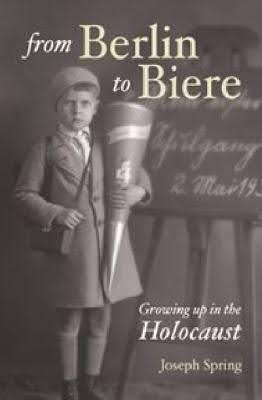 Title: From Berlin to Biere: Growing up in the Holocaust
Author: Joseph Spring
Publisher: Makor Jewish Community Library
Place of publication: Caulfield South, VIC
Year of Publication: 2009
Location of Book: Lamm Jewish Library, Melbourne Holocaust Museum, Sydney Jewish Museum and other public libraries
Cities/town/camps: Germany: Berlin, Gleiwitz and Turmalin labour camps; Belgium: Antwerp, Brussels, Eksel; France: Lyon, Nimes, Lorient, Montpellier, Bordeaux, Drancy internment camp; Switzerland: French-Swiss border; Poland: Auschwitz III-Monowitz; Australia: Melbourne
Note: those cities/towns/camps underlined are those which are most central to the narrative
Genre: Memoir
Key events/experiences: false identity; concentration camp; death march; adolescent survivor
From Berlin to Biere is the story of Berlin-born Joseph Sprung, whose flight from Nazi Germany to France, Belgium and Switzerland culminated in his being turned over to the Nazis in 1943 and incarcerated in Auschwitz III-Monowitz at the age of fifteen.
Pages 1-20 describe the author’s childhood in Berlin amidst the rise of Nazism. Pages 21-36 recount his flight to Antwerp with his mother and younger brother in February 1939 and their lives in Nazi occupied France and Belgium from 1940 until July 1942. Pages 36-66 detail the author’s flight to unoccupied France in July 1942 with his cousin, during which time they survived using false papers and ration cards until October 1943 when the author was turned over to the Gestapo by the Swiss border guards and sent to the Drancy transit camp. Pages 67-112 describe his internment as a forced labourer in Auschwitz III-Monowitz from December 1943 to January 1945. Pages 113-36 recount the ‘evacuation’ of Auschwitz in January 1945 and the author’s forced march to Gleiwitz and Turmalin labour camps in Germany. Pages 137-67 describe liberation by the American army and the author’s return to Belgium where he was reunited with his brother and mother. It also recounts his eventual emigration to Melbourne and lawsuit against the Swiss government for his arrest and expulsion to Nazi Germany in 1943. Also included are eight pages of photographs of the author and six prints by Walther Peiser, a former Auschwitz prisoner and the author’s friend and protector.
Joseph Spring (formerly Sprung) was born in January 1927 in Berlin, the first-child of Polish-Jewish immigrants Czarna Weichselbaum and Abraham Sprung. His younger brother Heini was born in 1928. The children grew up in a moderately religious, working-class family. In 1932, Joseph’s father tragically died of a blood infection. As a child, Joseph witnessed the rise of Nazism and in 1933, shortly after his sixth birthday, Hitler became Chancellor. As antisemitic measures worsened, Joseph suffered attacks by the Hitler Youth and living conditions in Berlin became unbearable. Finally, in early 1939, his brother Heini was smuggled over the Belgian border with his Aunt Dora. In February, Joseph was sent with his Aunt Cyla using her son’s identity. Their mother followed in June.
In Antwerp, the Sprung family lived with their relatives, the Henenbergs, his mother’s sister Dora, her husband Max and their three boys, Henri, Dolphe and Sylver. Joseph’s aunt Cyla and her family emigrated to Australia in 1939. In May 1940, when Joseph was thirteen, the German army invaded Belgium. His family sought safety in northern France, but the train on which they were travelling crashed, severely injuring several people and killing his aunt Dora. After recovering in hospital for seven months, Joseph went to live with his mother in Brussels.
In 1941, as antisemitic measures intensified, the Sprung and Henenberg families moved to the village of Eksel, in the Dutch-speaking province of Limburg. In May 1942, they returned to Brussels but, as deportations began in July, fifteen-year-old Joseph and his older cousin Dolphe travelled to unoccupied France with false papers whilst the rest of the family went into hiding.
For more than a year, Joseph and Dolphe moved from place to place in southern France, surviving off forged ration cards and working odd-jobs. In September, at Dolphe’s urging, Joseph travelled to Brussels to retrieve his cousins Henri and Sylver in order to smuggle the boys across the Spanish border. However, due to thick snow they were unable to cross the border. In November 1943, fearing arrest, Dolphe decided to send the boys to Switzerland whilst he returned to hiding in Brussels. Tragically, the boys were arrested for illegally crossing the border. Believing the Swiss to be sympathetic to the Jews, Joseph revealed his identity to the border guards who betrayed them to the German police. They were then deported to the French transit camp Drancy and in December 1943 they were sent to Auschwitz.
On arrival in Auschwitz, Joseph’s cousins were sent directly to the gas chambers and Joseph was sent to the Monowitz labour complex where he toiled as a slave labourer for more than a year. Joseph survived under the protection of Walther Peiser, an older German-Jewish prisoner who had risen to a position of relative power and prominence in the prisoner hierarchy. Peiser was instrumental to Joseph’s survival, providing him with food, protection and guidance. In January 1945, evacuations from Buna began and Joseph was sent on a death march to Gleiwitz with Peiser. After three days, they boarded a train to Mittelbau-Dora. From there, they were sent to the Turmalin forced labour camp in the Harz mountains. With the approaching American army, on 5 April, the prisoners were ordered to evacuate. This time without his guardian, Peiser, Joseph marched for several days in the German countryside until liberation by the American army.
Joseph then made his way back to Brussels where he was reunited with his brother and mother who had survived in hiding with his uncle Max and Dolphe. The family lived in Brussels for eighteen months whilst awaiting landing permits sponsored by Joseph’s aunt Cyla. In late September 1946, their permits arrived and, with the help of the HIAS, Joseph and his brother boarded a ship to Sydney, arriving in November 1946. They then travelled to Melbourne to live with his aunt and her husband. Joseph began work as an apprentice in the jewellery trade. His mother arrived in early 1947 and in 1951, Joseph obtained a landing permit for Walther Peiser, who emigrated to Melbourne that year. After establishing a successful business in Melbourne, Joseph married wife Ava in 1960, and the couple had two sons.
In 1998, Joseph lodged a claim for compensation with the Swiss government for his expulsion and arrest in 1943. A year-long legal battle ensued, resulting in a five week-long, highly publicised court case in Switzerland’s highest court in January 2000. Joseph travelled to Switzerland to give testimony to the court. Although the government rejected liability for the actions of the border guards, they nonetheless granted Joseph CHF 100,000 in compensation, approximately 700,000 AUD in today’s value.
From Berlin to Biere is a fascinating and candid account of the author’s Holocaust experiences. Everyday life in Auschwitz – the conditions and the social dynamics amongst the prisoners – is described in rich detail. Written chronologically, the memoir is devoted principally to the author’s wartime experiences and does not describe his pre-war or post-war life in depth. There are also some gaps in the narrative, including how Joseph and Heini were smuggled into Belgium.