
Current projects
Centre-wide projects
Monash Initiative for Rapid Research into Antisemitism

The Monash Initiative for Rapid Research into Antisemitism (MIRRA) is a major initiative that researches the nature, causes and effects of antisemitism in Australia, and will provide recommendations and support to governments and sectors across Australian society. The Initiative is a series of three-month projects each aimed at providing datasets that help us fully understand the nature and depth of antisemitism, and developing best practices to combat it.
Read more
MIRRA Training
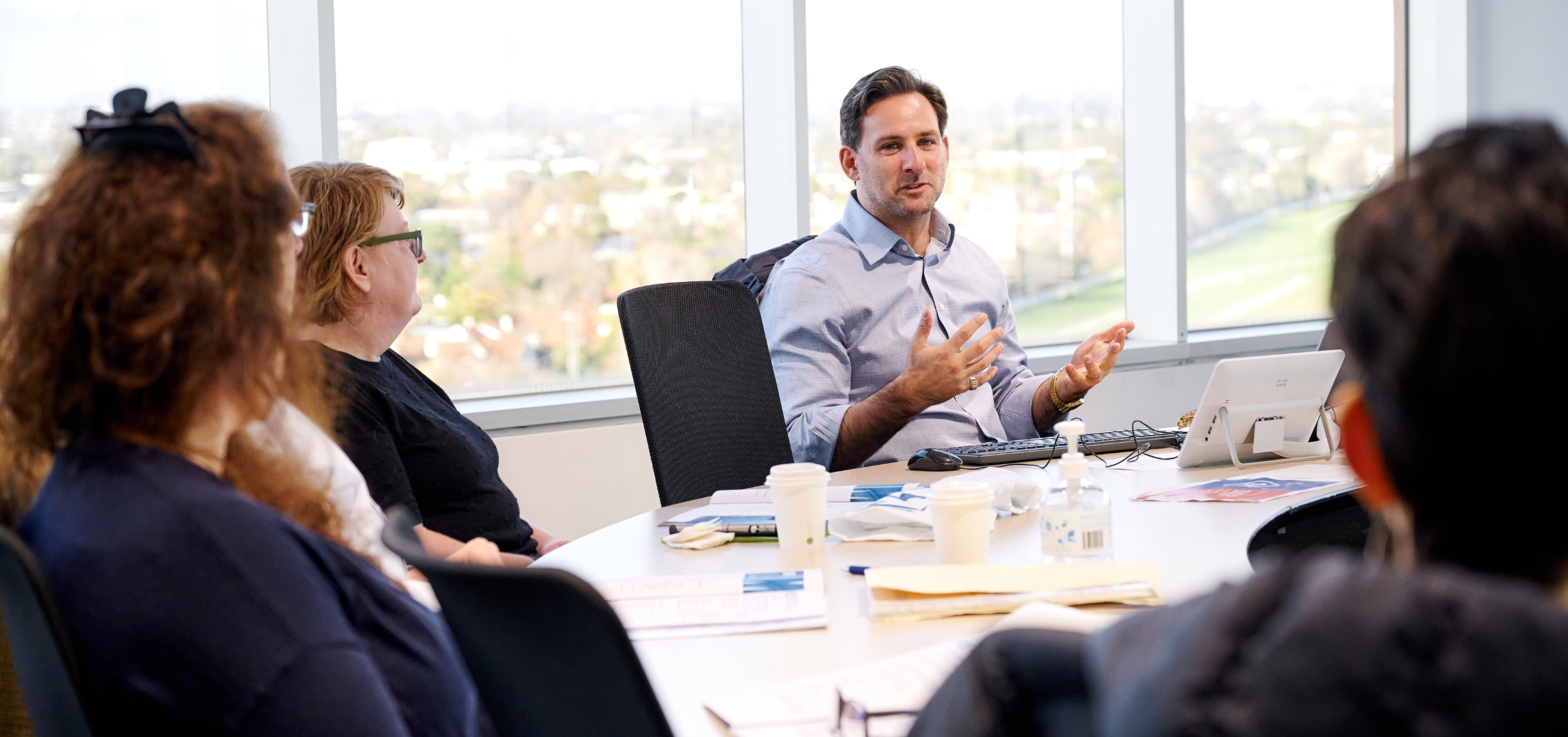
The training program uses testimonies, policy-aligned tools, and a carefully developed working definition of antisemitism to improve staff confidence, institutional response, and student safety.
Read more
Australian Jews in the Shadow of War (AJSW)
 Australian Jews in the shadow of war (AJSW) is a survey that was conducted by the Australian Centre for Jewish Civilisation (ACJC) at Monash University, Melbourne in conjunction with the Jewish Communal Appeal (JCA) in Sydney, Australia. This study was funded by JCA and the Loti and Victor Smorgon Family Foundation, in partnership with Australian Jewish Funders. The study employed post-hoc population weights developed out of an analysis of the 2021 Australian Census and a separate Jewish congregational census, to make the data more representative of Australia’s Jewish population.
Read more
The Melbourne Yiddish Seder Project
 The Melbourne Yiddish Seder Project documents and showcases the life and music of local musician, Boruch Kaluszyner (1911-1974). A survivor of the Holocaust, Kaluszyner composed a cycle of original songs for the Third Seder, a secular communal Passover meal traditionally held after the first two religious seders. Today, Boruch Kaluszyner’s songs continue to be sung at Passover seders and his music remains a rich trove that forms part of Melbourne’s distinct Jewish and Yiddish post-War cultural heritage. The project aims to honour this legacy by creating and sharing new recordings of Kaluszyner’s Yiddish songs; posting an accessible booklet of the lyrics in the original Yiddish, transliteration and singable English translation; and conducting educational programming.
Read more
Gender, Resilience and Adaptation in Melbourne’s Holocaust Survivor Community
 In the wake of the Holocaust, survivors embarked on a journey to rebuild their lives, and in doing so, reclaim hope, a sense of purpose and meaning in life. While researchers have explored the resilience and adaptation strategies of Holocaust survivors, few have considered the role of gender. The 2022 Kerryn Baker project brings together an interdisciplinary team of researchers from the fields of history, psychology and social work to investigate the role of gender in shaping the resilience and adaptation patterns of Holocaust survivors in Melbourne.
Read more
Gender in Jewish community organisations
 In 2019, the Victorian branch of the National Council of Jewish Women Australia Victoria (NCJWA Vic.) launched its gender equity campaign, #MakeSpaceForHer. This aimed to increase the representation of Jewish women within Jewish communal organisations in Victoria, recognising that only 14% percent of the boards of Jewish organisations had a balanced gender composition.
Read more
Jewish Melbourne COVID-19 online archive
 This archive is a documentation of Melbourne Jewish life during COVID-19, reflect the many different ways that Melbourne Jews (individuals, families, and institutions) adapted to life under quarantine. The archive is part of Journal of the Plague Year, a global undertaking initiated by Catherine O'Donnell, Richard Amesbury, and Mark Tebeau in the School for Historical, Philosophical, and Religious Studies at Arizona State University.
Read more
Rediscovering 'Joy of the Soul': Fusing creative arts and Jewish scholarship
 In the 18th and 19th centuries, Elkhonen Kirhcen’s (1655-1735) Simkhes ha-Nefesh (Joy of the Soul) was a best-seller. Working with internationally renowned Melbourne composers/performers, we will produce 14 new songs based on Kirchen’s lyrics and musical notation, and a website housing a plethora of creative works.
Read more
Staff projects
David Slucki, Sing This at My Funeral
 The rapid expansion of Yiddish-language cinema in the 1930s in its European and American centres came to an abrupt end after the decimation of the Nazi Holocaust. After some seventy years of silence, some two dozen movies and television series with spoken Yiddish-language dialogue have appeared over the last twenty years in the United States, Canada, Israel, and Europe.
Read more
New Yiddish cinema
 The rapid expansion of Yiddish-language cinema in the 1930s in its European and American centres came to an abrupt end after the decimation of the Nazi Holocaust. After some seventy years of silence, some two dozen movies and television series with spoken Yiddish-language dialogue have appeared over the last twenty years in the United States, Canada, Israel, and Europe.
Read more
Feeling familial separation: unaccompanied Jewish youth migration to the United States, 1933-1945
 The story of Nazi refugee youth is typically presented in post-war testimonies and current historiography as one of victimhood and loss, which lays in stark contrast to how refugee youth presented themelves at the time. This project knits together the history of emotions and the experiences of youth to make several critical interventions into existing scholarship on the experience and migration of Nazi-era Jews.
Read more
Metropolises of memory: Holocaust survivors in comparative perspective, 1946-1984
 This project investigates how Holocaust survivors in different cities tried to make sense of their traumatic pasts; although they found themselves resettled in cities with very different urban and political environments, a global sense of survivor identity emerged in the post-war decades.
Read more
Golda’s emissaries: African development and the gendering of Israeli foreign policy in the Cold War era
 In the late 1950s, Israel launched a sweeping development aid program focused on sub-Saharan Africa which has been largely overlooked by historians and forgotten by the public. Golda’s Emissaries will tell this neglected story for the first time, using untapped archival sources and new interviews, and weaving together the voices of both Israeli and African women.
Read more
Esotericism and exotericism in old Yiddish texts
 Yiddish has also been the bearer of the Jewish mystical tradition in important ways. This project aims to produce critical editions of three particular works from the 17th and early 18th centuries, mapping what was and wasn’t translated, how and why.
Read more
Beyond the era of the witness: testimony, digital media, and the afterlives of Holocaust memory
 This project is an exploration of new media representations of the Holocaust; an interdisciplinary collaboration looking at issues of ethics, testimony, trauma, and representation, new media pedagogy, AI and cognitive science, and arts-based research practice.