
Hania Mayer
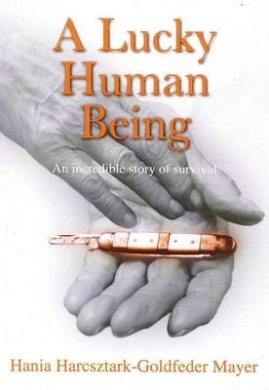 Title: A Lucky Human Being: An Incredible Story of Survival
Author: Hania Harcsztark-Goldfeder Mayer
Publisher: Makor Jewish Community Library
Place of publication: Melbourne, Australia
Year of Publication: 2009
Location of Book: LAMM Jewish Library of Australia
Cities/town/camps: Poland – Lodz, Auschwitz-Birkenau; Germany – Bergen-Belsen; Post-war – Sweden – Uppsala, Doverstop, Marieborg, Norrkoping; Australia – Melbourne; Israel
A Lucky Human Being: An Incredible Story of Survival is the memoir of Hania Mayer. The book is divided into four sections – the first section (pages 9-22) briefly reviews Hania’s family background and early school years before the war; the second part (pages 23-83) describes the war years; incarceration in Auschwitz and Bergen-Belsen and liberation on 15 April 1945. The third part of Hania’s memoir deals with her life in Sweden after the war (pages 84-135) and the remainder of the book (pages 138-222) describes Hania’s new life in Australia. An additional feature of this memoir is approximately 30 personal family photographs.
Hania Harcsztark was born in Lodz on 17 March 1922 to Sara (nee Biderman) and Abraham Harcsztark. She had three older brothers. Her parents were both children of rabbis. The family was ardent Zionists and went to live in Palestine for two years before returning to Poland. Back in Lodz, Hania went to school where she excelled in her studies. Tragedy struck the family when Sara passed away in 1937 when Hania was fifteen years old.
Part two of Hania’s memoir with a description of Hania’s brothers and the beginning of the war. In 1940, the Harcsztarks were ordered into the ghetto.
She shared a small room with her father and brother. Hania found work in a ‘straw resort.’ The Germans called the workplaces ‘resorts.’ With 300 women, she made plaited straw shoes that German soldiers wore over their army boots. She also worked in various other factories. Life in the ghetto was very difficult – lack of food, over-crowding, people taken out to work and never returning. Hania clung to the hope that things would improve. In 1943, Hania met Janek Golfeder who worked as a policeman in the ghetto. They were married by Chaim Rumkowski (head of Jewish Council) on 6 August 1944. There were 40 couples married that day. Three weeks later, they were sent on cattle trains to Auschwitz.
In Auschwitz-Birkenau, Hania's head was shaved and she did menial work – moving large stones from one side of the road to the other. Fortunately, she discovered that her brother Hary was also incarcerated in Auschwitz. They met almost every day by the fence which divided the men and women’s barracks. In October 1944, Hania was put on a train to Pirszkau Szlesensee where the prisoners were ordered to dig trenches for anti-aircraft guns. Their accommodation was a cow shed and the women were allocated spaces to sleep on the bare earth. From there, the girls were marched to Bergen-Belsen. She remembers very little about this camp as she was ill from typhoid. The British Red Cross liberated the camp on 15 April 1945. When Hania was found lying on the floor of the so-called hospital at Bergen-Belsen, her rescuers thought she was dead. Someone had another look and noticed her breathing. She was taken to the Red Cross hospital where nurses noted that one hand was clenched shut. They presumed it was paralysis associated with typhoid. Eventually Hania opened the hand herself and found she had been clutching a small penknife with two blades, one of which was broken. It was her only possession. The knife became a talisman for Hania.
Halina slowly regained her strength in the health facilities of Sweden. In May 1946, she was reunited with her husband, Janek Goldfeder and he lovingly saw her through yet another trauma, which was to remain private until 2005.
Halina and Janek decided to leave war-torn Europe and on 27 December 1950, they arrived in Melbourne aboard the SS Sorento.
Janek died young in Melbourne, leaving Hania to raise their daughter Marcia alone. Hania worked hard to provide a secure, loving home and eventually remarried. Hers is a tale of enormous courage, love and resilience which she attributes directly to the noble values of her family.