
Abram Goldberg
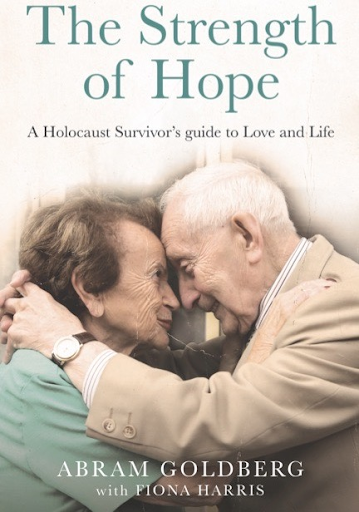 Title: The Strength of Hope
Author: Abram Goldberg with Fiona Harris
Publisher: Affirm Press
Place of publication: South Melbourne, VIC
Year of Publication: 2022
Location of Book: Lamm Jewish Library, Melbourne Holocaust Museum, Sydney Jewish Museum and most public libraries
Cities/town/camps: Poland: Lodz, Krakow, Auschwitz-Birkenau; Germany: Braunschweig, Watenstedt, Ravensbrück and Wöbbelin concentration camps; Belgium: Brussels; Australia: Melbourne
Note: those cities/towns/camps underlined are those which are most central to the narrative
Genre: Memoir
Key events/experiences: Lodz ghetto; concentration camps; death march
The Strength of Hope is the 314-page memoir of Abram Goldberg, who survived years of internment in the Lodz ghetto and multiple concentration camps. He emigrated to Melbourne in 1951 where he volunteered as a survivor-guide at the Melbourne Holocaust Museum, sharing his message of peace and tolerance.
Pages 1-9 cover the author’s return to Auschwitz in 1996 with his family and his reasons for writing his memoir: his promise to his mother that he would tell their story. Pages 10-49 describe the author’s childhood and the early stages of war with pages 50-109 recounting his confinement in the Lodz ghetto until its liquidation in August 1944. Pages 110-50 detail his internment in Auschwitz-Birkenau and various concentration camps until his liberation in May 1945, with pages 151-209 recounting the immediate post-war period and the author’s marriage to Cesia in Brussels. Pages 210-314 describe their emigration and new life in Australia. There are 16 unpaginated pages containing 44 family photographs.
Abram Goldberg was born in Lodz, Poland, in 1924 to secular, Bundist parents Chaja and Herszl Goldberg. The youngest of four siblings, Abram had three older sisters – Maryla, Frajda and Estera. Abram was raised in a working-class family in the poor, mainly Jewish, district of Lodz, where his father worked at a textile factory.
On 1 September 1939, when Abram was fifteen, Nazi Germany invaded Poland. A week later, Lodz was occupied, and antisemitic restrictions were instituted almost immediately. In the immediate aftermath of the invasion, Abram's sister Maryla married husband Jacob and the pair escaped to Russia. In December 1939, the remaining family was rounded up and transported to Krakow. There, they were placed in accommodation with two other Jewish families. In January 1940, Estera and Fajda stayed in Krakow whilst Abram and his parents made the long journey back to Lodz with the help of his father’s connections with the Polish Socialist Party. When they finally arrived, sometime in February, the Goldbergs discovered that the Nazis had established a ghetto in Lodz and strangers had been relocated to their flat. They were assigned to a new flat which they shared with another Bundist family, the Wieners. Abram befriended their son, Bono, leader of a Bund youth group (SKIF) who would later become an influential Bundist in Melbourne. In May, the ghetto was closed.
During their incarceration, Abram and his father continued to participate in Bund meetings and community activities. Through these contacts the family was able to secure life-saving work. Abram worked as a metal worker at Bono’s factory and smuggled metal parts for the construction of illegal radios. In 1942, there were large-scale deportations to the camps. In September, Abram’s father, his Aunt, and her six children were caught in an Aktion and deported. They were never seen again. For the remainder of their time in the ghetto, Abram and his mother worked in their respective factories. In the summer of 1944, deportations resumed with the impending liquidation of the ghetto. Abram constructed a makeshift attic and went into hiding with his mother on 9 August 1944, the day the ghetto was liquidated. They remained there for four weeks until, on 25 August, Abram’s mother, exhausted and defeated, decided to turn herself in for deportation. Abram went with her.
After a three-day journey in overcrowded cattle cars, they arrived in Auschwitz. Upon arrival, Abram was separated from his mother, who he never saw again. After three months in Auschwitz-Birkenau, Abram was transferred to the Braunschweig concentration camp where he worked at a truck manufacturing factory. After one month, he was sent on a death march to nearby Watenstedt concentration camp and, after delousing, on another death march to Ravensbrück the following day. Two weeks later he was sent to the Wöbbelin concentration where he was liberated on 2 May 1945 by the American army. At the time of liberation, Abram was 20 years old, and weighed just 29 kilos.
After liberation, Abram and several friends decided to return to Lodz, arriving in June 1945. However, they soon left, returning illegally to Germany where they hoped to reunite scattered Bund members across the DP camps. After several perilous trips to Russian occupied Europe to smuggle Bund members to the west, Abram escaped to the American zone of Berlin and then to Brussels where he was supported by the Bundist community. In March 1946, he met his future wife, fellow Auschwitz survivor Cesia, and the couple were married in June 1947. During his time in Brussels, Abram obtained work as a handbag maker and eventually as a tailor. Soon after his wedding, he learnt that his sister Maryla and her son had miraculously survived the war in Russian and was reunited with them two weeks later on a trip to Poland.
As their friends began emigrating from Europe, Abram and Cesia applied for permits to Australia, which were granted in December 1949. In January 1951 they were finally able to secure passage via Naples, in a trip funded by the JOINT, and arrived in Melbourne in March. In 1952, their son Charlie was born and in 1957 their daughter, Helen. In Melbourne, Abram and Cesia were active in the Bund community and Abram obtained work as a tailor before eventually establishing several successful cafes and, ultimately, a restaurant. In 1984, Abram began volunteering as a survivor-guide at the Melbourne Holocaust Museum and in 1990 he became its treasurer, a position he held for 15 years.
The Strength of Hope is a comprehensive account of the author’s life that describes everyday life during the Holocaust, particularly in the Lodz ghetto. Nearly half the memoir is devoted to the author’s post-war experiences, providing insight into the psychological impact of the Shoah and the life of a Jewish immigrant to Australia. Some chapters feature a “lesson” the author has drawn from his life experiences The memoir was written with the help of award-winning Australian journalist Fiona Harris.