
Andor Schwartz
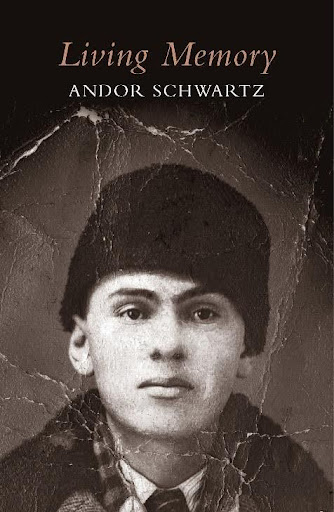 Title: Living Memory
Author: Andor Schwartz
Publisher: Black Inc
Place of publication: Carlton, VIC
Year of Publication: 2003
Location of Book: Lamm Jewish Library, Melbourne Holocaust Museum, Sydney Jewish Museum and most public libraries
Cities/town/camps: Hungary: Tyukod, Piricse, Nyírbátor, Budapest; Slovakia: Košice; Israel: Tel Aviv; Australia: Melbourne
Note: those cities/towns/camps underlined are those which are most central to the narrative
Genre: Memoir
Key events/experiences: Hungarian labour battalion; in-hiding; Swiss protection pass
Living Memory is the miraculous story of Hungarian-born survivor, Andor Schwartz. Following the Nazi invasion of 1944, Andor was enlisted for mandatory manual labour in a brick factory outside Budapest. After a bombing raid, he escaped to Budapest where he went into hiding, eventually finding refuge at the Swiss embassy where he survived the war as a porter.
The memoir is 312 pages in length. Pages 1-74 describe his family history at length, retelling stories told to him by his parents and grandparents. Pages 75-165 recount the author’s upbringing in rural Hungary and the escalating antisemitism in the war period. Pages 166-215 describe the German occupation of Hungary in March 1944, the author’s conscription into the Hungarian labour battalion, his escape and time in hiding in Budapest. Pages 216-280 give an account of the liberation of Hungary by Soviet forces and the author’s return to Nyírbátor to rebuild his life, reflecting on grief and faith in the aftermath of the Holocaust. Pages 281-312 describe his marriage to Baba, the birth of their son and the family’s escape from communist Hungary to Israel followed by a brief account of the author’s time in the Israeli army and the family’s emigration to Australia in 1958.
Andor Schwartz was born on 1 January 1924, in the small village of Tyukod, in north-eastern Hungary. The eldest child of Katalin Stern and Moric Schwartz, he had a younger brother Imre, and sister, Erzsike. A self-taught farmer, Andor’s Orthodox father gradually accrued sizable wealth through his successful farming. For the first six years of his life, Andor was raised by his grandparents in nearby Piricse whilst his parents lived and worked on the farm in Tyukod. In 1930, his parents purchased the Kacsavar castle estate in nearby Piricse where they lived until 1942. As there were no Jewish schools in Piricse, Andor attended a devout Catholic school, until he was sent to Nyírbátor to attend a Jewish school while boarding in a Jewish home. Throughout his teenage years, Andor was sent to various yeshivas as Jewish quotas stifled his plans for a university education.
In 1941, the family estate was requisitioned by the Hungarian army and, in 1942, the hardening of anti-Jewish laws meant they were forced to sell their home to a Christian family. To circumvent anti-Jewish laws governing property ownership, the family rented an estate in Nagy Mogyoros, farming tobacco, wheat and pumpkins as well as a home in Nyírbátor. In March 1944, whilst Andor and his family were at their home in Nyírbátor, Nazi Germany occupied Hungary and antisemitic restrictions were immediately enforced. Andor, then aged 20, was conscripted into the Hungarian labour battalion and was sent to the brick-factory barracks in Košice, Slovakia, whilst his family was sent to the Simaputsza ghetto.
Luckily, in Košice, Andor was taken under the protection of Commander Szallay and given relatively easy work. Whilst other conscripts were taken to the frontlines, Andor and his group were taken to the outskirts of Budapest to work with picks and shovels. In the summer of 1944, Commander Szallay was ordered to move his battalion to an industrial factory in Pest. Not long after, the factory was bombed in an aerial raid and Andor, taking advantage of the chaos, escaped to Budapest. For weeks Andor moved from shelter to shelter with the aid of family, friends, and kind strangers. On several occasions, he narrowly avoided capture by Hungarian and German authorities. Finally, he found refuge at the Swiss embassy where he was given the coveted job of porter. He remained there until Budapest was liberated by the Russian army.
On returning to Nyírbátor, Andor tragically learnt that most of his family had been murdered by the Nazis. He was so traumatised that at first he wanted to die, but after a period of profound mourning he decided to live and turned his attention to recovering some of his father’s fortune. Briefly relocating to Budapest, he began several business ventures, dealing in the black market to sell soap, oil and tobacco to Russian troops.
In May 1946, he returned to Nyírbátor where he was reunited with his former neighbour and future wife Margit (Baba) Keimovits, a concentration camp survivor and avid Zionist (see entry for The May Beetles). The couple married in January 1947 and lived in Nyírbátor where their son Moshe (Morry) was born in March 1948. Andor found success running a flour mill but gradually communist restrictions forced him to relinquish his business.
In May 1949, the Schwartz family escaped communist Hungary with the assistance of smugglers who took them through the Carpathian forest to the Czechoslovakian border. They then travelled by train to Vienna with the help of the JOINT, living for a time at the Rothschild DP camp before boarding a ship from Italy to Israel in August 1949. After three days, they arrived in Haifa and were taken to a kibbutz with other Hungarian refugee families and Andor was called up for army service. In August 1952, their second son Eli (Alan) was born. At the urging of Baba’s sisters, the Schwartz family emigrated to Melbourne in 1958. In 1962, their third son, Danny, was born. In Melbourne, Andor eventually established a successful construction business. After accompanying his son Morry to Hungary, Andor was finally prompted to write his story at the age of 79, which he wrote in long-hand over three months. The memoir was published by his son’s publishing company, Black Inc, in 2003.
Living Memory is a tale of one man’s journey of faith written with extraordinary fidelity and vividness. Not merely an account of the Holocaust, the memoir is a chronicle of Jewish Hungary told through the experiences of the author’s family. The memoir reflects deeply on faith and grief in the aftermath of the Holocaust and paints a rich portrait of Orthodox Jewish life in pre-war Hungary.