
Annita Sharpe
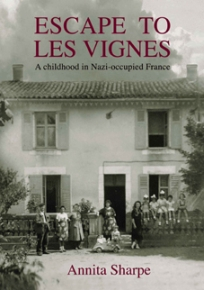 Title: Escape to Les Vignes:A Childhood in Nazi-Occupied France
Author: Anita Sharpe
Publisher: Makor Jewish Community Library
Place of publication: Melbourne, Australia
Year of Publication: 2007
Location of Book: Lamm Jewish Library of Australia
Cities/town/camps: France – Paris, Limoges, Les Vignes; Australia - Melbourne
Escape to Les Vignes is the memoir of Annita Sharp. The book is divided into three sections – the first section (pages 5-32) details Annita’s family background and life in Paris before the war; the middle part (pages 33-145) discusses escaping from Paris to the Free Zone in 1942, living in the relative safety of Les Vignes for two years, being arrested and sent to Limoges prison, liberation and returning to Paris in the summer of 1945. The remainder of the memoir (pages 146-172) describes the voyage to Australia, starting a new life in Melbourne, raising a family and becoming involved with the Child Survivors of the Holocaust organisation. It is worth noting that the book features approximately 24 pages of family photographs taken before the war in France and after the war in Australia and 10 pages of historical papers including a letter written from La Roquette prison in July 1942 and various documents relating to Charles Szkop (Annita’s father) who carried out many dangerous missions as a member of the French Resistance. The last few pages of Escape to Les Vignes are entitled ‘Descendant Reports.’
Annita’s Polish-born parents (Kayla (Gaby) Zuchliner and Shlomo (Charles) Szkop) both came as children to France in the 1920s and became true Parisians, embracing French culture and the freedom from discrimination. They married in August 1932. Annita was born in Paris on 5 April 1933 and her sisters Fanny (born 1937) and Bernadette (born 1938) soon followed. Annita had health problems and when she was four years old, she was sent to a Solarium near Bordeaux for nine months.
By June 1940, the Germans had occupied Paris. Annita’s father was arrested in a street roundup and taken to Drancy transit camp. He was given a 24-hour release pass to attend his mother’s funeral, but he escaped to the Free Zone. Life was exceptionally difficult for the rest of the family, so they made plans to join their father in the south of France. In April 1942, Annita, Fanny, Bernadette and Maman walked out of their home and took a train to Tours where they were to meet someone to guide them across the demarcation line into the Free Zone. After a harrowing ordeal they made it across the border and were reunited with Papa.
The family stayed in Les Vignes as refugees from Paris and lived in relative safety for two years. Then in the spring of 1944, they were arrested at gunpoint. Bernadette, who was five years old, was stopped by the Gestapo and told to go away. Papa had been denounced as a member of the Resistance, so he was taken into the custody of the Milice (French Militia). The rest of the family spent three long months in jail. After their release, they discovered that Bernadette had been given a false identity and placed in foster care. She was reunited with her family as was Papa after the liberation of Limoges in August 1944.
The Szkops returned to Paris in the summer of 1945 to discover that over 30 family members had perished during the war. By 1949, due to the tense political situation with Algeria, Papa decided that it was time to start a new life in a new country. He departed ahead of the family and arrived in Australia in 1950. Nine months later, Mama, Annita, Fanny and Bernadette boarded the SS Cyrenia and disembarked in Melbourne in August 1951.
The girls loved their life in Australia. In March 1955, Annita married Lionel Sharpe and they had two children, Monique and Danny. Annita sought professional counselling to help her deal with the trauma suffered during the war years. In 1970, Annita returned to Les Vignes with her sister Bernadette.
Annita’s story is a detailed and poignant remembrance of what was endured and lost, but also, one full of vivid characters and events that linger in the mind for a long time.