
Baba Schwartz
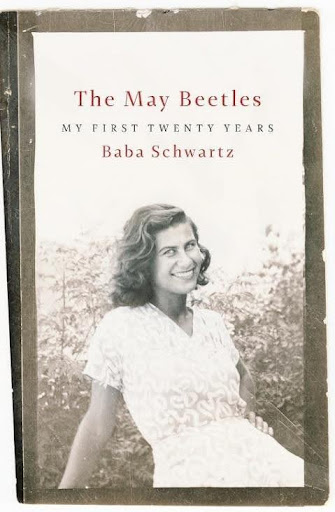 Title: The May Beetles: My first twenty years
Author: Baba Schwartz
Publisher: Black Inc.
Place of publication: Carlton, VIC
Year of Publication: 2016
Location of Book: Lamm Jewish Library, Melbourne Holocaust Museum, Sydney Jewish Museum and most public libraries
Cities/town/camps: Hungary: Nyírbátor, Simapuszta ghetto; Poland: Auschwitz-Birkenau, Stutthof, Szczecin; Germany: Baumgarten, Malchow and Fridendorf forced labour camps Marienwerder; Austria: Rotschild DP camp; Israel: Haifa; Australia: Melbourne
Note: those cities/towns/camps underlined are those which are most central to the narrative
Genre: Memoir
Key events/experiences: ghetto; concentration camp; death march
The May Beetles is the beautifully recounted and deeply personal life-story of Baba Schwartz, whose carefree Hungarian childhood was shattered in 1944 when she was deported with her family to the Simapuszta ghetto and Auschwitz-Birkenau. Guided by the strength of her mother, Baba and her two sisters survived multiple concentration camps and a death march until their liberation by the Russian army in 1945.
The memoir is 269 pages long. Pages 1-76 provide a detailed description of the author’s upbringing, recalling her childhood in Nyírbátor and the mounting antisemitism she experienced in the late 1930s. Pages 77-114 briefly recount the onset of war and escalating antisemitic restrictions in the early 1940s, before describing the German occupation in March 1944 and her subsequent internment in the Simapuszta ghetto. Pages 115-62 give an account of her six-week internment in Auschwitz-Birkenau with her mother and sisters followed by their incarceration in several other concentration camps. Pages 162-98 describe their escape from a harrowing death march in January 1945 and period spent sheltering in a Polish farmhouse, as well as the chaos of the Russian occupation in which many women were sexually assaulted. Pages 199-246 describe their return home to Nyírbátor, Baba’s marriage and the birth of her eldest son, Morry. Pages 247-69 present an afterword by Morry, describing their family’s emigration to Israel and Melbourne and a poem Baba devoted to her beloved father.
Baba Schwartz was born Margit Keimovits in Nyírbátor, a small town in eastern Hungary, on 15 December 1927 to parents Erzsebet Kellner and Gyula Keimovits. The second of three sisters, Baba was given her lifelong nickname by her eldest sister, Erna. She also had a younger sister Marta. Her father’s family were cattle dealers and owned an inn. Baba had a happy childhood raised by loving parents and the family lived in harmony with their Hungarian-Christian neighbours.
In the late 1930s, Baba’s idyllic childhood was increasingly impacted by the rise of fascism and antisemitism. By 1937, antisemitic restrictions were enforced in Hungary and Baba’s family experienced hostility from their once friendly neighbours. In 1939, with the onset of the Second World War, Hungary allied itself with Nazi Germany. In March 1944 German forces occupied Hungary when Baba was sixteen-years-old. On 5 April, the family were forced to wear the Jewish star and on 21 April, Hungarian gendarmes forced the Keimovits family to move from their homes to the nearby Simapuszta ghetto. On 22 May, they were marched to a nearby railway station and loaded into cattle cars destined for Auschwitz-Birkenau.
Although her immediate family survived selection, Baba’s aunt and young cousins were murdered on arrival. Interned with her mother and sisters, she endured the horrors of Auschwitz-Birkenau for five weeks before being sent to Stutthof. Six weeks later they were sent to a makeshift forced labour camp in Baumgarten to dig trenches for the retreating German army. After another six weeks, they were marched to a similar camp in Malchow and then to Fridendorf in November. In December, Baba became ill with a respiratory infection and was hospitalised for several weeks.
In January 1945, as the Russian army closed in, the women were sent on a death march in the freezing snow. After several days of the march, in which a number of their group perished, Baba, her mother and sisters escaped by hiding in a barn cellar. For days they wandered the countryside, until miraculously finding shelter with a group of German soldiers fleeing the front. Pretending to be a Christian refugee family, the women were placed with local Polish farmers of German origin. The ethnic German family soon fled from the approaching Russian army, leaving the women to manage the farm. Finally, the Russian army arrived in March 1945. Though grateful to have been liberated from the Germans, the women lived in fear of the Russian soldiers and their violent sexual advances.
After several weeks, the women registered with a Russian refugee centre which sent them to a military hospital in Marienwerder in Germany to work as seamstresses. In May, they were moved to Szczecin to work in a Red Army kitchen where they remained for the summer. In September they were finally granted travel papers to return to Hungary. Upon arrival they tragically discovered that almost all their relatives had been murdered, including Baba’s father. Returning to Nyírbátor, they lived with a surviving uncle and cousin and opened a haberdasher shop where Baba met her future husband Andor Schwartz.
Soon after their arrival in Nyírbátor Baba’s eldest sister, Erna, married and travelled to a DP camp in Germany, eventually emigrating to Australia. During this time, Baba attended a Zionist girls home in Budapest and became an ardent Zionist. When she returned to Nyírbátor, Baba and Andor became engaged. The couple married in January 1947 and their first son, Moshe (Morry), was born in March 1948. This is where Baba’s narrative ends.
In 1949, the Schwartz family fled communist Hungary for Israel, eventually emigrating to Australia in 1958 where Baba earnt a degree in English Literature at Monash University. These events are described in greater detail in Andor Schwartz’s memoir Living Memory (see entry). Baba began recording her experiences in 1991. After the death of her husband and at the urging of her sons, she was put in touch with Robert Hillman who helped convert her writings into a publishable memoir. The memoir was published by her son’s publishing company, Black Inc Books, in 2016.
The May Beetles is a richly detailed account that captures an idyllic Jewish Hungarian childhood violently ruptured by the Holocaust. The title refers to an episode in the author’s childhood foreboding her Holocaust experiences: by the order of their town authorities, the town children dislodged the may beetles from their home and captured them in boxes. Though the beetles could fly away, most were too stunned to make their escape. As indicated in the title, the memoir focuses on the author’s ‘first twenty years’ and the narrative ends with the birth of her first son in 1948. While Baba does not cover her life in Israel or Australia, there is a brief overview recounted by her son.