
Boris Stark and Vladimir Leykin
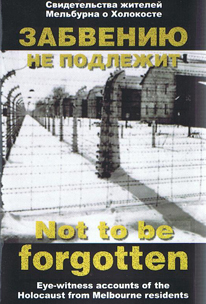 Title: Not to be Forgotten
Author: Boris Stark and Vladimir Leykin
Publisher: Self Published
Place of publication: Melbourne
Year of Publication: 2003
Location of Book: Lamm Jewish Library, Melbourne Holocaust Museum, Sydney Jewish Museum and other public libraries
Cities/town/camps: Belarus, Moldova: Bessarabia; Ukraine: Crimea, Kiev, Transnistria, Vinnytsia Oblast, Pechora concentration camp: Germany: forced labour camps; Australia: Melbourne.
Note: those cities/towns/camps underlined are those which are most central to the narrative
Genre: Memoir
Key events/experiences: Romanian occupation; ghetto; concentration camp
Not to be Forgotten is a short, 204-page anthology of eyewitness accounts of the Holocaust by survivors from the former Soviet Union residing in Melbourne and, in particular, those from the “Transnistria” region occupied by Romanian forces. The collection contains thirty-three eyewitness accounts by members of the Melbourne Association of Former Inmates of Nazi Concentration Camps and Ghettos from the Former Soviet Union. It is written in both English and Russian and edited by Boris/Benjamin Stark and Vladimir Leykin, with translations provided by Bradley Dawson and Vladimir Leykin.
Pages 1-17 provide a foreword describing the purpose of the anthology and translator’s notes, a map of Europe and the concentration camps and ghettos in the region of “Transnistria” as well as a photograph of members of the aforementioned Association. Pages 18-204 present the survivor testimonies with some also including the survivor’s portrait.
The survivors in the anthology originate from modern-day Ukraine, Belarus and Moldova. The majority (24) are from various towns across Transnistria, with more than half (18) from the Vinnytsia Oblast region in central Ukraine. In 1941, this region was invaded by both German and Romanian soldiers and ultimately became a Romanian-occupied and administered territory, known as the “Transnistria Governorate”. Boris Stark, the editor of the anthology and the president of the aforementioned association of survivors from 1999-2005, was himself a child Holocaust survivor from Vinnytsia Oblast. His memoir, A Long Way to Freedom, was published in 2010 and details his experiences in depth (see entry).
Most survivors in the anthology were interned in various ghettos and camps within this region and several were interned in the Romanian run concentration camp, Pechora. However, some were also deported to concentration and forced labour camps in Germany, others went into hiding, and one survivor was a partisan member. The vast majority of survivors in the anthology were either children or adolescents at the time the events took place; twenty were born between 1930-1940.
Not to be Forgotten, would be of interest to readers and scholars with an interest in the Holocaust in Ukraine, and in particular, the Romanian-occupied region of Transnistria. The entries are short, ranging from 2-8 pages and provide a very brief overview of the survivor’s wartime experiences. Details of how the survivors emigrated to Australia are not provided and only some mention the author’s pre-war childhood or post-war experiences. Each entry is written in Russian followed by an English translation with some written in the first-person, others in the third-person. Some of the entries are more detailed, providing a timeline of events, whereas others describe noteworthy episodes with infrequent references to specific dates or locations.