
David Benedikt
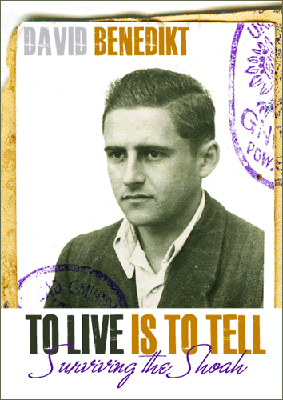 Title: To Live is to Tell: Surviving the Shoah
Author: David Benedikt
Publisher: Sydney Jewish Museum
Place of publication: Darlinghurst, NSW
Year of Publication: 2010
Location of Book: Lamm Jewish Library, Melbourne Holocaust Museum, Sydney Jewish Museum and other libraries
Cities/town/camps: Czechoslovakia: Brno, Theresienstadt; Latvia: Riga ghetto, Salaspils and Kaiserwald concentration camps; Poland: Stutthof concentration camp, Puck; Australia: Melbourne, Adelaide, Sydney; South Africa: Johannesburg
Note: those cities/towns/camps underlined are those which are most central to the narrative
Genre: Memoir
Key events/experiences: ghetto; concentration camp; death march
To Live is to Tell is the memoir of Czech survivor David Benedikt who endured several ghettoes, concentration camps and a death march before being liberated by the Russian army in 1945. In 1946, he emigrated to Australia where he eventually became a survivor-guide at the Sydney Jewish Museum.
The memoir is 130 pages in length and includes forty pages of photographs. Pages 1-25 describe his family history and childhood in Czechoslovakia. Pages 26-51 discuss the onset of the war, the escalation of antisemitic measures in Czechoslovakia and the author’s deportation to several ghettos and concentration camps. Pages 52-67 recount liberation by the Russian army and emigration to Australia. Pages 68-93 describe the author’s life in Sydney. Pages 94-130 provide a selection of poetry as well as an address to the Sydney Jewish Museum in his role as survivor-guide.
Oscar David Benedikt was born on 11 July 1920 in Brno, Czechoslovakia, the only child of parents Elsa Hoffman and Leopold Benedikt. He was raised in an assimilated, middle-class household and his family spoke fluent German and Czech. In March 1939, after Nazi Germany proclaimed the Protectorate of Bohemia and Moravia, Brno came under Nazi occupation. Antisemitic measures ensued and David was expelled from medical school for being Jewish. During this time, he spent a year at an agricultural school in the Czech countryside as well as some months in a Zionist collective farm before returning to Brno.
In autumn 1941, the Nazis began forcibly relocating the Jewish population to designated areas. In November 1941, David and his family were deported from Brno to Theresienstadt. On 15 January 1942, they were placed on a transport for ‘resettlement east’, arriving at Riga, Latvia, after a five-day journey without food or water. David and his father were selected, along with a small group of men, for forced labour. The rest of the transport, including David’s mother, were murdered in mobile gas vans. David was then sent to the Salaspils concentration camp.
In June 1942, he was sent to the Riga ghetto where he joined a work commando in the vicinity of the city. Tasked with carrying 80 kg bags of grain ten hours a day for the German army, David was given better food rations and began to regain his strength despite the hard labour. In the spring of 1944, as the Russian army advanced closer, the ghetto was liquidated, and David was sent to the Kaiserwald concentration camp. At Kaiserwald, David was selected to work at an industrial complex called Rote Duna. In September 1944, the remaining prisoners were marched to the harbour where they were taken on open barges to the Stutthof concentration camp.
During the last few days of February 1945, the prisoners were sent on a death march towards the harbour of Puck. After ten days of marching, German soldiers began abandoning the prisoners, who then dispersed into the countryside. David found refuge with a sympathetic farmer and, after losing consciousness for two-days, was roused to witness liberation by Russian troops. A few days later, a Russian medical unit arrived and David was taken to a field hospital where he remained for two months recovering alongside other survivors. There, he met his future wife, Dinah, a recently liberated survivor who worked for the Russian medical unit. Pressured to return with the unit to Russia, the couple decided to marry and take positions at a local Polish hospital before returning to Czechoslovakia.
After receiving landing permits from David’s aunt, who had emigrated to Australia in 1938, the couple arrived in Melbourne in early 1946. Shortly after they moved to Adelaide where their son Michael was born. They eventually opened a clothing store and after five years received Australian citizenship, but decided to move to Johannesburg in 1953 to reunite with Dinah’s brothers. In 1986 the couple divorced and David returned to Australia, moving to Sydney where, at the age of seventy-two, he began volunteering as a survivor-guide at the Sydney Jewish Museum.
To Live is to Tell is a brief overview of the author’s wartime experiences and subsequent life. Out of “necessity” for his sanity, the author acknowledges that the narrative is largely “episodic and sketchy”, noting that trauma “has altered the most cruel and blood-curdling scenes into more hazy memory.” As a result, some details and specific dates are missing; for example, the author does not describe the Theresienstadt ghetto. However, the memoir is driven by and reflects the author’s deep commitment to Holocaust remembrance. An avid Holocaust educator, David wrote and published his memoir as part of the Sydney Jewish Museum’s “Community Story Project”.