
David George Gilbert
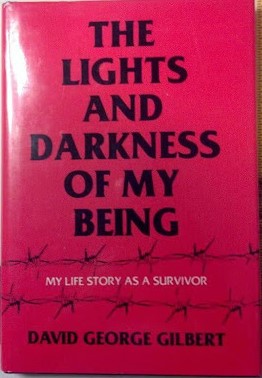 Title: The lights and darkness of my being: My life story as a survivor
Author: David George Gilbert
Publisher: Vantage Press
Place of publication: New York
Year of Publication: 1991
Location of Book: Lamm Jewish Library, Melbourne Holocaust Museum and Monash University
Cities/town/camps: Czechoslovakia: Prague; Poland: Lodz ghetto; Auschwitz-Birkenau and Gleiwitz concentration camps; France: Paris; Australia: Sydney, Melbourne
Note: those cities/towns/camps underlined are those which are most central to the narrative
Genre: Memoir
Key events/experiences: ghetto; concentration camp; death march
The Lights and Darkness of My Being is the 127-page memoir of Czech survivor, David George Gilbert, whose entire family, including his wife and young daughter, were brutally murdered during the Holocaust. The sole survivor of his family, David rebuilt his life with his second-wife and fellow survivor, Mimi, in Melbourne after emigrating in 1946.
Pages 1-26 describe the author’s family, marriage and career before the rise of Nazism. Pages 27-42 recount the birth of his daughter, the Nazi occupation of Czechoslovakia and escalation of antisemitic measures culminating in the family’s deportation to the Lodz ghetto in 1941. Pages 43-74 give an account of the Lodz ghetto where David remained until its liquidation and his deportation to Auschwitz-Birkenau in August 1944. This is followed by an account of his incarceration in Gleiwitz and liberation from a death march. Pages 75-100 describe the immediate post-war period, including his return to Prague, marriage to wife Mimi, and their emigration to Australia in 1946. Pages 101-127 recount their new life in Melbourne and reflect on the enduring impact of the Holocaust.
David George Gilbert was born 25 October 1908 in Prague. He had three older brothers, Herman, Heinz and Leo. His father had a leather-goods factory, and the family spoke fluent German. In 1923, David’s eldest brother Herman tragically died of pneumonia. At the age of fifteen, David left school to take an apprenticeship in dentistry, eventually teaching at the Dental Institute in Prague and establishing his own dental practice. In 1933, he met and married his wife, Gisela. The couple’s daughter, Susan, was born in May 1934.
The Gilbert family watched anxiously as Nazism rose to power in Germany. As the situation in Germany worsened, German-Jewish families fled to Prague bringing tales of abuse and destruction. In March 1938, Nazi Germany annexed Austria and the Sudetenland, bringing more Jewish refugees to Prague, including his wife’s relatives, who emigrated to Australia a year later. In March 1939, German troops occupied Prague, and antisemitic measures were quickly instituted.
On 25 October 1941, the day of David’s thirty-second birthday, German officers arrived at the Gilbert home to confiscate their household and possessions, informing the family they had forty-eight hours to report to Gestapo headquarters for deportation. They were sent to the exhibition grounds before being placed on a cattle train to the Lodz ghetto, where they were given meagre food rations and forced to live in crowded and unsanitary conditions. To feed his family, David was forced to work digging graves and carrying corpses. After four weeks he secured work at the food storehouse and at a factory repairing electronic equipment. In September 1942, his daughter was tragically rounded up in the infamous “Children’s Aktion” and murdered, though her parents lived in hope that she had been taken to a children’s camp. David and his wife remained in Lodz until the ghetto’s liquidation in August 1944 when they were deported to Auschwitz-Birkenau.
Upon arrival David was separated from his wife and taken into the camp. He remained there until early October 1944 when the men of his barrack were transferred to the Gleiwitz forced labour camp where David worked as a welder at a railway construction site. In January 1945, as the Russian army approached, the prisoners were sent on a death march in the bitter cold. After several days they reached an unnamed camp. A few days later, when Nazi soldiers tried to force the prisoners on another march, the utterly exhausted David and several others decided to hide in the barracks, escaping the massacre of prisoners by the Germans.
Frostbitten, starved and exhausted, the escapees left the camp in search of food in the nearby countryside. Fortunately, they found an abandoned home where there was sufficient food to support them until liberation by the Russian army a few weeks later. In March, aided by the Russians, they began the long journey back to Czechoslovakia. In May, David finally returned to his home in Prague where he tragically discovered that his entire family had been murdered.
Supported by a Jewish organisation, David built a community of fellow survivors and met his future wife, Mimi, also the sole survivor of her family. As many began to emigrate, David contacted his late wife’s family in Melbourne and made plans to emigrate to Australia. After David received his landing permits, he travelled to Paris in early September 1946. With the help of the HIAS (the Hebrew Immigrant Aid Society), he secured passage to Australia from Marseille a few weeks later, arriving in Sydney in November 1946. He then travelled to Melbourne where he boarded with his late wife’s family and eventually opened his own dental laboratory.
Ten months after David’s arrival, in October 1947, Mimi landed in Sydney, and the couple married the same day, before rebuilding their lives in Melbourne. In 1952, they became naturalized Australian citizens. In 1985, after being diagnosed with an incurable neurological condition, David decided to write his memoir, which was published by Vantage Press in 1991.
The Lights and Darkness of My Being is a detailed and articulate account of the author’s life. Beyond his wartime experiences, much of the memoir is devoted to the legacy and psychological impact of the Holocaust, as well as the author’s struggles to rebuild his life in post-war Europe and Australia.