
Ernst Raubitschek and Renata Yates
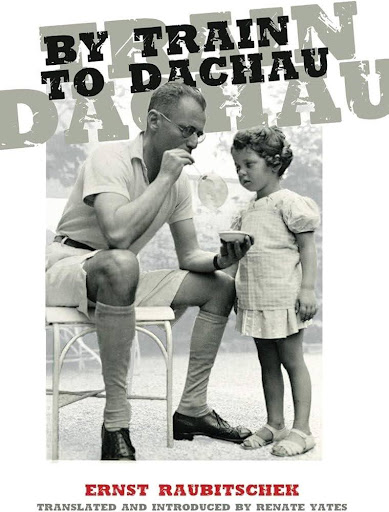 Title: By Train to Dachau
Author: Ernst Raubitschek and Renate Yates
Publisher: Sydney Jewish Museum
Place of publication: Darlinghurst, NSW
Year of Publication: 2009
Location of Book: Lamm Jewish Library, Sydney Jewish Museum, National Library of Australia and other public libraries
Cities/town/camps: Austria: Vienna; Germany: Dachau, Buchenwald; England: Manchester; Australia: Sydney
Note: those cities/towns/camps underlined are those which are most central to the narrative
Genre: Memoir
Key events/experiences: Anschluss; concentration camps; Jewish refugee; child survivor
By Train to Dachau tells the story of Viennese survivors Ernst Raubitschek and his daughter Renate (married surname Yates). After Ernst was sent to Dachau in 1938, Renate and her mother fled to England. Following his release from Buchenwald eleven months later, the family reunited in Manchester and emigrated to Australia in 1939. Following his death, Renate translated her father’s account into English and published their story with the Sydney Jewish Museum.
The memoir is 106 pages long. Pages 1-24 offer an introduction by Renate describing her father’s upbringing, the annexation of Austria by Nazi Germany, and her escape to England. Pages 25-64 present Ernst’s account of his incarceration in Dachau. Pages 65-106 give an account of his subsequent detainment in Buchenwald and release as told by Renate followed by a description of the family’s emigration to Australia. The memoir includes pictures of Ernst and his family as well as images of the original German manuscript.
Ernst Raubitschek was born 1896 in Vienna, the second-child of well-to-do, assimilated, Jewish parents Hermine Elkan and Alfred Raubitschek. He had two sisters, Fritzl and Marianne, and a brother Richard. Born into a family of dentists, Ernst was apprenticed in his father’s practice after matriculation. In 1915, he enlisted in the Austrian army and served as an officer in the cavalry. During his years of army service, he was a POW in Italy for eighteen months. Upon his return in 1919, Ernst studied medicine at the University of Vienna to become a dental surgeon. Whilst mountaineering in the Austrian Alps he met his future wife, Friederike. The couple were married in 1922 and had a daughter, Renate. Her birthdate is not provided.
After the Nazis came to power in 1933 in Germany antisemitism heightened in Austria. In March 1938, Nazi Germany annexed Austria and German troops marched into Vienna. As a young child, Renate watched from her apartment window as German soldiers flooded the streets of Vienna, to be met with cheering and Hitler salutes. Jewish businesses were boycotted and Jews were publicly humiliated. Seeking protection, Ernst approached the Archbishop of Vienna to baptise his wife and daughter.
Ernst’s manuscript begins on 28 May 1938 with his arrest by a Nazi officer at his dental practice. Alongside dozens of other Jewish men, he was taken to the police station where he was searched, interrogated and detained in a nearby school with hundreds of other prisoners. After several nights, the men were sent by train to Dachau. Enroute they were subjected to vicious beatings by the guards and several men were shot trying to escape. After sixteen hours of physical and psychological torture, the approximately 600 men arrived at Dachau, broken and exhausted. On arrival, Ernst was brutally introduced to concentration camp life: his first task was to offload one of the three corpses left by the carnage in his carriage. After being driven into the camp, Ernst lived in terror and deprivation – forced to endure backbreaking labour with insufficient food whilst being subjected to frequent beatings by the guards who often murdered prisoners for the slightest infractions.
After the shock of Ernst’s detainment, his wife began making desperate plans to flee. Three weeks after the arrest, Renate and her mother received the approved papers from Nazi authorities and boarded a train west, eventually arriving in Manchester. Their journey is not recounted in detail. In Manchester, the Raubitschek women were given shelter with Ernst’s sister Marianne and her husband Ben, who had emigrated to England in 1937. To help support the family, Renate’s mother found work as a dressmaker.
Meanwhile, as the population of Dachau swelled, Ernst was transferred to Buchenwald in September 1938. This is where his manuscript ends. In Buchenwald, Ernst was similarly terrorised and forced to perform physical labour in freezing conditions – as he relayed to Renate in later years. After eleven months of imprisonment he was released in April 1939. After returning to Vienna, he obtained a British entry visa from the consulate through papers mailed by his wife and boarded a flight to Manchester where he was reunited with his family. In July 1939, the Raubitschek family boarded a ship to Sydney, arriving a mere two days before war was declared.
As Ernst’s Austrian qualifications were not accepted in Australia, he enrolled in dental surgery at Sydney University and Renate was sent to boarding school. After the outbreak of the war, she and her parents were declared enemy aliens and had to secure travel permits to visit her. Ernst completed his degree in 1943 and established a successful dental practice. After matriculation, Renate followed in her father’s footsteps and studied dentistry at Sydney University. She later married and had two children. In 1971, Ernst died of a stroke. After his death, Renate discovered her father’s typed manuscript which she translated into English and had published by the Sydney Jewish Museum.
By Train to Dachau is the vivid account of Ernst Raubitschek’s experiences within the Nazi concentration camp system as relayed partly in his own voice, and partly by his daughter Renate. As the memoir is devoted to her father’s experiences, aspects of Renate’s life are missing from the narrative. Although at times sparse in detail, the memoir also recounts Renate’s experiences as a child survivor and Jewish refugee in Australia. The memoir was published as part of the Sydney Jewish Museum’s “Community Stories” Project.