
Fred Lowen
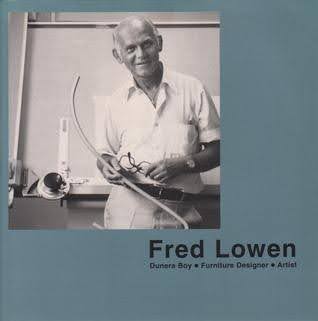 Title: Fred Lowen: Dunera Boy, Furniture Designer, Artist
Author: Fred Lowen
Publisher: Prendergast Publishing
Place of publication: Castlemaine, VIC.
Year of Publication: 2001
Location of Book: Lamm Jewish Library, Melbourne Holocaust Museum, Monash University and other public libraries
Cities/towns/camps: Poland: Gleiwitz; Germany: Berlin; Belgium: Brussels, Antwerp, Exaerde refugee camp, Nieuwpoort; England; Pentonville prison, Huyton internment camp; Australia: Sydney, Hay, Tatura and Orange internment camps, Melbourne
Note: those cities/towns/camps underlined are those which are most central to the narrative
Genre: Memoir
Key events/experiences: Kristallnacht; Jewish refugee; Dunkirk evacuation; Dunera; Australian internment camps
Fred Lowen was forced to flee Nazi Germany to Belgium and, ultimately, England, where he was one of 2,546 enemy aliens deported to Australia via the HMT Dunera in 1940. On arrival, he was placed in various internment camps and, upon his release, became a respected furniture designer and manufacturer. His memoir is a testimony to the author’s career and art as well as his wartime experiences.
Pages 1-21 briefly recount the author’s childhood in Berlin, the rise of Nazi Germany and his eventual flight to Belgium after Kristallnacht. Pages 22-48 describe the Nazi invasion of Germany and the author’s flight to England where he was imprisoned as an enemy alien. Pages 41-78 detail his deportation to Australia on the HMT Dunera and his time in various Australian internment camps until his release in August 1942. It also features 21 of Lowen’s sketches of the camps, courtesy of the State Library of Victoria. Pages 79-174 describe his life in wartime Melbourne and the establishment of his successful furniture business, Fler. Pages 175-200 detail his second business, Tessa, with pages 201-33 featuring the author’s watercolour artworks.
Fred Lowen was born as Fritz Karl Heinz Loewenstein on 16 August 1919 in Gleiwitz, Upper Silesia, then part of Germany, to secular parents Margot Hamburger and Karl Loewenstein. He had a younger brother Horst. In 1922, the family moved to Berlin. Though both his parents were born Jewish, Fred’s father converted to Lutheranism in 1919. Fred attended a local Lutheran school where he matriculated in 1938.
After witnessing the horrors of Kristallnacht in November 1938, Fred decided to flee Nazi Germany to Belgium. He was smuggled to Brussels with the help of a distant relative, while his parents and brother remained behind. Once in Brussels, Fred travelled to Antwerp to live with his Uncle Rudolf. Fluent in German, French and English, Fred worked secretly as a secretary and translator for his Uncle’s business, obtaining a Belgian identity card. His mother and brother were able to emigrate to England in 1939. In November 1939, Fred left Antwerp for the Exarde refugee camp in the hope of emigrating from Europe.
Fred remained in Exarde until May 1940 when the Nazis invaded Belgium and the refugees were evacuated from the camp to the coast in the hope of reaching England. For weeks, Fred along with hundreds of fellow refugees, walked the countryside on foot, with bombs falling around them. Together with several refugees he was arrested, abused and nearly executed by French authorities on suspicion of being a German parachutist. After their release, Fred made his way to Nieuwpoort, where he found himself in the midst of the Dunkirk evacuation. With the help of British soldiers, Fred and other refugees were towed out to sea on a fishing boat, where they were rescued by an English minesweeper which brought them to England.
Upon his release Fred and many evacuees were sent to Pentonville Prison in London. On 25 June, Fred was sent to an internment camp where German and Austrian refugees were being held. On 10 July, the refugees boarded a train to Liverpool and were loaded onto the HMT Dunera. They were treated as prisoners and subjected to cruel abuse. The prisoners had no knowledge of their destination. They journeyed for eight nightmarish weeks before reaching Sydney on 6 September. From Sydney, Fred was sent to the Hay internment camp in New South Wales, met along the way by friendly and sympathetic Australians.
In June 1941, the internees were evacuated from Hay to the Tatura camp in Victoria to make room for Italian prisoners-of-war. However, Fred, who was suffering from a knee injury, was sent to the Orange internment camp to recover in the camp hospital, where he stayed for two months before being transferred to Tatura. Fortunately, relatives in Sydney sent him drawing materials which were put to good use, documenting the lives of internees. Finally on 14 August 1942, Fred was released for ‘war work’ after being reclassified as a ‘friendly enemy alien.’ Fred had to register with the police and was only allowed to travel to and from work and his home in St Kilda, where he had found accommodation with fellow Jewish refugees. His father remained in Germany and survived the war, finally, in Theresienstadt.
In 1945 Fred started a furniture business with partner Ernest Rodeck, and their brand ‘Fler’ became a household name for modern design. In 1972, he and his brother started a new venture, ‘Tessa’, to produce designer furniture for a sophisticated market. Fred’s services to Furniture Design and Manufacturing as one Australia’s leading innovators earned him the Order of Australia Medal in 1987. After his retirement, Fred pursued a life-long passion for sketching and painting. His wartime sketches can be found in the State Library of Victoria and his designs have featured in galleries all over the world.
Fred Lowen is a detailed account of the author’s remarkable wartime experiences. It was written at the urging of the National Gallery of Victoria, and more than half the memoir is devoted to his furniture businesses and artwork. The book also features his sketches of the Australian internment camps, courtesy of the State Library of Victoria, as well as copies of his designs and watercolour artworks.