
George Freuden
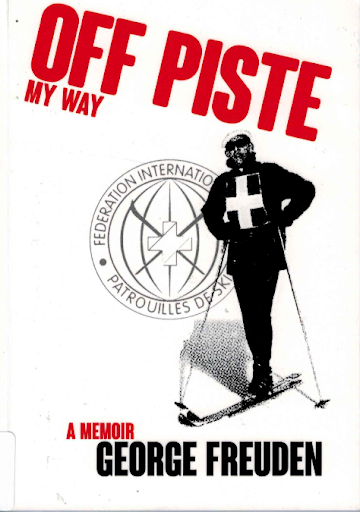 Title: Off Piste: My Way
Author: George Freuden
Publisher: Sydney Jewish Museum
Place of publication: Darlinghurst, NSW
Year of Publication: 2014
Location of Book: Lamm Jewish Library, Sydney Jewish Museum, State Library of Victoria and other public libraries
Cities/town/camps: Hungary: Budapest; Austria: Vienna, Rothschild Hospital and Arzberger DP camps; France: Paris; Australia: Sydney
Note: those cities/towns/camps underlined are those which are most central to the narrative.
Genre: Memoir
Key events/experiences: Budapest ghetto; in-hiding; child survivor
Off Piste is the 132-page memoir of child survivor George Freuden, who survived the Holocaust in Budapest with a Portuguese schutzbrief (protection pass).
Pages 1-23 describe the author’s extended family and childhood in Budapest. Pages 24-38 gives an account of the Nazi occupation of Hungary in 1944 and the author’s time in hiding until liberation. Pages 39-57 recounts his experiences in post-war Hungary and eventual emigration to Australia in 1951. Pages 58-89 describes his new life in Sydney, marriage to wife Hillary and their family. Pages 90-132 focus on the author’s love of skiing and his experiences as a ski patrol volunteer. The memoir contains 54 photographs, mainly of the author and his extended family.
George was born in Budapest on 30 August 1932 to Laura Schechter and Chanine (Henrik) Freuden. The family lived in a Jewish district of Budapest and George’s father owned a cafe. George was raised in a religious home and attended a Jewish school. His experiences before the occupation of Hungary in 1944 are not discussed.
With the Nazi occupation of Hungary in 1944, additional antisemitic restrictions were immediately introduced. In October 1944, in the context of rising antisemitic violence perpetrated by the Hungarian fascist Arrow Cross, George’s father decided to place his eleven-year-old son in hiding with his gentile business partner, who lived on the outskirts of Budapest. However, George was forced to return home after ten-days due to the risk of betrayal by suspicious locals. He was then placed with several Jewish children in a Catholic monastery. Whilst there, the homesick George routinely escaped back home and, in a miraculous stroke of luck, his father finally allowed George to return the same weekend the monastery was raided by authorities.
As the family home was in the Jewish district, the Freudens were not forced to move. George’s father was able to secure a ‘protection pass’ from the Swiss Consulate, which stayed their deportation for three months. Later, with the help of family in Portugal, the family secured highly coveted Portuguese protection passes, and were moved to a special three-story flat. They lived there in crowded conditions with dozens of other families who possessed a pass, sleeping on the floor with only rags for bedding. Sometime near Christmas, they were marched to the Budapest ghetto where they lived in a crowded accommodation for three weeks, suffering from starvation and cold whilst enduring allied bombing. Finally, they were liberated by the Russian army in January 1945.
Fearing communist rule, George, then aged 16, left Hungary in May 1949. He was first smuggled to Kosice in Czechoslovakia, walking 30 km through the forest at night before boarding a train to Bratislava and then onto Vienna. Enroute, he was sheltered by members of the Jewish community. In Vienna, he stayed at the Rothschild Hospital and Arzberger DP camps, subsisting on funds sent by his parents in Hungary. After six months in Vienna, George made his way to Paris to live with a distant uncle, cautiously crossing Germany to avoid border police. George arrived in Paris in September 1949, where he lived with his uncle for a year before moving into a shared apartment with friends.
Finally, George’s childhood best friend, George Weiss, who had emigrated to Sydney, managed to obtain a landing permit for him through his connections with the Jewish Welfare Society. With additional financial assistance from the JOINT, George secured passage, travelling to Marseille where he boarded a ship to Sydney. After seven weeks, George finally arrived on 21 November 1951.
In Sydney, George lived with his friend for a year whilst working at a nearby engineering company. He also became active in Maccabi Basketball Club where he met his future wife, Hillary, in 1957. The couple were married in 1960 and had three children, Daniel, born in 1963 and twins David and Naomi, born in 1966. In Australia, George developed a love of skiing, and became an active ski patrol volunteer. Eventually, he became involved with the International Skiing Federation (FIS), travelling all over Europe as an Australian delegate. Through his role, in 2007 George was miraculously placed in contact with long-lost Hungarian family members, sparking the writing of his memoir.
Off Piste is a brief but careful account of the author’s life. The period preceding the Nazi-occupation of Hungary in March 1944 is not recounted in detail and more than half the memoir covers the author’s life in Sydney. In particular, it focuses on George’s love of skiing and experiences as a ski patrol volunteer, imparting his life philosophy of tikkun olam. The memoir was written and published as part of the Sydney Jewish Museum’s “Community Stories” Project.