
Gertrude Mayer Aldor
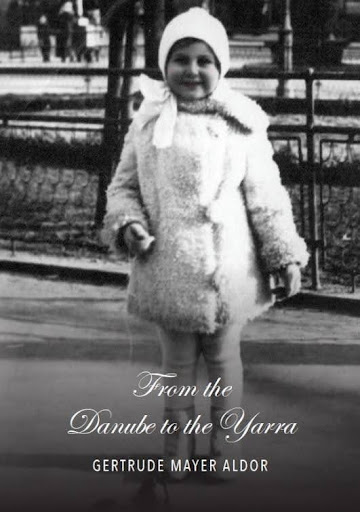 Title: From the Danube to the Yarra: An Autobiography with poetry and prose
Author: Gertrude Mayer Aldor
Publisher: Makor Jewish Community Library
Place of publication: Caulfield South, VIC
Year of Publication: 2017
Location of Book: Lamm Jewish Library, Monash University, State Library of Victoria and other public libraries
Cities/town/camps: Czechoslovakia: Bratislava, Sered labour and transit camp; Poland: Auschwitz-Birkenau; Germany: Freiburg concentration camp; Austria: Mauthausen; France: Paris; Australia: Melbourne
Note: those cities/towns/camps underlined are those which are most central to the narrative
Genre: Memoirs
Key events/experiences: in-hiding; concentration camp
From the Danube to the Yarra is the 158-page memoir of Slovakian-born survivor Gertrude Mayer Aldor who survived the war in fascist Slovakia after her family received an exemption from anti-Jewish laws. In September 1944, after Nazi Germany occupied Slovakia, she was deported, first to the Auschwitz concentration camp.
Pages 1-30 describes the author’s extended family and childhood in Bratislava. Pages 31- 58 tell the author’s wartime experiences and internment in various labour camps until her liberation in 1945. Pages 50-78 cover her return home, marriage and emigration to Paris after the communist seizure of Slovakia. Pages 79-110 recount the author’s emigration to Melbourne in 1950 and new life in Australia, as well describing the lives of her father and sister. Pages 111-58 present the author’s prose and poetry.
Gertrude Mayer was born on 7 July 1928 in Bratislava, then Czechoslovakia, to well-to-do modern Orthodox parents, Edit Kornfeld and Ludwig Mayer. She was raised in a German-speaking home and had an older sister Eva. Gertude’s father was a politician who also ran a successful wine exporting business. On 29 September 1938, Nazi Germany annexed the Sudetenland region of Czechoslovakia and Slovakia became an independent state ruled by the fascist Slovak People's Party. Following these events, Gertrude’s sister emigrated to England with her aunt Margit in March 1939, just days before the Nazi occupation of the Czech provinces of Bohemia and Moravia.
In November 1940, Slovakia officially joined the Axis powers. Though restrictions grew in intensity, Gertrude’s father was able to obtain an exemption from the anti-Jewish laws from Slovakian president, Jozef Tiso, and was able to continue running his wine business. Between March and October 1942, Slovak gendarmes began deporting the Jewish population to various labour and concentration camps, although Gertrude does not recount this period. In 1943, her father tried to smuggle Gertrude over the border into Hungary, but she was arrested by authorities who returned her to Slovakia.
In August 1944, Nazi Germany occupied Slovakia following the Slovak National Uprising and the family went into hiding with various employees of the wine business. Miraculously, they were also aided by a Nazi officer who helped her father build a hidden room. In the Yom Kippur Aktion, on 28 September, Gertrude and her mother were caught and deported to the Sered transit camp. Two weeks later they were sent to Auschwitz where Gertrude’s mother was murdered on arrival. As a sixteen year old, Gertrude passed selection and was deported to the Freiburg labour camp, a sub-camp of Flossenbürg, the next day.
In Freiburg, Gertrude fell gravely ill with diphtheria, falling into a coma for several weeks. She was miraculously nurtured back to health by the sympathetic German doctor at the camp hospital. When she woke from the coma, Gertrude could no longer speak and was rehabilitated over several weeks by the doctor. With the rapid approach of Allied forces, Gertrude was sent by cattle car to Mauthausen in May 1945, where she was liberated by the American army on arrival. With no room in the prisoner barracks, Gertrude spent a few days recovering in the SS quarters but was soon instructed by army officials to return to Slovakia. She then travelled on a barge along the Danube to Bratislava. On arrival, Gertrude was barely able to stand and was assisted by members of a Jewish refugee centre. Hours later, she was tearfully reunited with her father who survived in hiding. Luckily, her father obtained the help of a Jewish doctor who placed her in a local hospital and nursed her back to health.
In Bratislava, Gertrude was briefly reunited with her sister Eva, who returned from England. Gertrude, her father and cousin Marta, whose parents had not survived, moved into a new apartment, whilst her father resumed running the wine-business. In early 1947, Gertrude was sent to a boarding school in Switzerland and then to Oxford in September. However, she returned home for her sister’s wedding where she met her future husband, Richard. The couple were married in March 1948, two weeks after the communists seizure of power.
Richard, who had emigrated to Palestine before the war, had a British passport and the couple were thus permitted to leave the communist Czechoslovakia, moving to Paris in May in the hope of emigrating to Israel. However, Gertrude was rejected by a recruitment agency in Paris and the couple remained in France for over a year before emigrating to Australia, where her second-cousin, Edi, had emigrated before the war and was able to secure landing permits for them. The couple left for Genoa, boarding a ship to Australia on 20 February 1950. They disembarked in Melbourne on 7 March 1950. Gertrude’s father, who escaped Czechoslovakia after the government confiscated his wine business, joined them in Melbourne in 1951. In Australia, the couple had a son, Leslie, born circa 1955.
From the Danube to the Yarra is a brief but lucid account of the author’s key wartime experiences and includes poetry and prose commemorating the Holocaust. In particular, the memoir speaks tenderly of the author’s love for her father. It does not describe her time in Nazi-allied Slovakia in great depth as her experiences from 1940-42 are not recounted. The memoir was written and published as part of the Makor Jewish Community Library’s “Write Your Story” program.