
Halina Wagowska
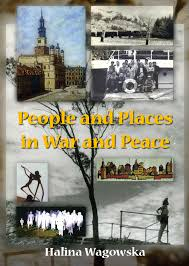 Title: People and Places in War and Peace
Author: Halina Wagowska
Publisher: Makor Jewish Community Library
Place of publication: Melbourne, Australia
Year of Publication: 2009
Location of Book: LAMM Jewish Library of Australia
Cities/town/camps: Poland – Poznan, Lodz, Auschwitz-Birkenau; Germany – Stutthof; Australia - Melbourne
People and Places in War and Peace is the memoir of Halina Wagowska. This memoir is written as a collection of short stories. The stories are a combination of Halina’s testimony, perceptions and reflections. The first part of the book (pages 3-22) describes Halina’s parents and Stasia, the family’s Catholic housekeeper before and at the start of the war. The middle section (pages 23-70) focuses on Litzmannstadt (Lodz) ghetto, her deportation to Auschwitz and work as a member of the Tod Kommando (death squad) in Auschwitz-Birkenau, incarceration in Stutthof, liberation by the Russians and returning to Lodz after the war. The last part (pages 71-124) outlines Halina’s journey to Australia on the SS Derna, learning English, working at the Alfred Hospital and adjusting to life in a new country.
Halina was born in 1930 to an assimilated, middle-class Jewish family in Poznan, Poland. Halina was less than ten years old when the Nazis invaded and the family was expelled from Poznan. They went to Litzmannstadt (Lodz) ghetto. Their pious Catholic housekeeper and cook, Stanislawa (Stasia) Lemanska insisted on accompanying the family to their new location. Stasia lived outside the ghetto and for a short time, she managed to smuggle food parcels to the desperate family.
Conditions were terrible in the over-crowded Lodz ghetto. Halina worked as a slave labourer in a factory making hats and various accessories. In July 1944, Halina and her parents were crammed in a closed goods train and deported to Auschwitz-Birkenau. She describes her harrowing experience as a member of the Tod Kommando, the death squad that loaded bodies into the crematoria. Hunger, pain, cold and fear permeated her existence.
At the end of 1944, Halina and her mother were sent to Stutthof, a concentration camp in East Prussia. There she befriended Frieda, a university professor of great intellect, whose conversations sustained Halina when morale was so low. Halina also recounts her public flogging, the brutality of the female overseers and her battle with typhus, a disease that killed her mother. In March 1945, the surviving inmates were marched out of Stutthof. Halina could barely walk, beset with a high fever and frostbite. The next thing Halina remembers is waking up under the care of Sasha, a Russian soldier.
Fifteen-year-old Halina returned to Lodz after the war. She was an orphan. She stayed in a one-room apartment with her friend, Judith Winograd, and her father Ludwig. Halina went back to school aiming to complete her matriculation. In evenings and on weekends, she did a six-month crash course in nursing, and she found work in a hospital and slowly regained her strength. Halina recognised that there was no future for Jews in Poland and made plans to leave.
On 30 August 1948, Halina was one of a group of refugees and war orphans who left Marseilles, bound for Australia on the SS Derna. After numerous incidents at sea and a harrowing eleven-week voyage, the ship docked in Melbourne. Halina’s first job was as a charlady who cleaned Henty House in little Collins Street every morning while studying science at Melbourne University. From 1953 – 1975, Halina enjoyed a long and successful career in the Pathology Department at the Alfred Hospital. After retirement, she started a not-for-profit community organization, Homeplus Living, that helped homeless Year 11 and 12 students complete their secondary education.
Wagowska’s memoir is a collection of short stories. Bridge building across human divides is a recurring theme. Each chapter contains a vignette relating to an aspect of Halina’s past. The stories are insightful, giving readers an understanding of the challenges faced by survivors in returning to life after the war. This book stands out in terms of its ability to engage readers.