
Helena Starkiewics
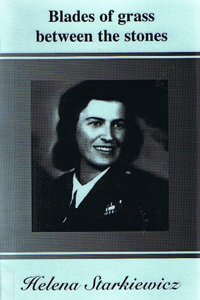 Title: Blades of Grass Between the Stones
Author: Helena Starkiewics
Publisher: Self Published
Place of publication: Melbourne
Year of Publication: 1998
Location of Book: Makor Jewish Community Library, Melbourne
Cities/town/camps: Poland: Tomaszow, Warsaw, Hrubieszow, Soviet Union: Novosibirsk, Rava Rassukaya , Zytomierzm (prison), Brygidki (prison), Zytomierz (prison), Kharkov (prison), Mariinsk (prison), Kazakhstan: Kazakh di Chan, Merke, Czaldawar
Note: those cities/towns/camps underlined are those which are most central to the narrative
Blades of grass between the stones by Helena Starkiewics is a compelling autobiography depicting Helena’s memories from the age of 5 in 1923 to the days of her resignation from the Polish Army in 1946. The first 45 pages deal with Helena life’s up until the war, for the most part in her home town of Hrubieazow in Eastern Poland. Pages 46-89 detail Helena’s time as a Soviet prisoner in the Brygidki, Zytomierz, Kharkov, Novosibirsk and Mariinsk prison camps. Pages 90-118 discuss her challenges as a nurse on a collective farm in Kazakhstan. The remainder of the book records Helens’s time in the Polish Army. Helena wrote down her story for the benefit of her children. The book was printed privately in Melbourne in 1998.
The book begins with the arrival of a letter from her cousin Pinio which contains a family photo taken in 1929, when Helena was eleven years old. This photo is Helena’s tool in remembering back to the pre-war years when her mother, father, sister and brothers all lived peacefully in their hometown of Hrubieszow. Her family members, relatives and friends are described in detail. Born in 1918, Helena is the third of four children. Her father Samuel, a non-religious man, was the owner of a well established leather and saddlery store. Consequently, Helena was able to enjoy luxuries known only to well off families. Her greatest pleasure was to read and at the age of five Helena entered primary school. Starkiewicz describes her stages of education in great detail, from the days at the local craft school for girls to the selection into the high school at Tomaszow, to being accepted into Law at Warsaw University. Having suffered little discrimination beforehand, Helena was shocked at the antisemitism enacted through the separate seating arrangement for Jewish and non-Jewish students at the university. This led her to the active role she played in strikes and protests against discrimination towards Jews.
Feelings of unhappiness caused by the antisemitism compelled Helena to discontinue her studies at Warsaw. For a short time she tutored children until she was able to complete her entrance examination to teacher’s college in Vilnius, but later returned to Warsaw to pursue a nursing career. As boycotting of Jewish businesses became more prevalent, Helena’s parents were no longer capable of providing financially for her education. As a result Helena’s sister Balka, who was already a matron, financed her recruitment course. Helena remained a nurse for the rest of her life. By 1939 the Germans had taken over Hrubieszow and in an effort to escape, Helena attempted to cross the border to the Soviet Union, only to be halted by the Germans. Much to her father’s disapproval, Helena attempted the border crossing again. This time she was captured at gun point by Soviet border guards and was taken to Rava Russkaya, a camp for refugees who had been caught trying to cross the border.
After her initial arrival at the camp, Helena was transferred many times to different labour camps. From Rava Rassukaya she was taken to the Brygidki prison in Lwow, then to Zytomierz prison at Kiev, followed by her arrival at Kharkov prison. Further transfers took place as she went from the labour camp in Novosibirsk, where she worked in the ‘provisional infirmary,’ to Mariinsk prison in 1941 where she worked in the T.B. ward. After the agreement between the Polish Government in London and the Soviet government, all Polish political prisoners were released and Helena was given the opportunity to stay in Siberia or go to Kazakhstan. After arriving in Kazakhstan, she worked in Kazakh di Chan, a Soviet collective farm where she met her husband Mietek. The two of them joined the Polish army and Helena continued her occupation as a nurse in a mobile hospital. After the war, in 1946, Helena resigned from her position in the Polish army. For many years she wondered what it would be like if she left her homeland, and after 14 years she was finally able to emigrate to Australia.
Blades of grass between the stones is an intelligently written account of an idealistic young woman’s battle with totalitarianism. Like its central character, the narrative moves fast, guiding the reader through the range of privation suffered by victims of WWII.