
Henrkya (Schermant) Shaw
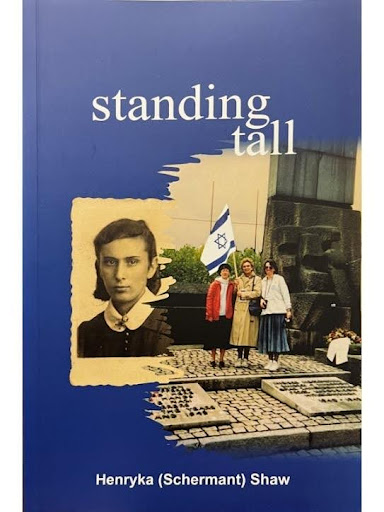 Title: Standing Tall
Author: Henryka (Schermant) Shaw
Publisher: Self-Published
Place of publication: Pyrmont, NSW
Year of Publication: 2009
Location of Book: Lamm Jewish Library, Sydney Jewish Museum, National Library of Australia and other public libraries
Cities/town/camps:Poland: Krakow, Plaszow forced labour camp, Auschwitz-Birkenau; Germany: Bergen-Belsen, Venusberg concentration and forced labour camp; Austria: Mauthausen, Enns DP camp; Hungary: Budapest; England: Manchester, London; Australia: Sydney
Note: those cities/towns/camps underlined are those which are most central to the narrative
Genre: Memoir
Key events/experiences: Krakow ghetto; concentration camp; death march
Standing Tall is the 159-page memoir of Henryka Shaw who endured the Krakow ghetto and Plaszow forced labour camp as a teenager. She was eventually sent to Auschwitz and several other concentration camps until she was liberated from Mauthausen in May 1945.
Pages 1-20 recount the author’s childhood and genealogy with pages 21-42 describing the onset of the war and the establishment of the Krakow ghetto. Pages 43-74 recall the author’s deportation to the Plaszow concentration camp in January 1943 and subsequently to Auschwitz in October 1944. Pages 75-90 describe her experiences in Bergen-Belsen and Venusberg concentration camps and death march to Mauthausen where the author was liberated. Pages 91-106 recall her life in Budapest with her sister after the war, and years in a DP camp in Austria before her emigration to England. Pages 107-44 recount her emigration to and life in Sydney Pages 145-59 present appendixes, a timeline of events and a glossary. The memoir features 66 family and historical photographs as well as three facsimiles of historical documents.
Henryka Schermant was born 14 July 1925 in Krakow, the third and youngest child of middle-class parents Mina Pleisner and Ignacy Schermant. She had an older sister Francziska (Nusia) and brother Szymon (Szymek). The family was not religiously strict but observed Shabbat and the high holidays. Henia attended a predominantly non-Jewish school where, only weeks before the onset of the war, she was expelled after standing up to her antisemitic history teacher.
On 1 September 1939, the Germans invaded Poland and the family attempted to flee Krakow. They travelled many days by foot, but Henia became sick with cholera, and Henryka and her parents were forced to return to German-occupied Krakow whilst her brother fled to Lviv and her sister to Hungary. In Krakow, they were subjected to antisemitic measures and in early March 1941, were interned in the ghetto. Henryka would often escape from the ghetto to obtain food.
The family managed to avoid deportation by going into hiding whenever there was a round-up but, in January 1943, the impending liquidation of the ghetto, Henryka was sent to Plaszow concentration camp. There she was subjected to back-breaking labour and terrorized by the sadistic camp commandant Amon Göth. Her parents arrived in March. In Plaszow, Henryka was forced to endure starvation and hard-labour as well brutalisation by Göth who, on one occasion, publicly flogged her in front of thousands of inmates. Early in 1944, Henia’s mother was deported. Heartbroken, her father lost the will to live and was taken to hospital where he was killed by lethal injection. In October, Henryka was sent on a transport to Auschwitz where she was branded with the number A-26538.
Within days, an older woman, Helcia Siegal, a friend of Henryka’s mother became her “guardian angel”, keeping Henryka alive by sharing her food. Soon after their arrival, the pair volunteered for work detail in a sewing workshop, repairing German army uniforms. As the Russians approached in January 1945, Henryka and Helcia were herded onto cattle trucks and taken to Bergen-Belsen. After only two weeks, they were sent on a transport to Venusberg, a subcamp of Flossenbürg, where they were forced to work in a factory manufacturing aeroplane components. There, Henryka became ill with typhus while nursing the sick. As the Allies approached, the pair were forced on a death march to Mauthausen. Gravely ill and near-death, Henryka was finally liberated on 9 May 1945 by the American army. Over three months she gradually recovered at a makeshift hospital before being taken on American army trucks to Czechoslovakia. From there, she returned to Krakow.
After a few days in Krakow, Henryka learnt that her sister was alive in Budapest, and travelled to meet her. She lived with her sister in Budapest for a few months, returning to Krakow on several occasions to search for surviving family. It was there that she learnt that her brother had died in Siberia from typhus, aged seventeen. Miraculously, Henryka also was reunited with her mother in Krakow; she had survived the war in labour camps in Germany. Together, they lived in Budapest with her sister.
Fearing communist rule, Henryka made her way to American-occupied Vienna, where she was sent to the displaced persons camp in Enns. She remained there for two years before emigrating to England. She studied nursing in Manchester, eventually moving to London. During this time her mother remarried and emigrated to Sydney with her new husband. Henryka followed, arriving in November 1953. There, she met and married the love of her life, Rudy Shaw in 1954. The couple had three daughters, Tamara, Naomi and Yvette and were married for seventeen years before his death from cancer in 1970. After suffering in silence for many years, Henryka finally gave her testimony to the Shoah Foundation in 1996. In 2005 she reluctantly wrote her memoir, Standing Tall, at the urging of her children and grandchildren.
Standing Tall is an articulate and concise overview of the author’s life from her childhood to her twilight years in Sydney. Though it is not comprehensive, and some dates and events are missing from the narrative, it provides important insight on the Plaszow commandant, Amon Göth, as well as the personal and psychological impact of the author’s experiences and her gradual recovery after the war.