
Jacob Celemenski
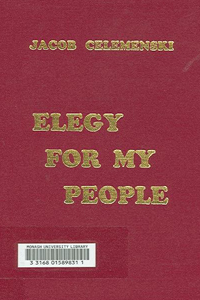 Title: Elegy for my people
Author: Jacob Celemenski
Publisher: Self Published
Place of publication: Victoria
Year of Publication: 2000
Location of Book: Sir Louis Matheson Library, Monash University Clayton Campus
Cities/town/camps: Poland: Czenstochowa, Gombin, Krakow, Lublin, Lwow, Miendzyrec, Olkusz, Piotrkow, Radom, Tarnow, Tomaszow, Warsaw, Auschwitz, Mauthausen, Schomberg
Note: those cities/towns/camps underlined are those which are most central to the narrative
Celemenski’s Elegy For My People was published in Yiddish in 1963, but was only made available in English translation in 2000. Whilst documenting his life in Poland during the war years, Celemenski’s text is also a testimony to the underground operations of the socialist workers’ party, the Jewish Labour Bund, for whom he worked as a courier, and later as a Central Committee delegate. Celemenski, born in Warsaw in 1904, was a constant supporter of the party in his childhood and throughout his adult life. During the years of the Holocaust he provided a vital link between the Bund headquarters in Warsaw and members in the surrounding provinces as contact became increasingly difficult in the midst of the Nazi killing-machine.
Elegy For My People is 235 pages long, and is divided into two parts. The first 25 pages of Part I cover the early days of the war, Celemenski’s ‘discovery’ of his ability to pass as a Pole, and his first work as a courier for the Bund. 65 pages are devoted to Celemenski’s travels to various towns as a roving delegate for the Bund’s Central Committee. 24 pages are spent on his final return to the Warsaw Ghetto, and his period in hiding from the Germans. Part II begins with Celemenski’s relocation to the ‘Aryan’ side of Warsaw. 52 pages are spent describing his resistance activities there, as well as his experiences outside of the ghetto during the Warsaw Ghetto Uprising. The following 57 pages relate Celemenski’s experiences working with the Polish resistance – first with partisans in the forests, and then in Warsaw, where he partook in the Polish Uprising. Finally, 11 pages are devoted to Celemenski’s incarceration in Auschwitz and then Mauthausen as a Polish P.O.W., and liberation by the Americans.
Celemenski begins by writing of the organisation of the Bund underground in 1940, and his initial experiences in its operations in Warsaw, Krakow and several other towns. He remembers many missions where he met with fellow comrades, providing them with money, bulletins, permits and forged documents to aid their travels and activities. It was Celemenski’s Aryan appearance that made his work during the war years possible; by posing as a Polish gentile, he was able to move around Poland with relative freedom. Celemenski’s first objective as a courier for the Bund was to arrange a conference of provincial Bund leaders that was to be held in Warsaw early 1941. After various initial setbacks, the meeting was postponed indefinitely following the disastrous first wave of deportations from Warsaw in July, 1942. The same deportations saw most of Celemenski’s family taken to the Treblinka gas chambers.
The second half of the book deals with the militant reaction to these deportations and the increasingly desperate lives of Polish Jewry. Celemenski gives a firsthand account of the 1943 Warsaw Ghetto Uprising from his perspective, outside of the ghetto walls. He took part in the organisation of the uprising, which saw many of his comrades lose their lives. Celemenski devotes much of the remainder of his book to telling the stories of these and other victorious and fallen comrades, honouring their memory, courage, sacrifices and constant devotion to their people and the Bund in the face of merciless torture and death.
While managing to evade capture for almost 5 years, the Polish Warsaw Uprising in September 1944 saw Celemenski arrested as a Polish prisoner of war and transported to Auschwitz and then onto the camps of Mauthausen and Schomberg. He lived under his Polish alias, until he escaped from a Dachau-bound death march and was liberated by the American army on May 1st 1945. Despite the eight months that Celemenski spent in the camps, he only devotes a few pages of the book to his time there, and most of that deals with his anguish at not being able to see his Jewish comrades and bring them news of the Bund. This is testimony to the spirit of a man who devoted years to ensuring the welfare of others, at constant risk to his own life.