
Jacob G. Rosenberg
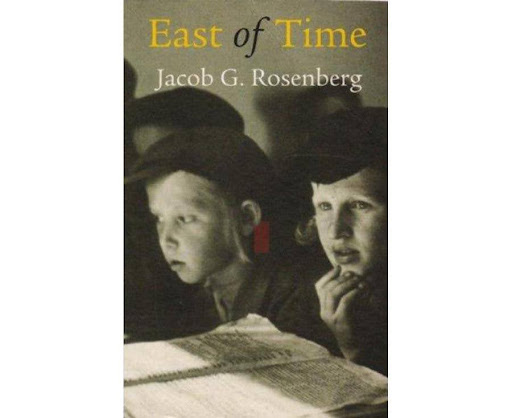 Title: East of Time
Author: Jacob G. Rosenberg
Publisher: Brandl & Schlesinger
Place of publication: Blackheath, VIC
Year of Publication: 2005
Location of Book: Lamm Jewish Library, Melbourne Holocaust Museum, Sydney Jewish Museum and other public libraries
Cities/town/camps: Poland: Lodz, Auschwitz-Birkenau, Oberwüstegiersdorf concentration camp; Austria: Ebensee concentration camp; Italy: Santa Maria di Bagna DP camp; Australia: Melbourne.
Note: those cities/towns/camps underlined are those which are most central to the narrative
Genre: Memoir
Key events/experiences: Lodz ghetto; concentration camp; death march
East of Time is a work of autobiographical prose by renowned poet and novelist, Jacob G. Rosenberg, a Polish-born survivor who endured the Lodz ghetto and multiple Nazi concentration camps. It is the first of two English-language works to detail his Holocaust experiences and recounts his upbringing in pre-war Lodz and confinement in the Lodz ghetto from 1939 to August 1944. It is succeeded by his second memoir, Sunrise West (see entry) which details his internment in various concentration camps and eventual emigration to Australia.
Pages 1-10 provide acknowledgements and a preface, with pages 11-55 recounting his pre-war upbringing in Lodz during the 1920s and early 1930s. Pages 56-99 describe escalating tensions between communist and fascist forces in Lodz, and Europe more broadly, during the mid-1930s, as well as the rise of antisemitism. Pages 100-44 chronicle the onset of World War Two and life in the Lodz ghetto from February 1940 to 1942. Pages 145-220 describe the Lodz ghetto between 1942 and August 1944, when the author was deported to Auschwitz with his family.
Yaakov (Jacob) ben Gershon Rosenberg was born in Lodz, Poland, in 1922, the youngest of three siblings born to Gershon and Masha Rosenberg, both textile workers and members of the Bund. He had two older sisters, Pola and Ida. The Rosenberg’s lived in an apartment in the poor Jewish district of Bałuty. Jacob attended the Medem School, a secular Bundist school, and from early childhood was imbued with the socialist ideals of the Bund, as well as a love of literature and the Yiddish language. As a youth, Jacob was a member of SKIF, the youth organisation of the Bund.
In September 1939, when Jacob was seventeen, Nazi Germany invaded and occupied Poland. Soon, a curfew was established, several men were hanged in the marketplace and antisemitic attacks ensued. The family apartment was located within what became the Lodz ghetto, which was crowded with thousands of Jews from surrounding districts. His two sisters and two young nieces, Frumetl and Chayale, lived in the same building. In May 1940 the ghetto was enclosed by barbed wire and its inhabitants were subject to horrific conditions, resulting in many deaths from disease and starvation.
Jacob became a slave labourer, working as a machinist in a clothing factory making uniforms for the German army. In early 1942, Jacob’s aunt and uncle and their children were all “resettled” East. Six months later it was learnt that they had been killed in Chelmno. During his internment in the ghetto, Jacob was active in an unarmed underground socialist movement, of which Bono Wiener, later an influential Bundist in Melbourne, was the ‘cell leader’.
On 4 September 1942, Jacob witnessed Chaim Rumkowski’s famous “Give me your children” speech. The following day, in a brutal Aktion, 20,000 Jewish children and the elderly were rounded up and deported to their deaths. The family hid Jacob’s nieces and his parents went into hiding. With luck they all survived, and his niece was hidden in a padlocked room for the remainder of their time in the ghetto. In the spring of 1943, the family narrowly escaped another Aktion whilst hiding in an attic after a warning from a friend in the underground. The Rosenberg family survived until the ghetto’s liquidation in August 1944, when they were deported to Auschwitz-Birkenau and murdered, with the exception of Jacob. This is where the narrative ends.
Jacob remained in Auschwitz for two months, before being deported to Oberwüstegiersdorf labour camp and Ebensee, a subcamp of Mauthausen, where he was liberated in May 1945. After liberation, Jacob spent the next few years in Italy in a DP camp at Santa Maria di Bagna where he met his wife, Esther Laufer. They married in 1946. With help from the JOINT, the couple emigrated to Melbourne in 1948 (for further details see the entry on Sunrise West). In Melbourne, Jacob was a regular contributor to Yiddish newspapers and journals, eventually publishing three volumes of poetry in Yiddish. In the 1990’s, Jacob began writing in English in the hope of reaching a wider audience, publishing three volumes of poetry which received widespread recognition. Following this success, his first memoir East of Time was published by commercial publisher Brandl and Shlesinger in 2005, winning the Douglas Steward Award for non-fiction and the Australian National Biography Award.
East of Time is an autobiographical work of immense literary merit that has been described by the author as “rendezvous of history and imagination”. The author rarely recounts his own experiences, choosing instead to describe pre-war Lodz and ghetto life through the lives of its inhabitants, describing episodes, anecdotes and characters. As such, the memoir does not contain chapters but is divided into individual ‘reminiscences’ a few pages in length, and reads like a novel that is interspersed with poetry, fables, and “ghetto legends”. As the author writes, “most of our legends are so rooted in reality it’s hard to tell which is which”. It is thus a memoir devoted not to the strict factual recollection of events but to recapturing Jewish life in Lodz in all its richness, and bringing the lost world of Jewish Lodz and its inhabitants to life.