
Kalman Katz
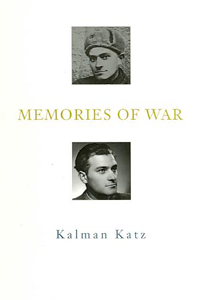 Title: Memories of war
Author: Kalman Katz
Publisher: Eskay Press
Place of publication: Melbourne
Year of Publication: 1995
Location of Book: Rare Books Collection, Sir Louis Matheson Library, Monash University Clayton Campus
Cities/town/camps: Poland: Auschwitz, Birkenau, Brzuchowice, Kosteniw, Krosieno, Lwow, Ostalowice, Pless, Przemyslany, Rzeszow
Note: those cities/towns/camps underlined are those which are most central to the narrative
First published when the author was already over seventy years old, Memories of War is Kalman Katz’s concise account of his experiences during the Holocaust and in its aftermath. The book is 69 pages long. The first five pages introduce Katz’s life in pre-war Poland and in the early years of World War II. The following 39 pages cover the period of German occupation of Eastern Poland and Katz’s experiences in hiding until the liberation of Eastern Poland by the Russians in 1944. 18 pages are spent discussing Katz’s enlistment into the Red Army, his experiences as a soldier and the end of the war. The final seven pages are devoted to Katz’s immigration to Australia, and his reflections on life in his new country.
Katz was born in Brzuchowice, near Przemyslany, on the Russian side of Poland. His family was well respected and religiously observant. After finishing high school in the town of Lwow, Katz worked in a Russian owned factory which produced light planes, until June 1941, when Germany invaded Eastern Poland. Four days after the Nazis arrived in Lwow, Katz and his cousin Eisek Heilweil decided to leave for Brzuchowice, where their families still resided. Both Aryan in appearance and fluent in Ukrainian, the two cousins joined two sons of a Russian Orthodox priest on their journey, which enabled them to walk the 40km without too much trouble.
The day after Katz and Heilweil arrived in Brzuchowice, the German army entered the village, and around 50 soldiers stationed themselves in the Katz home. On July 15, the Germans and the local Ukrainians began killing Jewish people and destroying Jewish-owned buildings. The largest synagogue in the town was burned to the ground along with three children who were thrown into the flames (two of them being children of the Belzer Rebbe). Towards the end of July 1941, a Judenrat was established in Brzuchowice, and was made responsible for sending Jews to labour camps. Three months later, the Gestapo ordered all males between eighteen and sixty years of age to register at the high school, or otherwise be shot. Katz’s father forbade him to register, thus saving his life - the men were taken to the forest in Krosienko, where they were killed.
In early 1942, Katz’s family decided to separate and go into hiding. His father and sisters moved to the Jewish ghetto in Brzuchowice, and his Mother and brother went to a farmer in the next village, Kosteniw. Katz went to stay with Iwan Kacherowski, an ethnic Russian farmer who had been a friend of the Katz family. For almost three years the Kacherowski family hid and protected Katz, risking their lives to save his.
After surviving until the Russian liberation of Eastern Poland, Katz was enlisted into the Red Army, together with his cousin Eisek, who was later killed. In an unlikely turn of events, it was Katz’s regiment that liberated Auschwitz-Birkenau in January 1945. Shortly afterwards, Katz was injured in a German ambush, and was sent home. He was reunited with his family shortly before the end of the war.
Katz writes economically and concisely; the book is 69 pages long. The memoir is personal, direct and factual. Attention is given to important factual details and character descriptions, but less space is devoted to Katz’s emotional reactions to his circumstances. The shocking brutality of many of his experiences is left to speak for itself.