
Laszlo and Katalin Fleiszig
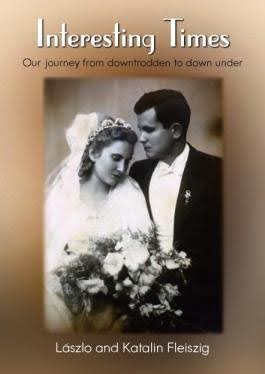 Title: Interesting Times: Our journey from downtrodden to down under
Author: Laszlo and Katalin Fleiszig
Publisher: Makor Jewish Community Library
Place of publication: Melbourne
Year of Publication: 2006
Location of Book: Monash University, Lamm Jewish Library, Melbourne Holocaust Museum, Sydney Jewish Museum, and other public libraries
Cities/town/camps: Hungary: Budapest; Austria: Vienna, Rothschild DP camp; Australia: Melbourne
Note: those cities/towns/camps underlined are those which are most central to the narrative.
Genre: Memoir
Key events/experiences: Hungarian forced labour battalion; in-hiding
Interesting Times is the story of the Fleiszig family, who survived the Holocaust in Hungary in-hiding with the help of a Hungarian Sergeant.
The memoir is 82 pages long. Pages 1-23 describe the authors’ childhoods in Budapest and marriage. Pages 23-36 describe the birth of their children, the onset of the war and Laci’s time in the Hungarian forced labour brigade. Pages 37-56 recount the escalation of anti-Jewish laws in 1944 and the family’s time in hiding. Pages 57-68 give an account of the post-war period, the family’s flight from communist Hungary to Vienna in 1949 and their eventual emigration to Australia in 1950. Pages 69-82 cover their life in Melbourne. The book includes 18 photographs of the author’s extended family, as well as a family tree.
Katalin Fleiszig (née Stern) was born 14 November 1921 in Budapest to middle-class parents Zoltan and Gabriella Stern. She had an older brother Tibor, a younger brother Dezso and a younger sister, Edit. Her father was a tailor. Though her family was not religious, they observed shabbat and the high holidays. Laszlo was born 27 October 1918 in Budapest to parents Lajos Fleiszig and Franciska Gattein. He had two younger sisters, Kato and Ibi. His family ran a successful poultry business.
The couple met whilst Katalin was in high school. After their marriage in September 1939, Katalin moved in with Laszlo and his family and began working at their poultry shop. In 1940, the couple’s first child Stephen was born, and Laci was conscripted into the Hungarian forced labour battalion. He was sent to the village of Iklad where he was forced to dig trenches for two months. He was then sent to a labour detail at an army warehouse in Timot Utca in Budapest, cleaning and storing equipment. In September 1941 their second son Gabor was born.
In January 1942, Laszlo was one of twelve Jewish men sent from the warehouse to the headquarters of the Budapest high command at the Maria Theresa barracks. There, his job was to clean and maintain the historic building under the command of Colonel Ernö Csipkes and Sergeant Jozsef Palko. Sergeant Palko in particular became instrumental to the family’s survival, securing Laszlo documents allowing him to travel freely in Budapest to visit his family. Whilst Laszlo was at the barracks, Katalin remained at home caring for their children and working at the poultry shop.
Although life was difficult, the family managed until March 1944 when Nazi Germany occupied Hungary and new antisemitic restrictions were instituted. The family was forced to close the poultry shop and Katalin’s brothers were sent to forced labour camps whilst her sister, parents and grandparents were moved to the Jewish quarter. In July 1944, Katalin learnt that her family was sent to Auschwitz. She and the children were also forced to leave their apartment for the Jewish quarter and food became scarce. Fortunately, Laszlo was able to supply food for his family with the aid of Sergeant Palko and his wife. Around the same time, Laszlo’s father and sister, Kato, were also deported to Auschwitz.
The family lived in constant fear of the fascist Arrow Cross soldiers who, on one occasion, beat and nearly killed Laszlo. With the help of Laszlo’s army connections, the family moved from hiding place to hiding place to avoid deportation. Towards the end of 1944 Katalin, passing as a gentile Christian, approached the authorities to requisition an abandoned Jewish apartment. Without asking for her papers, the authorities gave her an apartment where she lived for the duration of war with the children. Although they lived in terror, in constant fear of discovery, enduring hunger, freezing conditions and allied bombings, the family survived the war. Laszlo continued to visit them but remained at the Maria Theresa barracks where he was protected by Sergeant Palko. Finally, Budapest was liberated by the Russian army and Laszlo was reunited with his family.
After the war, they reestablished their poultry business and lived for a time in relative peace. Their youngest son Luis was born in June 1948. However in 1949, the Hungarian communist regime came to power and Laszlo was arrested in connection to a friend who had defected. After a week in prison he was released and the family decided to flee Hungary. Carrying only a small bag for the children, they made the three-day journey to Vienna where they lived at the Rothschild DP camp.
As Laszlo’s uncle, who had emigrated to Melbourne years prior, was only able to obtain two landing permits, their eldest son Stephen and his grandmother emigrated to Australia first. Laszlo, Katalin and their two younger sons remained in the Rothschild DP camp for a year awaiting landing permits, living off financial aid provided by the JOINT. Finally, their landing permits arrived and they travelled to Genoa to board a ship to Australia, arriving in Melbourne in October 1950. They established a successful family poultry business and maintained close contact with the Palko family throughout their lives.
Interesting Times is a brief but absorbing account of Katalin and Laszlo’s wartime experiences in Hungary. As the memoir alternates between their perspectives, the narrative is not always chronological and dates are sometimes unclear. The memoir quotes extensively from letters written by Katalin’s mother and brother, Tibor. It was written and published as part of the Makor Jewish Community Library’s “Write Your Story” Program.