
Leonard Spira
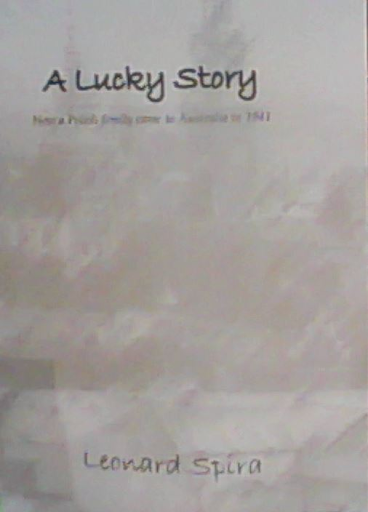 Title: A Lucky Story: How a Polish family came to Australia in 1941
Author: Leonard Spira
Publisher: Self-Published
Place of publication: Sunshine Beach, QLD
Year of Publication: 2008
Location of Book: Lamm Jewish Library and Melbourne Holocaust Museum
Cities/town/camps: Poland: Krakow, Lublin, Kovel; Ukraine Lviv (Lwów); Lithuania: Vilnius (Vilna); Russia: Moscow; Vladivostok; Japan: Suruga, Kobe; Australia: Sydney
Note: those cities/towns/camps underlined are those which are most central to the narrative
Genre: Memoir
Key events/experiences: Jewish refugee; Soviet occupation; child survivor
A Lucky Story is the tale of Leonard Spira’s journey to Australia from war- torn Poland via the Japanese ship, the Kasima Maru – the last Japanese ship to dock in Australia before Japan entered the war in December 1941.
It is a short memoir of 53 pages long. The first ten pages recount the author’s family history, his pre-war childhood and move to Lublin in August 1939. It also includes a map of Europe, family tree and foreword by the author. Pages 11-20 cover the Spira family’s flight from Lublin to Vilna, Lithuania, in December 1939. Pages 21-37 recount their journey to Japan and subsequent emigration to Sydney in 1941. Pages 37-53 present a postscript including several articles concerning the Kasima Maru published in the 1940s and 1990s by Australian news outlets.
Leonard Spira was born in Krakow on 1 January 1935, the only child of Jurek and Felinka Spira. Leonard’s father was a lawyer and he was raised in a middle-class home. On 24 August 1939, Germany signed a nonaggression pact with Russia. Fearing that German invasion of Poland was imminent, Leonard’s family moved to Lublin in the hopes of escaping the occupation, staying in an estate owned by family-friends. As their accommodation was crowded with Jewish refugees from western Poland, the family moved to a flat in the city centre. When war broke out on 1 September 1939, Leonard’s father travelled east to report for army duty as ordered by the Polish government. As the bombing of Lublin became worse, Leonard and his remaining family were forced to hide in the cellar and eventually joined the flood of refugees travelling east.
They fled to the town of Kovel where they were reunited with Leonard’s father. Whilst in Kovel, the Russian army occupied eastern Poland. After two weeks in Kovel, Leonard’s uncle Joseph arrived to bring the family to Lwów where they stayed for approximately two months. Due to the stress of Russian occupation, however, they decided to move to Vilna in Lithuania which was at that time a “free state” and where Leonard’s uncle Edward lived. In the middle of the night on 31 December 1939, the family illegally crossed the border to Lithuania where they remained for a year. In June 1940, Lithuania was occupied by the Russians and the family decided to emigrate east.
The Japanese Consul in Lithuania, Chiune Sugihara, who was sympathetic to the plight of refugees, issued visas for the Spira family to Japan. After Leonard’s father endured interrogation by the Russians, the family was granted an exit-visa. With the financial aid from relatives overseas, the family were finally able to secure travel to Japan. On 27 January 1941, when Leondard was six-years-old, the family left Vilna travelling by train to Vladivostok in Siberia via Moscow, before boarding a packed cargo ship to Suruga, Japan, many of them Jewish refugees.
They were greeted in Suruga by members of the American Jewish Joint Distribution Committee and were taken to a welfare home in Kobe. With the help of the Polish ambassador in Kobe, and continued aid of overseas relatives, the family were able to secure visas to Australia where a distant cousin was living. They left for Sydney on the Kashima Maru in late July 1941, carrying the new Japanese Consul to Australia and approximately sixty Polish refugees. During the journey, the passengers realised that the ship had been recalled and was travelling back towards Japan. However, the ship was intercepted by a Dutch warship whose crew boarded the Kashima Maru and redirected the ship to Australia, bringing the refugees to safety. The family disembarked in Sydney on 9 August 1941 where, with the help of Jewish aid organisations, they began their new lives.
A Lucky Story is a straightforward, chronological account that begins with the author’s birth and ends with his arrival in Australia. It provides a brief overview of the author’s key wartime experiences and some specific dates and details are not included. A young boy at the time, the memoir is primarily based on the recollections relayed by his parents as well as the author’s own memories.