
Lita Nadel
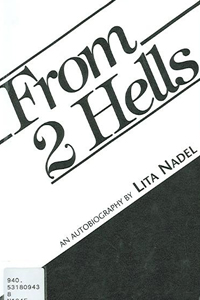 Title: From 2 hells:an autobiography
Author: Lita Nadel
Publisher: Self Published
Place of publication: Sydney
Year of Publication: 1995
Location of Book: Sir Louis Matheson Library, Monash University Clayton Campus
Cities/town/camps: Poland: Lvov, Warsaw, Soviet Union, Germany: Berlin
Note: those cities/towns/camps underlined are those which are most central to the narrative
From 2 Hells is a young girl’s story of wartime survival. The first 35 pages outline Lita’s time in Lvov from 1939, her exile in Siberia and her subsequent return to Lvov. Pages 36-74 describe life in German occupied Warsaw, while pages 75-93 portray her time in a peasant village and her eventual liberation. Lita originally wrote her story in an attempt to pass on her family’s history to her daughters. From 2 Hells was published privately in 1995.
Lita Nadel was born into a prominent upper-class Jewish family in Lvov, Poland. Her father was a physician and her mother was one of the few career women at that time. While cognizant of their Jewish identity, Lita’s family was assimilated and did not practice any Jewish rituals. When the war broke out in September 1939, Lita’s father was called up by the Polish army. He was captured by the Russians and, owing to his status as an officer, murdered. Lita and her mother then fled to stay with their grandmother in a different part of the city. Lita was only ten years old at the time.
In April 1940 Lita and her mother were arrested by the Russians and transported to southern Siberia. 150km from the nearest railway, the prisoners were simply dumped in the village of Kokpiekty and left to fend for themselves. In Kokpeikty, Lita contracted typhus but was able to survive despite inadequate medical care. In October Lita and her mother manage to escape the village and reach the train station. After a lengthy zigzag across the Soviet Union, desperately trying to avoid the intrusive security services, they arrived home in Lvov. After surviving numerous close encounters with the feared NKVD (Soviet security police) in Russia, Lita and her mother had hoped that their hometown would provide a modicum of safety. However, no sooner were they reunited with family than the Germans invaded Lvov.
After obtaining false documents, Lita and her mother fled to Warsaw in December 1941, hoping that it would be easier to hide in a large city. In Warsaw Lita began attending a regular school and was taught all the appropriate church rituals and prayers. Lita describes the struggles, tension and fear that residents of Warsaw were forced to endure in those days. When the Polish uprising began in August 1944, Lita and her mother were forced from their apartment. They wandered the city in search of food and shelter before finding refuge at Lita’s aunt’s apartment.
In October Lita and her mother were captured by the Germans and marched out of Warsaw. When the Germans asked all former residents of Warsaw to congregate at the nearest train station, Lita’s mother knew it was time to escape. They managed to reach a village (Lita cannot recall the name) where they were fortunate to find hospitality with some peasants. Living with the peasants proved to be a filthy and lice-ridden existence. Nonetheless, it allowed Lita and her mother to survive until liberation in January 1945. After a brief stint in Berlin, where she refused to make friends with the German schoolchildren, Lita and her mother immigrated to Australia to begin a new life.
The book’s narrative is fast-paced, as the central protagonists escape from one danger to the next in quick succession. Written in an unadulterated and matter-of-fact fashion, From 2 Hells conveys the frustration, wonder and horror of a young patriotic Polish Jew surrounded by betrayal and cruelty.