
Marian M. Pretzel
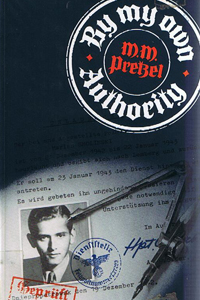 Title: By My Own Authority
Author: Marian M. Pretzel
Publisher: Kangaroo Press
Place of publication: Kenthurst, NSW
Year of Publication: 1985
Location of Book: Lamm Jewish Library, Melbourne Holocaust Museum, Sydney Jewish Museum, University of Sydney and other public libraries.
Cities/town/camps: Ukraine: Kiev, Lvov, Janowska concentration camp, Wilniczka; Romania: Bucharest; Hungary: Budapest; Israel: Haifa; Austria, Vienna; Australia: Sydney.
Note: those cities/towns/camps underlined are those which are most central to the narrative
Genre: Memoir
Key events/experiences: Lvov ghetto; false identity; survival in hiding
By My Own Authority is the remarkable account of a young Polish Jew, Marian Pretzel, who, using his skills as a trained artist, was able to forge his way out of Nazi-occupied Europe to eventual freedom in Australia. Pages 1-22 cover the author’s pre-war childhood in Lvov with pages 23-44 detailing life during the early years of the war and Pretzel’s first attempts at forgery. Pages 45-96 recount life in the Lvov ghetto and his internment and escape from Janowska concentration camp. Pages 97-134 recount his escape to Kiev and eventually to Bucharest on forged papers during 1943. Pages 135-188 details the rescue of a young Jewish girl, Helen, from the Budapest ghetto. Pages 189-224 cover the author’s immigration to Israel in early 1945, and eventually to Australia in 1949.
Marian Pretzel was born in Kochanowski Street in Lvov, Poland (now Ukraine) in 1922 where he lived until the German invasion in 1941. Marian was the second child to religious, though well-assimilated, Jewish parents. His neighbourhood was predominantly Christian, Polish and Ukrainian, though Marian recalls that in spite of antisemitic outbursts, his personal experiences of Gentile-Jewish relations were positive. At 17, and during the Soviet occupation of Lvov, Marian decided to enrol in Art School with his friend Milek. With the Nazi invasion in July 1941, the family narrowly escaped an Aktion in which 6,000 Jews from Lvov were arrested or murdered. Marian was forced to work various labour jobs for the German army and in the Summer of 1942, the family home was looted. Around this time, a friend approached Marian and Milek to forge official German stamps; the young artist thus began the process of learning to forge German documents.
In the summer of 1942, Marian was sent to a farm in nearby Wilniczka as a forced labourer. When he returned home two months later – after having walked several hours wearing only self-fashioned cardboard ‘shoes’ – he discovered that his parents and almost all his possessions were gone. They had been rounded up in a recent Aktion and killed. Thankfully, his sister Giza was still alive in the Lvov ghetto. In October 1942, Marian was arrested and sent to the Janowska forced labour camp where he met Simon Wiesenthal, the famed Austrian survivor and “Nazi hunter” who dedicated his life to tracking down and bringing Nazi war criminals to justice. Aware of Marian’s skills as a forger, Wiesenthal organized a desk job for Marian so he could forge life-saving work permits. After two nights, and with forged Polish papers in hand, Marian escaped from Janowska, returning to the Lvov ghetto where he planned to escape to Kiev. His sister, who was reluctant to risk leaving the ghetto on false papers, remained behind where she tragically perished.
In early 1943, Marian and a group of friends fled the Lvov ghetto on forged papers, travelling to Kiev where they lived off forged ration cards. For a time, they lived comfortably and when a friend invited them to a wedding they agreed. After a night of drinking and celebrations, the group lost contact with one of their members, Adek, later learning that he had been arrested by the Gestapo. Despite protestations, his sister, Felka left to confirm his whereabouts. Soon thereafter, the group heard Adek had been killed and Felka arrested. Fearing they would all be caught, the rest fled for Romania via Odessa where they parted, hoping to avoid further detection. Again, using forged documents as well as stolen German uniforms, Marian and his friend Janek, reached Bucharest in the summer of 1944. There, a wealthy Jewish couple, who had heard of Marian’s expertise in forgery, begged him to rescue their daughter, Helen, from the Budapest ghetto in exchange for a large sum. After initially rejecting the offer, they agreed, travelling to Budapest where they rescued Helen and brought her back to Bucharest. The pair were well paid and were able to live out the rest of the war in Bucharest.
In late 1944, Marian made his way from Bucharest to mandatory Palestine where he arrived in January 1945. After nearly two years, he left for Vienna, to continue his artistic studies. After living in Vienna for three years, Pretzel emigrated to Australia in 1949, living for the first six months in the Queensland “bush” before settling in Sydney. Though life as a penniless emigrant was a struggle, Marian met and married his wife Yvonne in 1955, and eventually established a career as a painter and graphic artist. The couple had a son and a daughter, Stephen and Shari.
By My Own Authority is principally a tale of survival characterised by daring and adventure. Due to the author’s unique experiences as a forger able to hide in plain sight throughout Nazi-occupied Europe, this memoir is highly unusual. Although it recounts the events of the early war period in occupied Poland, as well as the Lvov ghetto, the memoir conveys a narrative focused less on the details of daily life during the war or major wartime events than on the author’s state of mind and will to survive.