
Marian M. Pretzel 3
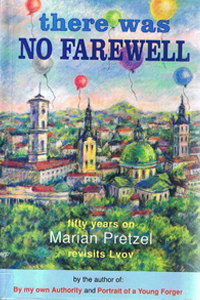 Title: There Was No Farewell: Fifty years on Marian Pretzel revisits Lvov
Author: Marian M. Pretzel
Publisher: Sydney Jewish Museum
Place of publication: Darlinghurst, NSW
Year of Publication: 1995
Location of Book: Lamm Jewish Library, Melbourne Holocaust Museum, Sydney Jewish Museum, University of NSW and other public libraries
Cities/town/camps: Ukraine: Kiev, Lvov, Janowska concentration camp, Wilniczka; Romania: Bucharest; Hungary: Budapest; Israel: Haifa; Austria, Vienna; Australia: Sydney
Note: those cities/towns/camps underlined are those which are most central to the narrative
Genre: Memoir
Key events/experiences: Lvov ghetto; false identity; survival in hiding
There was No Farewell is the latest edition to Marian Pretzel’s autobiographical works. Born in Lvov, Poland (now Lviv, Ukraine) in 1922 and having trained as an artist, Marian’s artistic talents soon became his key to survival – he began forging official German documents such as identity papers, travel permits and ration cards in order to survive and evade Nazi occupation, arrest and deportation. Fifty years after leaving his hometown Lvov, Marian Pretzel and his wartime friend and fellow-survivor, Janek Fuchs, went on a “farewell journey” back to their hometown. Where previous publications served as historical documents of the Holocaust and the author’s story of survival as a forger, There Was No Farewell is an account of the author’s travels throughout Europe with Fuchs in the 1990s, and the memories and reflections they evoked.
Pages 1-23 open with the author’s decision to finally return to Lvov fifty years after emigrating. In pages 23- 59, Pretzel returns to Europe, meeting Fuchs in Vienna. In pages 59-146, he retraces the physical landscape of memory in the streets of Lvov, recounting memories both happy and tragic as well as reflecting on Lvov as a city both changed and unchanged. In pages 121-146, Pretzel returns to his family home in Lvov, and in pages 167-189, he revisits the former Jewish ghetto, recalling the last time he saw his sister, Giza who perished there in 1942. He also revisits the Jewish cemetery and the former Janowska concentration camp, recounting painful memories as well reflecting on Lvov’s evolving physical and political landscape since the Holocaust. Pages 190-217 cover the author’s return to Budapest, Vienna and Paris, recalling and discussing the wartime experiences he shared in these cities with Fuchs. Finally, the author returns to his home in Sydney, offering reflections on his life since the publication of his memoir and the legacy of the Holocaust.
There Was No Farewell is a fascinating and profound meditation on memory, in the context of the author’s return to the sites of his wartime experiences. As Pretzel traverses his beloved hometown Lvov, and other European cities, the various landmarks he encounters spark his recollections. In this way, the author alternates between his recollections of the war and reflection on the nature of memory, as well as the emotional and psychological legacy of his experiences. Stylistically, There Was No Farewell is not a factual, chronological account of the Holocaust but is emotive, contemplative and fragmentary. As Pretzel writes, rather than functioning merely as a “sequel” to earlier accounts, this memoir is better described as a “parallel memory” which provides a glimpse into emotions and memories once regarded as “too obscure” or too difficult to describe. Ultimately, There Was No Farewell, is a poignant reflection on one man’s memory and Holocaust legacy. It was published by the Sydney Jewish Museum as part of their “Community Stories” project.
Note: Marian Pretzel’s story of surviving the Holocaust as a forger is recounted in rich detail in his memoirs By My Own Authority and Portrait of a Young Forger (also published as Outwitting Hitler).