
Marie Milder
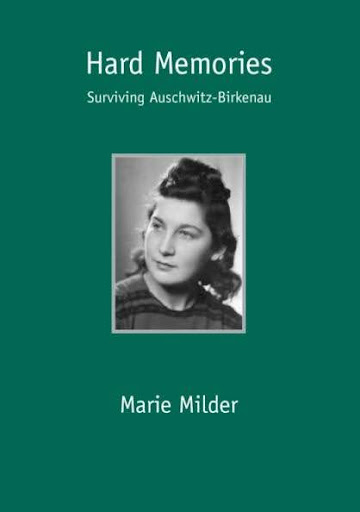 Title: Hard memories: Surviving Auschwitz-Birkenau
Author: Marie Milder
Publisher: Makor Jewish Community Library
Place of publication: Caulfield South, VIC
Year of Publication: 2006
Location of Book: Lamm Jewish Library, Melbourne Holocaust Museum, Deakin University and other public libraries
Cities/town/camps: Poland: Będzin, Auschwitz II-Birkenau, Auschwitz I, Katowice; Czechoslovakia: Prague; Germany: Munchberg, Munich; Australia: Melbourne
Note: those cities/towns/camps underlined are those which are most central to the narrative.
Genre: Memoir
Key events/experiences: Będzin ghetto; concentration camp
Hard Memories is the 66-page memoir of Polish-Jewish survivor Marie Milder, who survived the Będzin ghetto and Auschwitz-Birkenau where she was ultimately liberated by the Russian army.
Pages 1-11 describe the author’s childhood and extended family history. Pages 12-26 recount the Nazi invasion of Poland in 1939 and the author’s internment in the Będzin ghetto from 1940 until her deportation to Auschwitz-Birkenau in July 1943. Pages 27-46 provides an account of her internment in Auschwitz until liberation by the Russian army in January 1945. Pages 47-66 describe her post-war experiences in Poland, Prague and American-occupied Germany, and her emigration to Melbourne with her husband in 1949, briefly recounting their life in Melbourne. It contains 17 photos of the author and her extended family.
Marie Milder (née Beserglick) was born 25 November 1924 in Bedzin to parents Moshe and Faigele Beserglick. In 1927, when Marie was just three-years-old, her father died of a heart condition. She also had a younger sister, Sala, who was tragically killed in a tram accident in 1933. Marie’s mother remarried in 1936 to Alter Honigman, a businessman.
When Marie was fifteen-years-old, Nazi Germany invaded Poland and new antisemitic restrictions were quickly instituted. With a large textile industry in Będzin, several army-run factories were established. Sometime in 1940, Marie’s step-father was taken to a labour camp where he was eventually killed. In 1941, Marie and her mother found work at a clothing factory tasked with making German army uniforms run by German industrialist Alfred Rossner, who would later be recognized as a Righteous Gentile.
For some time, Będzin was an open ghetto and Marie was able to live at home with her mother. In August 1942, the pair were rounded up in an Aktion but were given a reprieve due to their working papers. During this Aktion, many of their family members were murdered. In March 1943 they were moved to the closed ghetto, which was established in an outer suburb of Będzin. On 29 July 1943 they were deported to Auschwitz-Birkenau during the liquidation of the ghetto. Marie’s mother and two young nieces were killed on arrival, whilst Marie was taken into the camp where she remained for eighteen months.
In October 1943, Marie was sent to a commando tasked with sorting shoes. In March 1944, she was selected as a translator and sent to Auschwitz I. On 18 January 1945, as the Russian army approached, the women were ordered to leave on a forced march. Instead of joining the march Marie and a group of prisoners hid in the barracks. After several days they were discovered by a Polish prisoner and brought to the men’s camp. Soon the SS left and, on 27 January 1945, Auschwitz was liberated by the Russian army. After liberation, Marie remained in Auschwitz for two weeks.
With a group of prisoners, Marie set out for Katowice where they were supported by the local Jewish community. Marie remained in Katowice until the end of the war. She returned to Będzin briefly but tragically found no surviving family or friends, later learning that two cousins who fled to Russia had survived. When in June 1945 a Jewish man was shot in daylight in Katowice, Marie decided that there was no place for Jews in Poland and she left with a group of Jewish survivors for Prague. She then travelled to Munchberg in the American Zone of Germany to reunite with her surviving cousins. Marie was given accommodation with a German family with the help of an unnamed relief organisation. In 1947, she enrolled at the University of Erlangen to study languages and in the summer of 1947 she met her future husband Paul Milder. The couple married in October 1948 and moved to Munich. They obtained landing permits from Paul’s business friends in Australia and they emigrated to Melbourne in November 1949 when Marie was five months pregnant. The couple had three sons, Morris, John and Allan.
Hard Memories is a brief, lucid memoir, describing the author’s wartime experiences. In particular, the memoir provides detail on the Judenrat in the Będzin ghetto and her social relationships in Auschwitz. It does not provide a detailed account of post-war life in Australia. The memoir was written and published as part of the Makor Jewish Community’s “Write Your Story” Program.