
Moshe Ajzenbud
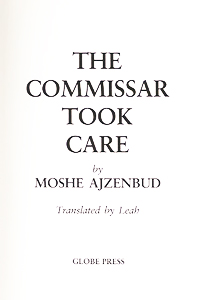 Title: The Commissar Took Care
Author: Moshe Ajzenbud
Publisher: Globe Publishing
Place of publication: Melbourne
Year of Publication: 1986
Location of Book: Sir Louis Matheson Library, Monash University Clayton Campus
Cities/town/camps: Chusovaya, Kizel, Lengar, Molotov, Niesviez (situated on the Russian/Poland border), Tashkent, Utios, Zirbulack, Uzbekistan, Kizel Prison, Molotov Prison, Iranchee Labour Camp
Note: those cities/towns/camps underlined are those which are most central to the narrative
After overcoming his initial doubts, Moshe Ajzenbud decided to put pen to paper and produce an account of those ‘painful events’ (p.ii) that had shattered his life. First published in Yiddish in 1956, later translated into English by his wife Leah in 1986 and published in Australia, The Commissar Took Care is the tale of a young Jewish man’s struggle for survival during World War II. The book presents the story of Michael Lvovitch (which we can assume is the characterised depiction of Ajzenbud) in a third person narration. Michael’s adversities during his time in a number of labour camps and prisons are detailed over the twenty-eight chapters of this one hundred and eighty-three page book.
The text opens with the beginning of the war and the invasion of Eastern Poland by the Red Army. The first forty-eight pages of the book detail the dramatic changes that take place within Poland as a result of Soviet domination. The following chapter describes Michael’s escape from his hometown of Niesviez, Poland to Uzbekistan with thousands of other Jewish war refugees, eager to escape the harsh Soviet rule. He arrives in Zirbulack, Uzbekistan with his father and brother, who are later sent to labour camps, leaving Michael alone with nothing but his excruciating hunger and will to live. The description of the weather in these two chapters allows us to assume that he spends a number of months hiding out in this place. With the belief that more rations and a warm bed were provided to workers, Michael boards a freight train to labour at the Lengar construction site. Throughout the following two chapters much detail is provided regarding the sufferings experienced by both Michael and his co-workers. He spends a number of months at this camp before being sent to labour in the stone quarries of Utios. During his time at Lengar Michael struggles to survive the twelve-hour long working days with only a small ration of bread daily and a few soiled rags to protect his frail body from the harsh conditions.
During the second year of the war he is sentenced to serve five days imprisonment in Chusovaya, charged with ‘hindering the war effort’ (p.103), for failing to work at the required pace. Upon his return to Urios, Michael’s physical wellbeing declines rapidly, and on a harsh winter’s day he refuses to work without the provision of adequate clothing and sustenance. He is initially sent to prison in Kizel where he is put on trial and sentenced to serve five years imprisonment at Molotov. Chapters twenty-three to twenty-six detail the operation of the Iranchee camp were he was assigned for ‘light-work’ (p.145) however, as a result of scurvy and pellagra Michael spends a number of months semi-conscious in hospital. Following his recovery Michael is later assigned to work at the bathhouse, and after only a few weeks the word ‘Amnesty’ booms over the loudspeakers of the camp. After a number of impatient months, Michael is finally released from Iranchee, where he travels back to Uzbekistan to be reunited with his father. The Commissar Took Care is an eloquently written autobiography written in the style of a third person narrative. It is highly descriptive and evocative, detailing the harrowing experiences of a young Jewish man trapped in the Soviet War machine and its notorious forced labour camps.