
Naomi Rosh White
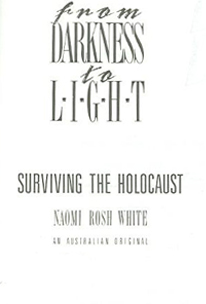 Title: From darkness to light - surviving the holocaust
Author: Naomi Rosh White
Publisher: Collins Dove
Place of publication: Melbourne
Year of Publication: 1988
Location of Book: Sir Louis Matheson Library, Monash University Clayton Campus
Cities/town/camps: Poland: Warsaw, Vilna, Treblinka, Pionki-Zagozdon, Auschwitz, Kielce, Majdanek, Pawiak, Germany: Bergen-Belsen, Dornau, Hirschberg, Buchenwald, Langenbielau
Note: those cities/towns/camps underlined are those which are most central to the narrative
From Darkness to Light is an anthology of survivor testimony coupled with analysis and commentary. The format of the book is best described by its author, Naomi Rosh White.
“The first chapter introduces the survivors through their life stories. It conveys a sense of the individuals on whose experiences this book is based. The remaining chapters present the survivors stories through various themes. The survivors stories have been organised into periods, and their recollections of themselves and of their daily lives are documented for each period. These recollections are interspersed with analysis and historical background material. This approach highlights the similarities and differences in the experiences and perceptions of the survivors who were interviewed. It also recreates the feeling of a particular historical period.”
Some of the themes included are ‘Recollections of Home,’ ‘War in Partitioned Poland,’ ‘New Lives’ and ‘Reflections,’ with sub-themes such as ‘Jewish-Polish relations’ and ‘In hiding.’ There are eleven survivors featured in the book, all of them Polish in origin. 229 pages long, the book also contains a brief biographical sketch of each of the survivors. All of the survivors were interviewed on the condition of anonymity. As such, full names are not used. Following is a brief outline of the experiences of the survivors who contributed to the book
Renia
Seventeen years old at the outbreak of war, Renia came from a poor, Orthodox Jewish family. She spent the war in ghettos and concentration camps, including Pionki-Zagozdon and Auschwitz. Renia was the only member of her family to survive the war.
Marysia
Marysia grew up in a well-to-do religiously diverse family and spent the war years in the ghetto, labour camps and concentration camps, including Langenbielau. She was the only member of her family to survive the war.
Frania
Frania grew up in a poor family and at the outbreak of war, fled to the Russian occupied zone before rejoining her parents in the Warsaw ghetto. As deportations increased, she escaped the ghetto but ended up being sent to Bergen-Belsen. Frania was the only member of her family to survive the war.
Rozka
Rozka grew up in a well-off Orthodox Jewish home in eastern Poland. During the war her family was forced into a ghetto, but Rozka eventually escaped with her husband and lived on ‘Aryan’ identity papers in Warsaw. Rozka was the only member of her family to survive the war.
HaniaHania was raised in a comfortable religious household. During the war she fled to Czechoslavakia on ‘Aryan’ papers. She survived the rest of the war by in hiding, sometimes with gentile families or in the mountains, or by using her ‘Aryan’ papers.
Wladk
Wladk grew up in a comfortable secular home. He used to smuggle people and currency across the German-Soviet border. He was arrested as a smuggler in 1941 and spent time in Pawiak and Majdanek, before escaping from Buchenwald.
Avram
Avram was raised in a secular family in Vilna. After narrowly escaping a massacre, he worked as an electrician in the ghetto. As the ghetto was being liquidated, he escaped to the forest to join the partisans. Avram was the only member of his family to survive the war.
Genek
Genek grew up in a well-off and assimilated family. During the war he was consigned to the Warsaw ghetto and once escaped a train bound for Treblinka. He and his family hid out the remainder of the war with a gentile family on the ‘Aryan’ side of Warsaw.
Kuba
Kuba was raised in a poor, traditional Jewish family. During the war he fled to the Russian zone but was arrested and sent to a freezing gulag for thirteen months. After his release he joined the Polish army but was discriminated against as a Jew.
Julek
Julek grew up in a poor, atheist and communist home. At the outbreak of war Julek worked as medical aid in the ghetto. After eight months he was transported to the first of six concentration camps he endured during the war. Julak was the only member of his family to survive.
Henryk
Henryk was the only child in a prosperous, assimilated family. After fleeing eastward at the outbreak of war, Henryk returned to Warsaw and managed to smuggle his parents out of the ghetto. He managed to obtain ‘Aryan’ papers and eventually joined the German army’s engineering branch. Towards the end of the war Henryk and his parents escaped to Romania.