
Niusia Janowski
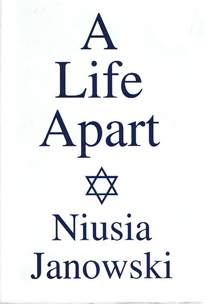 Title: A life apart
Author: Niusia Janowski
Publisher: Self Published
Place of publication: Melbourne
Year of Publication: 1993
Location of Book: Makor Jewish Community Library, Melbourne Jewish Community Library, Melbourne
Cities/town/camps: Poland: Szczebra, Studzieniczne, Lipowiec, Augustow, Lodz
Note: those cities/towns/camps underlined are those which are most central to the narrative
A Life Apart is the story Niusia Janowski’s survival during the war years. It also devotes considerable space to the fate of many of her family and friends. Pages 6-41 portray Janowski’s experiences working in towns such as Studzieniczne, Lipowiec, and Augustow. Pages 42-62 describe Janowski’s time with the German army, in Szczebra and on their journey westward. Pages 63-81 deal with her time after liberation until her return to Lodz. Pages 82-120 recount the stories of what happened to Janowski’s family and friends during the war, while pages 121-147 give the reader an insight into Janowski’s family life before the war. There are also a brief epilogue and a number of photos and documents in the book. Janowski intended the book to be, “a sort of verbal family photo album” for her children, who never knew their grandparents or many of their other relatives. Her story was written in Polish from 1989 to 1992, then translated into English and published by the Jewish Holocaust Centre in 1993.
The first section of the book deals with the years 1941-1945, when Janowski, a Polish Jew separated from her family after escaping from Lodz ghetto, adopts a new identity. Blessed with a ‘non-Jewish’ appearance, Janowski took on the name of Stefania Wodzinska, a girl that she used to know, and managed to convince a priest to give her Christian identity papers. Janowski drifts from job to job, city to city. Initially working in Studzieniczne, with good friend Zosia, as a fieldworker during the summer harvest period, Janowski then moves on to a clerical position at Herman Goering Werke, a sawmill in Lipowiec. Here her Jewish past is discovered for the first time, forcing her to leave her position. This happens again while working at the railway station. Janowski then moves on to a physically demanding job in Augustow, drying up swamps near the river. When Hitler begins to taste defeat on the Russian front, she is ordered to go and work for the German Army.
After many months attached to a cavalry unit in the German army, Janowski decides to escape. After hiding in a cellar for two days, she eventually comes out upon hearing Russian voices. When the Russian soldiers discover that she has been working for the German Army, she is labelled a traitor and put in the hands of the NKVD (the secret police) where she is interrogated for many days until her release. In April 1945 Janowski starts the journey home to Lodz in search of surviving family.
The second section deals with what happened to Janowski’s family, both those that survived and those who did not. It becomes apparent that many spent time in the Warsaw ghetto, and many of those that did not survive were murdered in the Auschwitz gas chambers. Both of Janowski’s parents and most of her wider family perished in Holocaust.
The final section portrays what life was like in Lodz before the year 1941, when people were only just beginning to feel the effects of the Nazi regime. Janowski describes experiences and people from her childhood, including her household maids. Their family was very well off, thanks to her father’s successful family business. Unfortunately, he lost much of their fortune to gambling and the effects of the war.
The jumps between places and dates in the book, and the lack of chapters, can be somewhat disorienting for the reader. This slightly disordered narrative, however, is due to the fact that A Life Apart is primarily about one woman’s memories and experiences, particularly those relating to the people she encountered. Great attention is dedicated to Janowski’s family and friends and their lives before and during the war. Indeed, the text is rich in personal anecdotes and fond recollections of a world that was lost forever. Despite the horror, those that helped Janowski remind the reader to, in her own words, “never give up on human decency.”