
Peter Sedgman
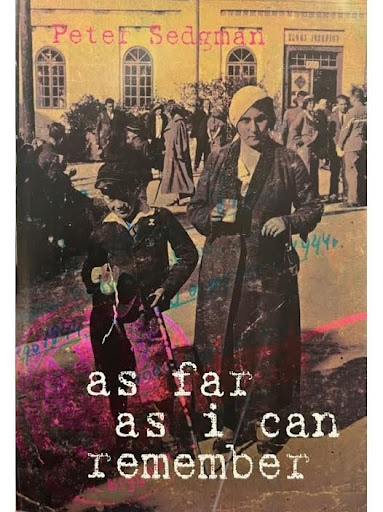 Title: As far as I can remember
Author: Peter Sedgman
Publisher: Sydney Jewish Museum
Place of publication: Darlinghurst, NSW
Year of Publication: 2006
Location of Book: Lamm Jewish Library, Sydney Jewish Museum, State Library of NSW and other public libraries
Cities/town/camps: Poland: Hammerstein POW camp; Lublin and Majdan Tatarski ghettos, Lipowa 7 forced labour camp, Majdanek concentration camp, Borek Forest Camp; Italy: Santa Maria DP camp; Australia: Sydney
Note: those cities/towns/camps underlined are those which are most central to the narrative
Genre: Memoir
Key events/experiences: German POW camp; ghetto; in-hiding; concentration camp; Sonderkommando; Operation Harvest Festival; Polish partisans.
As Far as I Can Remember is the 150-page memoir of Polish-born survivor, Peter Sedgman. One of very few prisoners to survive the Majdanek Harvest Festival Aktion of November 1943, Peter was selected for a Sonderkommando squad tasked with exhuming and cremating bodies at the Borek Forest camp. He ultimately survived by escaping through an underground tunnel before joining the Polish partisans.
Pages 1-19 briefly recount the author’s life in pre-war Lublin and his time in Palestine from 1937-1939. Pages 20-42 describe his return to Lublin, conscription into the Polish army, capture and internment in a German POW camp, as well as his incarceration in the Lublin and Majdan Tatarski ghettoes with his family. Pages 43-57 give an account of his internment and escape from the Lipowa-7 forced labour camp and time in-hiding following his escape. Pages 58-78 provide photographs of the author and his family. Pages 79-98 describe his imprisonment in Lipowa, deportation to Majdanek and the Borek Forest camp followed by his escape and time with the Polish partisans until liberation in August 1944. Pages 99-127 describe the author’s return to Lublin after the war, his marriage in 1946 and time in an Italian refugee camp before his eventual emigration to Australia. Pages 127-150 recount his new life and family in Sydney.
Perez Szechtman (Peter Sedgman) was born in Lublin on 10 November 1917. He had an older brother Cadok, and sister Masza, and a younger brother, Gidal. His parents ran a haberdashery shop. An avid Zionist, Peter’s father emigrated to Palestine in 1936. In 1937, Peter left for Palestine to join his father. When his sister became engaged, the pair returned to Lublin for her wedding in early 1939. Soon after their arrival, Peter was conscripted into the Polish army. In September, Nazi Germany invaded Poland. Peter was quickly captured and sent to a German POW camp in Hammerstein where he remained for the next eighteen months. He was released in late 1940 and interned in the Lublin ghetto with his family.
In the summer of 1941, the Sedgman family were relocated to the Polish countryside as forced labourers. Tragically, Peter’s father became gravely ill. The family brought him to the Lublin ghetto hospital where he died in August. Returning to Lublin to sit shiva, the family decided to remain in the ghetto. As deportations intensified in the summer of 1942 they were moved to the smaller ghetto in Majdan Tatarski on the outskirts of Lublin. Shortly thereafter, they were caught in a round up. As they were being marched towards the Majdanek concentration camp, Peter escaped into an open field but his mother, sister and younger brother were driven into the nearby forest and shot.
Peter then returned to the Majdan Tatarski ghetto where his older brother, Cadok, had survived in hiding. The brothers remained in the ghetto for a short time whilst Peter searched for a hiding place. Their plans were disrupted when they were caught in a round-up and deported to the nearby Lipowa-7 labour camp. The brothers managed to escape in November 1942 and were given shelter by a devout Catholic woman and her son, who hid the brothers for six months. Narrowly escaping exposure by suspicious neighbours, the brothers fled their hiding place. After walking for two weeks, Cadok lost the will to live and decided to turn himself in. Unwilling to abandon his brother, Peter accompanied Cadok to Lipowa, where they were brutally beaten and interrogated.
In the early hours of 3 November 1943, Nazi officials launched Operation Harvest Festival – a brutal Aktion to eliminate all surviving Jews in the Lublin district of the General Government – and the Lipowa prisoners were marched to Majdanek where they were shot in open graves. As part of the Aktion, the Nazis also formed special squads of camp prisoners to exhume mass graves across the region and destroy the evidence of their crimes from the advancing Russian army. On arrival at Majdanek, Peter was selected for one of these squads and placed on a truck. His brother was marched into the camp and murdered alongside thousands of other Majdanek and Lipowa prisoners. Peter was then sent to an isolated camp in the Borek forest where he and a small workforce of approximately sixty men were forced to exhume mass graves and burn the corpses. For weeks, Peter and his fellow prisoners dug a tunnel underneath their barracks at night, finally escaping into the surrounding forest. Alongside two of his fellow escapees, Peter wandered the Polish countryside for a week, aided by local Polish peasants until they made contact with Polish partisans.
Peter engaged in several missions with the partisans until the region was liberated by the Russian army in August 1944. He then returned to Lublin as the only survivor of his family. There he met his future wife, Stella, who had survived the war with forged papers. The couple married in May 1945. Two weeks later, they left Poland to emigrate to Palestine. Assisted by the JOINT, they travelled to Bucharest where they remained for two months waiting for a ship. However, their plans changed and the couple travelled to Italy, sheltering at the Santa Maria DP camp where their daughter Christine was born in September 1946. Finally, friends who had settled in Australia sent the family landing permits in 1949 and with the assistance of the JOINT they migrated to Sydney.
As Far as I Can Remember is a brief but precise summary of the author’s wartime experiences. As one of few surviving witnesses to the Operation Harvest Festival Aktion in Majdanek, and, particularly, as a member of the ‘clean-up’ squads, Peter’s memoir is a particularly rare and valuable account. It was written and published as part of the Sydney Jewish Museum’s “Community Stories” Project.