
Phillip Maisel
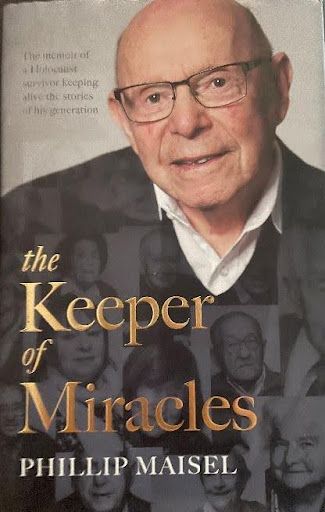 Title: The Keeper of Miracles
Author: Phillip Maisel
Publisher: Pan Macmillan Australia
Place of publication: Sydney
Year of Publication: 2021
Location of Book: Lamm Jewish Library, Melbourne Holocaust Museum, Sydney Jewish Museum and other public libraries
Cities/town/camps: Lithuania: Vilnius (Vilna); Estonia: Vaivara concentration camp; Poland: Stutthof concentration camp; Germany: Balingen, Dautmergen and Frommer forced labour camps, Ostrach, Landsberg DP camp, Tübingen; Australia: Melbourne.
Note: those cities/towns/camps underlined are those which are most central to the narrative
Genre: Memoir
Key events/experiences: Vilna ghetto; concentration camp; death march
The Keeper of Miracles is the memoir of Lithuanian-born survivor Phillip Maisel who endured two years in the Vilna ghetto before surviving six concentration camps and a death march before his liberation in April 1945. He emigrated to Melbourne in 1949, where he devoted 30 years to volunteering at the Melbourne Holocaust Museum, recording more than 1,700 Holocaust survivor testimonies as the Director of the Testimonies Department from 1991-2021. Calling each recorded testimony “a miracle,” Phillip earnt the title “the keeper of miracles.”
The memoir is 214-pages long with an additional 8 pages containing 24 photographs of the author and his pre-war and post-war family. Pages 1-34 briefly recount the author’s childhood and life under Soviet occupation after the onset of WWII. Pages 35-58 describe the Nazi occupation of Vilna in June 1941 and the establishment of the ghetto where the author lived with his family until its liquidation in September 1943. Pages 59-114 recall his incarceration in various concentration camps in Estonia and Germany until his liberation in April 1945 whilst on a death march. Pages 115-142 describe the immediate post-war years in Germany with pages 143-69 recounting his emigration to and life in Melbourne. Pages 170-214 detail his work recording survivor testimonies at the Melbourne Holocaust Museum from 1992 to 2021.
Phillip (Falk) Maisel was born on 15 August 1922 in Vilna, Lithuania to an upper middle-class family. At that time, Vilna was part of Poland and had a large and vibrant Jewish community. He had a twin sister, Bella and brother Joseph, six years his senior. At home, Phillip spoke Russian, his mother’s native tongue. At school, he spoke Polish, within the broader Jewish community he spoke Yiddish. When Phillip was ten, his mother passed away suddenly from an infection. Due to antisemitic restrictions, his brother Joseph left to attend university in France.
Just two weeks after the Nazis invaded Poland, on 19 September 1939, Soviet troops occupied Vilna. During this time, the family was subjected to communist restrictions as members of the bourgeoisie – Phillip was prevented from entering university, his father’s business was confiscated, and the family was forced to share their home with strangers.
On 22 June 1941, Nazi Germany broke the non-aggression pact and invaded the Soviet Union and its occupied territories. Within a week, Vilna was occupied by German soldiers and antisemitic laws were enforced. On 1 September 1941 the Vilna ghetto was established in the poorest part of the city, and on 7 September 1941, Phillip’s family were forcibly relocated to the ghetto where they lived in crammed and unsanitary conditions. Luckily, Phillip was able to secure life-saving work repairing German army cars at an automobile factory, quickly becoming a highly skilled auto-electrician.
On 23 September 1943 the ghetto was liquidated, and Phillip was separated from his family and sent to the three day transport to the Vaivara concentration camp in Estonia. There, he was subject to back-breaking labour mining shale-rock. When the prisoners were approached by two SS-officers in need of a mechanic Phillip volunteered and was assigned to a ‘mobile garage’ that travelled to various concentration camps in Estonia to repair German automobiles. With the Russian army approaching, in July 1944, the prisoners were sent on a seven day transport by ship to Danzig, where they were marched to the Stutthof concentration camp. After a few weeks, Phillip was selected for a transport to Dautmergen concentration camp in southern Germany where he endured harsh conditions constructing a railway. After two weeks, he was luckily selected for work at a nearby garage as an auto-electrician and was eventually transferred to a more humane camp in Frommer, near the city of Balingen, at the foreman’s request. He remained in Frommer until its closure in April 1945 when he was sent on a death march.
On 27 April 1945, Phillip was liberated by a French unit of the British army in the town of Ostrach. Following liberation, he returned to work in the same garage in Balingen which was then run by the French army. He was eventually transferred to work at the UNRRA, interviewing refugees and taking their photographs. In September 1945, Phillip learnt from a fellow survivor that his sister was alive in Landsberg DP camp and he rode 250 km on a motorbike to be reunited with her. In Landsberg, the pair began searching for their father, only to find that he was tragically murdered at a camp in Estonia. Heartbroken, Bella and Phillip returned to Balingen and two weeks later their older brother, Joseph, who survived the war in France, found them.
Bella and Phillip travelled to Tübingen in Germany so Bella could complete her medical degree. During this time, Phillip supported the pair financially through his work with the UNRRA. In 1948, they decided to emigrate to Australia. Phillip’s uncle, who had emigrated to Melbourne in 1924, obtained landing permits from Phillip and Bella. They travelled to Paris and then to Marseille, boarding a ship to Sydney, arriving in 1949 where they were met by their uncle. In Melbourne, Phillip obtained work at a garage and in 1956, he married his Australian-born Jewish wife, Miriam Rohald. The couple had two daughters, Michelle and Yvonne. In 1990, aged 68, Phillip began volunteering at the Melbourne Holocaust Museum. Determined to preserve the stories of those who survived, Phillip became Director of the Testimonies Department from 1992 to 2021, retiring at the age of 99.
The Keeper of Miracles is a lucid and heartfelt memoir that stresses the cathartic power of storytelling – and human kindness. It was written at the suggestion of Pan Macmillan commissioning editor Alex Lloyd, who interviewed Phillip in 2019 for a podcast about war veterans. It is not a comprehensive reporting of events, as some details and dates are missing, but rather a testament to the emotional and psychological burdens endured by survivors. It also offers insight into the author’s experiences recording survivor testimony.