
Renate Grossmann
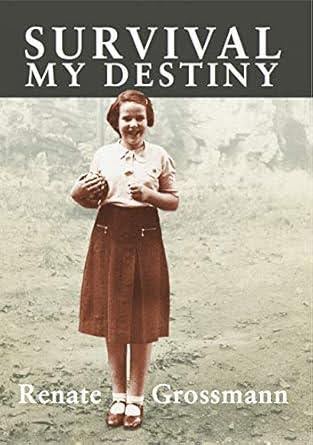 Title: Survival My Destiny
Author: Renate Grossmann
Publisher: Sydney Jewish Museum
Place of publication: Darlinghurst, NSW
Year of Publication: 2010
Location of Book: Lamm Jewish Library, Melbourne Holocaust Museum, Sydney Jewish Museum, and other public libraries
Cities/town/camps: Germany: Dortmund, Nordhausen concentration camp, Bergen-Belsen, Lübeck; Poland: Krakow, Tarnow, Plaszow forced labour camp, Auschwitz-Birkenau, Hindenburg concentration camp; Ukraine: Lviv (Lwów); Sweden: Forsbacka, Stockholm; Australia: Sydney
Note: those cities/towns/camps underlined are those which are most central to the narrative
Genre: Memoir
Key events/experiences: refugee; ghetto; concentration camp; death march
Survival My Destiny is the 72-page memoir of German-born survivor Renate Grossman who sought refuge from the Nazis with family in Poland only to endure internment in the Tarnow ghetto and multiple concentration camps.
Pages 1-10 detail the rise of Nazism in Germany and the family’s flight to Poland in 1938. Pages 11-40 recall the onset of the war and the author’s internment in the Tarnow ghetto and multiple concentration camps until her liberation from Bergen-Belsen in May 1945. Pages 41-51 describe her recovery and training as a nurse in Sweden. Pages 52-72 recount her marriage, emigration to Sydney in 1950 and life in Australia. The memoir contains 25 photographs of the author and her extended family.
Renate Grossmann (née Abend) was born 10 January 1923 in the German city of Dortmund, the only child of Polish immigrants Gizela and Josef Abend. The family lived in Berlin, where her father worked as a wine salesman. Renate was raised in a traditional Jewish family that observed kosher dietary laws.
When Renate was seven, she began schooling at a state school. With the rise of Nazism, she endured increasing hostility from her teachers and classmates. Eventually, her parents transferred her to a Jewish school. Her father’s business also began to suffer as he was prevented from selling to non-Jewish customers. As acts of violent antisemitism became more widespread, the family fled to Krakow in 1938 to live with Renate’s maternal grandparents.
On 1 September 1939, when Renate was twelve-years-old, Nazi Germany invaded Poland and Krakow was bombed. As her father was conscripted into the army as a chauffeur, he was able to warn the family of the approaching German army, prompting them to flee to Lwów. Upon their arrival, they encountered heavy fighting between Polish and German forces. Overrun by both German and Soviet forces, Lwów was soon occupied by the Soviets.
Sometime later, Renate and her mother made the journey back to their home in German-occupied Krakow to retrieve their belongings whilst her father remained in Lwów. Upon arrival, they found German officers occupying their flat and they had to find separate accommodation. After hearing rumours that a ghetto was to be established, they moved to Tarnow to live with Renate’s paternal grandparents and worked on their farmhouse. The Tarnow ghetto was officially established in March 1941. In May, Renate and her mother were relocated to the ghetto where they witnessed increasingly brutal roundups, with those selected being shot on site or in the nearby forest. As they were fluent in German, Renate and her mother were given special life-saving work permits and spared from selections.
In October 1942, the ghetto was divided. Due to their work permits, Renate and her mother were placed in the section for forced labourers where they worked at a clothing factory. Although she endured starvation, Renate managed to survive off food scraps provided by her boyfriend, Kalmek, who worked in the kitchen. One day, Renate cut her finger and contracted blood poisoning. Without antibiotics to cure her or anaesthesia, her finger was amputated. Unable to work due to her injury, Renate went into hiding to avoid deportation. In August 1943, the ghetto was liquidated and everyone in Renate’s factory was sent to Plaszow forced labour camp.
At a date unspecified in the book, Renate was deported to Auschwitz-Birkenau. A week later, she was sent to a labour camp in Hindenburg where she worked producing artillery. In January, the prisoners were sent on a death march to Nordhausen. Without food or water, they were forced to walk for miles in the freezing snow before being placed in open railway carriages. Two days after arriving at Nordhausen, they were sent on another march, again travelling for days on foot and in carriage before arriving at Bergen-Belsen. Exhausted and malnourished, the conditions in Belsen were the worst Renate had experienced, and she quickly became infested with lice and sick with typhoid. Finally, the camp was liberated by the British army on 5 May 1945, and Renate was taken to an army camp in Lübeck to recover.
In June, she was taken to hospital in Forsbacka Sweden where she spent time recovering with other young concentration camp survivors. After her recovery, Renate trained as a nurse with the Red Cross and found employment in Stockholm. In the meantime, she registered with the Red Cross to search for surviving family but soon discovered her parents had not survived. In December 1946, after her maternal aunt in Brussels made contact, Renate emigrated to Belgium with assistance from an unnamed Jewish welfare organisation. There, Renate met and married husband, Leo, in 1947. Soon after, the couple had a son, Josef. In December 1950, the family left Brussels for Marseille, boarding a ship to Sydney, Australia. The details of their emigration are not provided. In Sydney, a second son, Gary, was born and they forged a happy life in their adopted country.
Survival My Destiny provides a brief overview of the author’s wartime experiences, with detailed discussion of memorable episodes. The narrative is general, and specific dates are often missing. The memoir was written and published as part of the Sydney Jewish Museum’s “Community Stories” Project.