
Robert L. Kahn
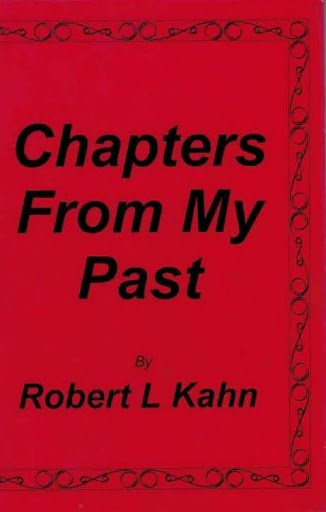 Title: Chapters From My Past
Author: Robert L. Kahn
Publisher: Self-Published
Place of publication: East Bentleigh, VIC
Year of Publication: 1991
Location of Book: Lamm Jewish Library, Melbourne Holocaust Museum, Sydney Jewish Museum and other public libraries
Cities/town/camps: Germany: Fürth, Aschaffenburg; England: Westgate-on-Sea, London, Huyton internment camp; Australia: Hay and Tatura internment camps, Melbourne
Note: those cities/towns/camps underlined are those which are most central to the narrative
Genre: Memoir
Key events/experiences: Kristallnacht; Kindertransport; Jewish refugee; Dunera; Australian internment camps
Chapters From My Past is the 179-page memoir of Robert L. Kahn who fled Nazi Germany on a Kindertransport to England only to be arrested as an enemy alien, deported to Australia via the HMT Dunera and detained in various internment camps.
Pages 1-34 describe the author’s childhood and the lives of his extended family. Pages 35-60 recount the intensification of antisemitic measures in Nazi Germany culminating in Kristallnacht and the author’s flight to England on a Kindertransport in May 1939. Pages 61-87 recall his time in various refugee shelters, his arrest as enemy alien and deportation to Australia in 1940. Pages 88-118 describe the seven week journey aboard the HMT Dunera and the author’s subsequent detainment in the Hay and Tatura internment camps. Pages 119-34 recount his release in February 1942 to work as a labourer and time in the Australian army labour division. Pages 135-79 recall his settlement in Melbourne, marriage and careers as a public servant and journalist.
Robert Leo Kahn was born on 27 August 1923 in the Bavarian city of Fürth, the only child of parents of Lilly Stern and Meier Kahn. His father was a member of the German judiciary and the family frequently relocated for his work. In 1928, they settled in Aschaffenburg in northwest Bavaria.
As a child, Robert witnessed the rise of Nazism. In 1935, his father was dismissed from his job. As antisemitic measures increased, the Kahn home was raided twice and his father briefly arrested. In November 1938 during Kristallnacht Robert’s family was spared but his Jewish neighbours were ransacked and the local synagogue was destroyed. A few days later he was expelled from his school. After witnessing these cruelties, Robert’s extended family sought to leave Germany. In May 1939, Robert secured a place on a Kindertransport to England with his friend, Rudi. On 17 May, Robert bid his parents goodbye in the hopes of reuniting in England. He never saw them again.
After travelling by train to Holland, the boys boarded a ferry to the English coast and were taken by train to the San Remo Hotel in Westgate which had been converted to a refugee hostel. Robert and Rudi remained in Westgate with approximately ninety refugee boys from Germany and Austria until they were moved to another hostel in London in September. When war was declared, the boys were classified as ‘enemy aliens’ and subjected to state surveillance. Due to increasing paranoia and a concerted press campaign for the internment of all alien refugees, Rudi was arrested by British authorities in June and deported to Canada. A month later, Robert was taken to the Kempton Park transit camp and then to the Huyton internment camp.
On 10 July 1940, Robert was one of 2,542 detainees who embarked aboard the HMT Dunera at Liverpool. Upon boarding, they were immediately met with harsh treatment by the escorting British soldiers who roughly searched the detainees and confiscated their belongings. They were then herded below deck into grossly crowded conditions with minimal ventilation unable to change their clothes or wash. Permitted only a few minutes of daylight under heavy guard, they were frequently subjected to abuse and harassment. During one episode, a guard smashed beer bottles on the deck and forced the barefoot internees to walk on the glass shards. A week before landing Robert fell ill with dysentery..
The sick and emaciated prisoners reached Sydney on 6 September 1940 and were transported by train to the Hay internment camp in regional New South Wales where they lived in arid conditions and with little contact with the outside world. In May 1941 the prisoners were sent to the Tatura internment camp in rural Victoria. As conditions in Tatura were gradually improved Robert was able to recommence his education with the help of the Australian Student Christians Movement.
As the detainees were gradually released for labour in key industries, Robert was sent to Shepparton in February 1942 as a fruit-picker. In April, Army authorities assembled the former internees in Bendigo and brought them to the Caulfield racecourse where Robert was enlisted in the 8th Labour Company. He was given various hard-labour assignments, working six days a week. After an emergency operation to remove a benign tumour, he was given lighter duties and was able to continue his studies. After matriculation, and with access to army education services, Robert enrolled in a Bachelor of Arts degree at Melbourne University, studying part-time. In March 1946, he was finally discharged and able to enrol as an on-campus, full-time student. In July 1946, Robert tragically received word from family in America that his parents had been murdered in Auschwitz.
Although his army service earnt him official immigration rights, Robert continued to experience alienation until he found acceptance in the Jewish community after joining the St Kilda Synagogue and befriending fellow German-Jewish refugees. In his second year of university, Robert met his future wife, Mozelle. The couple married in July 1949 and had two children, Alec and Evelyn. After graduation, Robert began working as a journalist for the Australian Jewish News and later as a public relations officer for the Commonwealth government.
Eloquently and vividly recounted, Chapters From My Past is a tale of alienation as a Jew in Nazi Germany and an ‘enemy alien’ in Britain and Australia. The author not only retells his experiences with attention to detail, he also reflects deeply on Jewish refugee experience, discussing the political rhetoric in wartime Britain and Australia, the Australian immigrant experience and the struggle to rebuild life in the aftermath of the Shoah. Ultimately, the memoir is an enlightening story of hope, perseverance and compassion amidst widespread distrust and upheaval.