
Ruth Rack
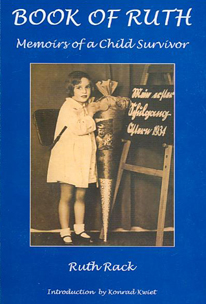 Title: Book of Ruth:memoirs of a child survivor
Author: Ruth Rack
Publisher: Southern Highlands
Place of publication: Sydney
Year of Publication: 2002
Location of Book: Rare Books Collection, Sir Louis Matheson Library, Monash University Clayton Campus
Cities/town/camps: Germany: Leipzig, England: London, Devon
Note: those cities/towns/camps underlined are those which are most central to the narrative
Ruth Rack spent many years trying to write down her story. At one point, she even attempted to write it as a fictional novel, written in the third person about someone else. This proved too hard for her emotionally. Nevertheless, after a process that took a decade, her memoir was finally published, in the first person, in 2000. 227 pages in length, the book includes, in addition to the narrative itself, photos, documents, newspaper articles and an index. The opening pages of the book contain an introduction written by Konrad Kwier, a professor of Jewish Studies and lecturer of Holocaust Studies at the University of Sydney. Pages 1-44 of the book describe Ruth’s life in pre-war Leipzig, Germany, until she leaves for England on a kindertransport in 1938. Pages 45-98 tell of Ruth’s traumatic experiences in wartime England, separated from her family, as well as her life in the years immediately following the war, until her emigration to Australia in 1949. Finally, pages 99-215 cover Ruth’s new life in Australia together with her husband, Peter. A significant part of this last section is devoted to Ruth’s visit to Europe in 1994.
Ruth was born in 1929 in Leipzig, Germany, a large town with a population of about 13,000 Jews. Her parents came from Eastern Europe and her family were religiously observant. Her father was the chazzan (cantor) in their local synagogue. Ruth describes the loving relationship that she had with her close and extended family. Her family had a history of suffering anti-Semitism. Her paternal grandparents had been murdered in their home in Russia by Cossacks during a pogrom.
As a young Jewish child growing up in 1930’s Germany, Ruth faced growing anti-Semitism. At the age of eight she was expelled from her school, along with all of the other Jewish students. Violent and non-violent incidents occurred sporadically, and Ruth’s family began to feel decidedly unsafe. The situation worsened in 1938 when Jews of Polish origin began to disappear; they were being deported. Ruth and her immediate family went into hiding. In the meantime, most of her extended family ‘disappeared’. Kristallnact, November 9, 1938, is a turning point for her family. They leave their home and find refuge in the Polish consulate, witnessing on their way there angry mobs destroying their school, synagogue and Jewish-owned businesses. Upon returning to their house, they discover it has been ransacked. Immediately, her parents make provisions for Ruth and her siblings to get out of Germany. Ruth is sent on a kindertransport to England. She never saw her parents again, though she would not find out their fate for several years.
Ruth spends the war years in England, at first with an aunt in London and later, when children are evacuated from the city to escape bombing raids, in Devon. She lives with fear and anxiety about her parents’ fate; feelings which cannot be understood by those around her. She describes one occasion when, after trying to tell her aunt about the destruction she had witnessed, she was told to “go out and play”. In Devon, she moved throughout her childhood from billet to billet. On numerous occasions, she found herself isolated and discriminated against either because she was Jewish or because she was from Germany.
At the end of the war, Ruth moved back to London, where she met her husband, Peter. The two got married and left for Australia in 1949 to build a new life. Before leaving, Ruth approached her older sisters to find out what had happened to her parents – she had been less than ten years old when she parted with them. Her sister informed her that her father had died in a concentration camp, and her mother had been executed in Poland after being deported. Poles had denounced her to the Nazis as a Jewess. Ruth describes the suffering that years of uncertainty had caused her. It would have been easier, she says, had her sisters not attempted to protect her from the awful truth.
Ruth Rack’s story is different from that of many who survived the Holocaust. She did not live in a ghetto, and she experienced no concentration camp. She lived in democratic England whilst the war raged. And yet, her immense suffering can be felt on every page of her memoir. The loss of her extended family; the uncertainty about the fate of her parents; the crippling lack of understanding that surrounded her in England, where she was seen as a little girl just like any other, one who hadn’t seen her entire community barbarically destroyed. Ruth’s book is eloquent, descriptive, and at times, emotional. It is a moving, heart-rending account of the experiences of a girl too young to fully appreciate the awful tragedy that had unfolded around her.