
Saba Feniger
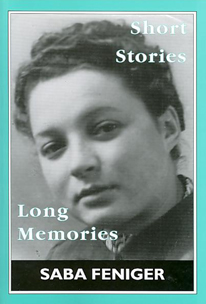 Title: Short stories long memories
Author: Saba Feniger
Publisher: Vista Publications
Place of publication: Melbourne
Year of Publication: 1999
Location of Book: Rare Books Collection, Sir Louis Matheson Library, Monash University Clayton Campus
Cities/town/camps: Germany: Neustadt-Holstein, Stutthof, Italy: Rome, Merano, Australia: Melbourne Poland: Lodz, Auschwitz
Note: those cities/towns/camps underlined are those which are most central to the narrative
Saba Feniger’s autobiography details her life before, during and after the Holocaust. Her narrative is structured around short stories and vignettes that recreate vivid memories of a life filled with tragedy, hope and survival. The first sixty pages details her life, family and friends in pre-war Poland (1924-1939). The second seventy-two pages focuses on her holocaust experiences, depicting her daily struggle to survive and the death of loved ones (1940-1945). The last thirty pages explore her life in the post war climate of Europe and Australia and her ultimate reclamation of a full and productive life (1945-).
The narrative begins by detailing Feniger’s life in pre-war Poland, paying particular attention to her family and sweet memories of childhood. Born in 1924, Saba Feniger was a protected, nurtured youngest child in a household of loving women, headed by a devoted father. The detailed accounts of family life demonstrate the affection, devotion and respect Feniger held for her father, mother, aunt and oldest sister, dedicating separate chapters to them. Feniger also harbours sadder memories of her mother’s illness and subsequent death and the confused emotions she felt as an eleven year old at the time. Feniger describes her childhood friends and the many trials and tribulations she experienced as a youngster in a secure and loving environment.
Feniger’s account of the war begins in the Lodz ghetto where her father, two aunts and elder sister were forced to live in a single room with primitive facilities. Feniger, however, survived the worst horrors of the ghetto due to continuous family sacrifices and efforts to alleviate her fragile health. It was during this time in the ghetto that she tragically lost her father. On her twentieth birthday, Feniger declared that she could no longer live in constant fear and hiding and decided to go to the “collection point” for “resettlement”. Her two aunts decided to go with her. They were packed into red cattle trucks and dispatched to Auschwitz, where they underwent the notorious “selections”. This was the last time she saw her aunt Gucia. Ironically, Auschwitz briefly re-united her with her sister Eda. Twelve days later, Feniger and her aunt Pola are transported to Stutthof, where she is helpless to prevent her beloved aunt succumb to disease and death. Feniger survives by undertaking various jobs for the guards, thereby bolstering her meagre food rations.
Before detailing her survival, Feniger begins with a poignant poem titled, “How can I forget”. This is the first of five poems scattered throughout the narrative. The use of different narrative forms help to convey shifts in tone and provokes an emotive response from the reader. Feniger moves her narrative from the past to the present and back again, as she journeys back to Poland in 1989, revisits the sites of her incarceration and ultimately to her present life in suburban Melbourne. This breaks the linear narrative and injects the story with perspective and the wisdom of hindsight.
Part three of her autobiography focuses on the aftermath of the war, and her struggles to resume normal life. Here again she shares her experiences, her new friendships and the difficulties faced in trying to find lost family members in the chaos of post war Europe. Feniger skilfully details her arrival and gradual integration into Australian life. She attributes her reunion with her sole surviving immediate family member and her luck in finding her own place to live, as a result of numerous selfless acts performed by others.
Saba Feniger’s memoir focuses on the plight of herself and her family, their tragic dislocation and fragmentation, and their subsequent survival and relocation. Fittingly, Feniger describes her book’s main purpose as a source of family history for her children and grandchildren, and secondly, as a human document which bears witness to a period of history never to be forgotten.