
Sarah Saaroni 2
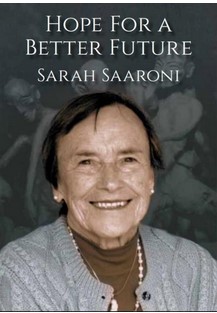 Title: Hope For a Better Future
Author: Sarah Saaroni
Publisher: Jewish Holocaust Centre
Place of publication: Elsternwick, VIC.
Year of Publication: 1994
Location of Book: Lamm Jewish Library, Melbourne Holocaust Museum and Sydney Jewish Museum.
Cities/town/camps: Israel: Tel Aviv, Haifa; Australia: Melbourne.
Note: those cities/towns/camps underlined are those which are most central to the narrative
Genre: Memoir
Key events/experiences: post-war refugee; migrant; Aliyah Bet.
Hope For a Better Future, is the 111-page sequel to Sarah Saaroni’s first memoir, Life Goes on Regardless, published in 1989. It begins where the previous memoir leaves off – with Sarah’s arrival in Palestine in 1946, her experiences as a Haganah member, the establishment of the State of Israel and her eventual emigration to Australia in 1953. For details on the author’s wartime and immediate post-war experiences see the entry for Life Goes on Regardless.
The frontmatter presents an introduction and remarks by Warren Fineberg and Lisa Phillips of the Melbourne Holocaust Museum, as well as freelance journalist Julie Szego. Pages 1-9 recount Sarah’s emigration to and arrival in Palestine in May 1946 with pages 10-42 describing her involvement in the Haganah and life in Haifa. Pages 43-66 detail the family’s immigration to Australia and struggles to establish themselves in Melbourne from 1953-60. Pages 67-111 recount happier times in Melbourne, the growth of her family and the writing of Sarah’s memoir. The memoir includes 28 photographs of Sarah and her extended family.
Sarah Saaroni was born Saba Fishman in June 1926 in Lublin. After surviving the war in Germany disguised as a Polish forced-labourer using false papers, Sarah joined the Aliyah Bet movement, emigrating to British Mandate Palestine in 1946. After a five-week long blockade at La Spezia port, Sarah and 500 other refugees were granted legal visas to travel to Palestine, arriving in Haifa port on 10 May 1946 where she was reunited with her brother Gidal, who had emigrated in 1937. Sarah lived in Tel Aviv with Gidal and his family. There she met her future husband, Lewi Saaroni.
As tensions between Palestinian Arabs and Jewish settlers escalated into civil war, Sarah joined the Haganah, the underground Jewish resistance movement. During the civil war, Sarah was assigned to the home army on sentry duty, tasked with defending the Jewish section Tel Aviv from invading Arab paramilitary forces. During this time, Sarah met her future husband Lewi Saaroni, and on 10 May 1948, when Sarah was 21, the couple married and moved to Haifa. Four days later, the British Mandate ended, and the State of Israel was declared. The following day, on 15 May 1948, the civil war transformed into a full-scale conflict as neighbouring Arab states invaded.
In Haifa, Sarah quickly fell pregnant and began working at a knitting mill whilst Lewi served in the Air Force for the duration of the war. In March 1949, the Arab forces were defeated and shortly after, on 22 June, their son Gideon was born. He quickly became ill and spent several months in hospital which was overrun with Jewish casualties from surrounding Arab states. Gideon recovered, but life remained difficult for the Saaroni family in a context of continuing unrest and economic difficulties. On 9 May 1953, their daughter Adina was born. After years of scarcity in Israel, Sarah’s brother Julek, who had emigrated to Melbourne, encouraged them to emigrate to Australia and obtained landing permits. Believing they could save money and return to Israel when conditions improved, the Saaroni family emigrated to Melbourne in December 1953.
With little money, no knowledge of English and no friends, life in Melbourne was difficult and the family struggled to adjust. Lewi struggled to find secure work, but eventually purchased a shop with help from friends and the Jewish Welfare Society and Sarah began working as a machinist. Over several years they achieved some financial stability and bought a home in East Bentleigh in 1960. Sarah began to see Australia as her home.
In 1981, she decided to pursue her love of sculpting, taking courses and receiving mentorship from established artists. Eventually, Sarah began sculpting scenes from the Holocaust, and one of her sculptures, Out of the Ashes, was purchased and displayed in the Melbourne Holocaust Museum. Following Lewi’s death, Sarah began to write her first memoir, Life Goes on Regardless, which was published in 1989. After decades of suffering in silence and experiencing recurrent nightmares, Sarah finally felt she could confront her wartime experiences. In 2008, she began volunteering at the Holocaust Museum as a survivor-guide and at the age of 91, published her second memoir.
Hope For a Better Future is a chronicle of the everyday difficulties of a Jewish immigrant rebuilding her life in the aftermath of the Holocaust, and her healing process. It is a supplement to the author’s first memoir, which principally details her wartime experiences. Hope For a Better Future was written and published in 2017 as part of the Lamm Jewish Library’s “Write Your Story” program and centres on the author’s message of peace and optimism for her family and future generations.