
Susan Varga
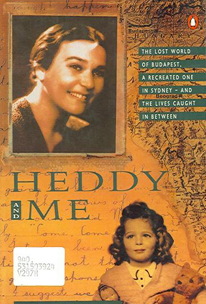 Title: Heddy and Me
Author: Susan Varga
Publisher: Penguin Books
Place of publication: Melbourne
Year of Publication: 1994
Location of Book: Sir Louis Matheson Library, Monash University Clayton Campus
Cities/town/camps: Hungary: Budapest, Dobogókö, Hódmezövásárhely, Kisláng, Szeged, Austria: Vienna, Australia: Sydney
Note: those cities/towns/camps underlined are those which are most central to the narrative
Susan Varga tells the story of her mother, Heddy, and her experiences preceding, during and following the Holocaust. The first eighty pages look at Heddy’s childhood, her family and their lives in Budapest. The next ten pages deal with her stay in Hódmezövásárhely. Pages 91-179 tell the story of Heddy’s frantic attempts to survive, hiding out in Budapest and Kisláng until the end of the war. Susan, with increasing personal contributions, then looks at their emigration to Australia in the 1950s, and the difficulties of living in a strange culture. Susan’s work was written at the age of 51, after she and her family had returned to Hungary to confront the past, and to enable Susan to come to terms with the unique experiences of a child holocaust survivor. The book was published by Penguin Books in 1994.
Heddy was born in Budapest in 1916 to a middle class, non-practicing Jewish family. The family was forced to frequently relocate within Budapest due to her father’s gambling problem. Heddy discusses the worsening antisemitism of the 1930s and the effect it had on her family, especially her brother Pali who left university during his third year, unable to cope with the persecution he endured. Heddy married in 1938 to a wealthy Jewish man, Ferenc (Feri) Schwimmer, and lived quietly in Budapest until 1943.
The beginning of the war initially had little effect on the Jewish way of life in Budapest. The Jews had experienced anti-Semitism before and the phrase ‘megusszuk’, meaning ‘we’ll make it yet’ was a commonly expressed opinion. In 1943 Feri sent Heddy to their country home in Hódmezövásárhely, to give birth to their second child. Susan was actually born in Szeged, a town closer to home. Shortly afterwards Feri was sent to a labour camp, where he died after less than a year. On the 21 of March 1944 the Germans entered Hódmezövásárhely and the deportations began. They were organised into five circular zones, with Budapest at the centre. Scared to stay in the countryside any longer, Heddy fled to Budapest. Only two weeks later all the Jews in Hódmezövásárhely were deported. Soon after Heddy’s father died of illness in Budapest.
Heddy describes the fear of living in the Hungarian capital, the abductions and beatings of Jews in the street and the creation of the ‘Jewish Houses’. Deciding to flee to the countryside with Christian papers, she went to the resort town of Dobogókö. As a painful strategic measure, Heddy’s other daughter was entrusted to Christian friends. In Dobogókö, however, Heddy was recognised by an acquaintance, and immediately went to join her mother in a peasant village called Kisláng. Fortunately, they managed to stay there undetected until the Russian army arrived in January of 1945. After the war Heddy married Gyuszi Weiss, who had lost his wife, two sons, parents and siblings in the deaths camps. In the early 1950s Heddy and her family fled the harsh Communist rule in Hungary and immigrated to Australia.
The early years in Australia proved a traumatic experience as the family struggled with the daunting language and cultural barriers of their new homeland. Over a period of years the family was able to establish itself. Eventually Susan undertook a series of visits back to Hungary, both with and without Heddy, which stirred up complex and disturbing emotions for the author.
The book is written as a series of non-consecutive flashbacks, with frequent segments of historical fact and the author’s frank thoughts interspersed between Heddy’s recollections of what was happening in Hungary at the time. Susan details the life and culture in Budapest, particularly the middle and upper class, and makes brief voyages into the experiences of the many people connected to Heddy. There are also interwoven notes discussing Susan’s and Heddy’s trips to Hungary after the war.