
Susanna Fisher
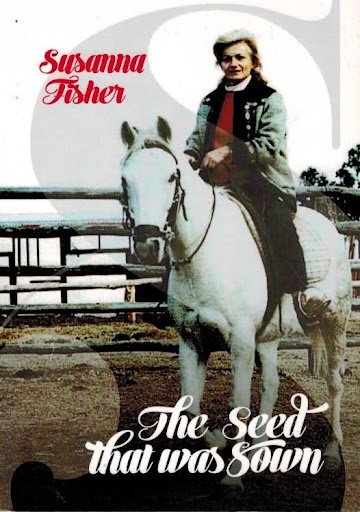 Title: The Seed that was Sown
Author: Susanna Fisher
Publisher: Sydney Jewish Museum
Place of publication: Darlinghurst, NSW
Year of Publication: 2013
Location of Book: Lamm Jewish Library and Sydney Jewish Museum
Cities/town/camps: Romania: Ocna Mureș, Cluj; Poland: Auschwitz-Birkenau; Germany: Bremen forced labour camp, Bergen-Belsen; Italy: Trieste, Santa Cesarea and Bicoca DP camps, Trani; Australia: Sydney
Note: those cities/towns/camps underlined are those which are most central to the narrative.
Genre: Memoir
Key events/experiences: Hungarian occupation; concentration camps; death march
The Seed that was Sown is the 122-page memoir of Romanian-born survivor, Susanna Fisher, who fled fascist Romania to Hungarian-occupied Transylvania only to be deported to Auschwitz in 1944.
Pages 1-29 describe the author’s upbringing in Romania, presenting 13 pages of photographs. Pages 30-41 briefly recount her life after the Hungarian annexation of Transylvania in 1941, before describing her incarceration in several concentration camps in 1944 until her liberation in April 1945. Pages 42-59 detail the author’s return to Cluj, her marriage to Stephen, and their flight to Italy where they lived in several DP camps until their emigration to Australia in 1950. Pages 60-80 gives an account of their new life in Sydney. Pages 81-122 tell of her husband’s death and extended family in Sydney. The memoir contains 97 photographs.
Susanna Fisher (née Friedman) was born on 3 March 1924 in Ocna Mureș, a shtetl in Romania, to Hungarian-born parents, Bertha Stern and Samuel Friedman. Her parents ran a general store and pub. Susanna was the youngest of eleven children - with two brothers and ight sisters - including two half-siblings from her father’s previous marriage. Susanna was closest to her two sisters, Mimi and Pep, who were ten and five years her senior. Though religious and strictly kosher, the family was otherwise modern. When Susanna was fourteen years old, her sister, Seren tragically died in childbirth.
In 1937, the fascist government gained power in Romania and began instituting antisemitic restrictions. As a result, Susanna was expelled from school. In 1940, Northern Transylvania was annexed by Hungary. Due to violent antisemitism perpetrated by the fascist Iron Guard in Romania, her parents decided in 1941 to leave for the city of Cluj (newly under Hungarian occupation) in the hope that life in Hungary would be safer, taking Susanna and four of her siblings. In Cluj, Susanna’s father had to report to police weekly as the family were not considered Hungarian citizens, although her parents were Hungarian-born. The family experienced relative peace for two years and Susanna’s sister, Mimi, started a shop to support the family.
In April 1944 Susanna’s mother died of leukemia. Shortly after, the family was arrested by the Arrow Cross and sent to a brickwork factory. After a few weeks, Susanna was deported to Auschwitz with her father, two sisters, and baby niece. Only Susanna and her sister Mimi survived selection. The sisters were in Auschwitz for approximately eight weeks when, in early August, they were sent with approximately three hundred women to Bremen where they cleaned debris and helped reconstruct the bombed city. They remained there until March 1945, when they were sent on a death march to Bergen-Belsen. On 15 April 1945 they were liberated from Bergen-Belson by the British army. During this time, Susanna became sick with typhus, recovering from the illness in the camp hospital until October.
After Susanna’s release from hospital, the sisters returned to Cluj where they were reunited with their surviving family members – their two brothers, two sisters, Sarolta and Ida, and their children. At a New Year’s Eve party in Cluj, Susanna met her future husband, Stephen. The couple were quickly married and made plans to emigrate to Israel, as Stephen had been drafted into the Romanian army. The couple lived in Bucharest for a few weeks until false papers were arranged for travel to Israel. In early 1946, they were smuggled to the Yugoslav border, making their way to Trieste in Italy. The details of their journey are not discussed. In Trieste, Stephen was arrested by English soldiers and placed in prison, but was released after three days.
After Stephen’s release, the pair travelled to Bari, and later, the Santa Cesarea refugee camp in southern Italy where they stayed for an undisclosed time, surviving on money sent by Stephen’s father. Their daughter, Pauline, was born 1 January 1949. They then travelled to another camp in Bicoca, and onto Trani in the spring of 1949, where Stephen began working at the International Refugee Organisation (IRO). During this time, the pair decided to emigrate to Australia. In 1950, they finally obtained papers through Stephen’s IRO connections and settled in Sydney.
The Seed that was Sown is a brief overview of the author’s life and Holocaust experiences and is largely written as a testament to her love for her family. The author provides a general narrative, focusing on specific episodes and at times her account lacks detail and dates. The memoir was written and published as part of the Sydney Jewish Museum’s “Community Stories” Project.