
Susanne Wright
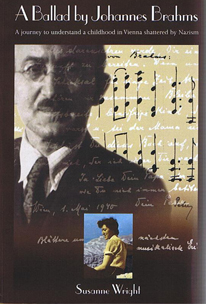 Title: A Ballad by Johannes Brahms: A journey to understand a childhood in Vienna shattered by Nazism
Author: Susanne Wright
Publisher: Makor Jewish Community Library
Place of publication: Caulfield South, VIC
Year of Publication: 2006
Location of Book: Lamm Jewish Library, Melbourne Holocaust Museum, Sydney Jewish Museum, Monash University and other public libraries.
Cities/town/camps: Austria: Vienna; Poland; Belzec; New Zealand: Auckland; Australia: Melbourne Note: those cities/towns/camps underlined are those which are most central to the narrative
Note: those cities/towns/camps underlined are those which are most central to the narrative
Genre: Memoir
Key events/experiences: ‘Mischling’; child survivor
A Ballad by Johannes Brahms is the account of Susanne Wright – the Viennese daughter of an interfaith marriage between a Jewish father and Catholic mother – whose paternal family perished during the Holocaust whilst she survived the war in Vienna. Susanne’s memoir explores the nature of identity and loss as she traces her family history and reconstructs her memories of a childhood brutally disrupted by the Holocaust. The title of the memoir is derived from a heart-rending letter penned by her father after he was arrested and deported to the camps. Peter Friedländer – a gentle man with a love for classical music – was ultimately murdered in the death camp Belzec. In his letter, Susanne’s father attached a ballad by the famous composer Johannes Brahms. It was the last contact he would ever have with daughter.
Pages 1-36 detail the author’s early childhood memories in pre-war Vienna, with the author’s research on the history of Vienna interspersed throughout. Pages 37-54 briefly address the author’s strained Jewish identity as a ‘Mischling’ and child survivor and reconstruct her paternal Jewish family line. Pages 55-87 presents historical notes on “Jewish Vienna”, the author’s research on the fate of Viennese Jews during the Holocaust, including her father, with the author’s memories of the war scattered throughout. Pages 88-107 chart Susanne’s experiences as a volunteer with the Jewish Holocaust Centre in Melbourne in 1999-2000 and her relationships with other survivors. Pages 108-127 chronicle Susanne’s return to the past, both physically and psychologically, to retrace her childhood in Vienna. Pages 128-141 cover her maternal family: the life and death of her mother as well as her maternal grandfather’s deportation to, and subsequent death in, Auschwitz for aiding Jews. Pages 142-164 provide Susanne’s memories of the final months of the war and its aftermath in post-war Vienna, with pages 165-201 covering her life as an immigrant in New Zealand and Australia as well as the legacy of the Holocaust for her family.
Susanne Wright was born in Vienna in 1931 as the first and only child of Gertrude Kronegg and Peter Friedländer. Her father belonged to a well-assimilated, secular family of Ashkenazi Jewish descent. However, her mother was Catholic. Susanne was raised culturally Christian, and Jewish holidays were never mentioned. In 1938, Nazi Germany annexed Austria, bringing terror and destruction to Susanne’s once-peaceful childhood. Ultimately, Susanne’s entire paternal family were murdered in Belzec. Her maternal grandfather was also arrested and deported to Auschwitz for aiding his Jewish in-laws, where he too was killed. Remarkably, Susanne’s family was sent a death certificate and an urn from Auschwitz with the purported ashes of her grandfather. Though the family doubted the authenticity of the urn, they nonetheless placed it by his wife’s grave.
Susanne and her mother survived the war in Vienna though Susanne was classified as a Mischling, a half-Jew, and so subject to discrimination under the race law. During the Allied bombing of Vienna, Susanne and her mother hid in an underground cellar. After the war, Susanne studied at the University of Vienna where she completed her PhD in education. During her post doctorate at Iowa State University in the USA, she met her husband, Harry, and the couple lived in the UK until emigrating to Auckland in 1964 with their two young daughters. They settled in Melbourne in 1968, and the family grew to include two sons. In 1999, after retiring as a Senior Lecturer at the University of Melbourne (and with prompting by her younger daughter Eileen) Susanne became active at the Jewish Holocaust Centre in Melbourne. During this time, Susanne developed friendships with several survivor-volunteers at the centre, and with their support and encouragement, she was finally able to embrace her identity as a child survivor and begin the difficult journey of confronting her painful wartime past – particularly the loss of her beloved father.
Susanne Wright’s memoir avoids a traditional chronological re-telling in favour of a narrative style that moves between past and present, memory recollection and historical scholarship. In part, it is a reconstruction of the author’s childhood memories, however it also incorporates a wealth of scholarly research on the fate of Viennese Jews during the Holocaust as the author traces her Jewish ancestry throughout the tumultuous history of Vienna. The memoir is also deeply reflective, with the author reflecting on war, loss, identity and injustice. It was published by the Makor Jewish Community Library’s “Write Your Story” Collection. A German translation was also published in 2010 in Klagenfurt, Austria, by the Hermagoras Society, a Slovenian publishing house named after Catholic Saint Hermagoras of Aquileia.