
Susie Wise
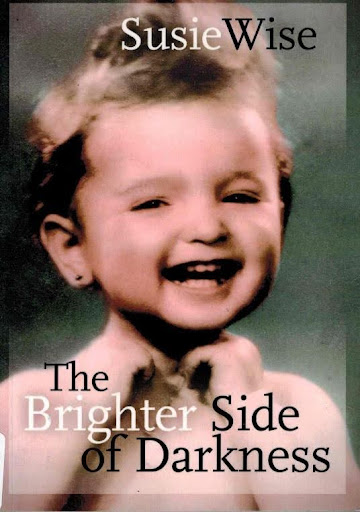 Title: The Brighter Side of Darkness
Author: Susie Wise
Publisher: Sydney Jewish Museum
Place of publication: Darlinghurst, NSW
Year of Publication: 2013
Location of Book: Lamm Jewish Library, Sydney Jewish Museum, State Library of NSW and National Library of Australia
Cities/town/camps: Hungary: Budapest; Austria: Vienna, Rothschild Hospital DP camp; France: Paris; Australia: Sydney
Note: those cities/towns/camps underlined are those which are most central to the narrative
Genre: Memoir
Key events/experiences: child survivor; in-hiding
The Brighter Side of Darkness is the 165-page memoir of Hungarian child survivor, Susie Wise, who survived the Holocaust in hiding with the assistance of Christian acquaintances. After emigrating to Sydney, she eventually found comfort in a meaningful career as a social worker.
Pages 1-13 briefly recount the author’s upbringing in Budapest alongside photographs from the author’s childhood. Pages 14-22 recall her time in hiding with her mother under a false Christian identity. Pages 23-44 describe the family’s flight from Hungary to Vienna and eventually to Australia where Susie was able to embrace her Jewish identity. Pages 45-165 recount her marriages, children and healing following a meaningful career in social work.
Susie Wise was born Zsuzsanna Hoffenreich on 23 August 1938 in Budapest, the only child of Livia and Zoltan Hoffenreich. Her father ran a successful jewellery business, and her family led a comfortable, middle-class existence. The family was assimilated and only attended synagogue on high holidays.
With the onset of the Second World War, Hungary allied itself with Nazi Germany and began instituting additional antisemitic measures. In 1942, Susie’s father was conscripted into the Hungarian forced labour battalion and in November 1943 was shot and killed whilst trying to escape. The family received news of his death in 1944, when Susie was just five-years-old. Alone in Budapest, Susie and her mother survived by selling what was left of her father’s jewels. Following the German occupation in March 1944, antisemitic measures were intensified. When Nazi authorities announced that the Jewish population was to be relocated to a ghetto, Susie’s mother acquired Christian identity papers from her housekeeper who had a daughter the same age as Susie. Susie took on a Christian identity as Marika and was told never to acknowledge her Jewishness.
Soon thereafter Susie, her mother, aunt and grandparents moved into the farmhouse of an unnamed Christian acquaintance, who lived on the outskirts of the city. The family remained in the farmhouse for approximately five weeks but when the neighbour’s son began questioning Susie about her real identity, they left for a mountain resort where they obtained refuge with her father’s business associate. Before long, the resort was requisitioned by Hungarian soldiers and they were forced to return to Budapest. They were again given refuge through her father’s business connections – living in the apartment of a Christian woman, Aranka, until the war’s end. During the siege of Budapest conditions worsened: food became increasingly scarce and the city was bombed, forcing women and children to hide in cellars in the freezing cold. Finally, Budapest was liberated by the Russian army in January 1945.
In September 1946, eight-year-old Susie and her mother escaped Hungary. After bribing border officials, they were transported by truck to the border, crossing into Austria on foot. Aided by the JOINT, they journeyed to Vienna and sought refuge at the Rothschild Hospital DP camp. In the camp, Susie’s mother met her future husband, Joe Kaufmann, a survivor of concentration camps. Five months later the couple were married and Joe became a loving adoptive step-father to Susie. A few months later, the family travelled by train to Paris as illegal refugees where they lived with friends.
Fearing antisemitism, the family lived ostensibly as Catholics. As both her mother and step-father obtained full-time work, Susie was sent to a boarding school where she was bullied for being a foreigner. The family remained in France for two years until a man they had met in DP camp obtained Australian landing permits for them. With financial assistance from the JOINT, they secured passage to Sydney, at a date unspecified in the book.
In Sydney, they were given accommodation at a boarding house with fellow refugees. With the help of the Jewish Welfare Society, Susie’s step-father, an accomplished tailor, established a clothing factory where her mother also worked. Although frightened and unable to speak the language, Susie quickly adapted to her new life in Australia through the patience and kindness of her classmates. As Anglicanism was the dominant religion in Australia, Susie quickly became a ‘member’ and continued to hide her Jewishness for fear of antisemitism. After learning that other students at her school were being educated in Jewish scripture, Susie finally had the courage to reveal her identity to her headmaster. After being met with empathy and reassurance, Susie finally began to openly embrace her Jewish identity after years of concealment and she became an active member in the community.
When she was sixteen-years-old, her parents had saved enough money to purchase their own home. Following years in-hiding and life in crowded, temporary accommodation, Susie finally had a place to call home. After matriculation, she began working at a ladieswear store and married husband Tom in 1957. The couple had two children, Vivienne and Ron. After her divorce, Susie began studying social work part-time, completing her studies at the age of 37. She finally found meaning and happiness helping underprivileged and marginalised members of society.
The Brighter Side of Darkness is a candid account that explores the lasting psychological impact of a life spent in hiding. It provides a very brief view of the author’s wartime experiences. As such, some details, such as specific dates and locations are missing from the narrative. The memoir predominantly focuses on the author’s life as an Australian immigrant and is a powerful meditation on her Jewish identity and path to healing. It was written and published as part of the Sydney Jewish Museum’s “Community Stories” Project.