
Tova Tauber
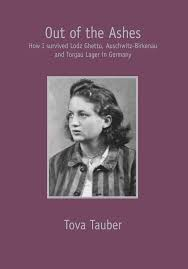
Author: Tova Tauber
Publisher: Makor Jewish Community Library
Place of publication: Melbourne, Australia
Year of Publication: 2011
Location of Book: LAMM Jewish Library of Australia
Cities/town/camps: Poland – Lodz, Auschwitz; Germany – Torgau; Post war - Switzerland – Lugano; Australia - Melbourne
Out of The Ashes: How I survived Lodz Ghetto, Auschwitz-Birkenau and Torgau Lager in Germany is the memoir of Tova Tauber. The book is divided into three sections – the first section (pages 3-8) briefly reviews Tova’s family background and life in Lodz before the war; the middle part (pages 9-49) describes conditions in the Lodz ghetto; deportation to Auschwitz; working as a ‘helper’ in a hospital in Auschwitz-Birkenau; transportation to Torgau ammunitions factory in Germany and liberation by the American forces on 25 April 1945. The remainder of the memoir (pages 50-85) describes reunification with her brother, Abraham Cykiert, spending nearly four years healing and recovering in Lugano, Switzerland; the voyage to Australia, starting a new life in Melbourne and raising a family. It is worth noting that the book features 6 pages of family photographs of Tova’ siblings; a copy of her sister Bejla’s work card from Lodz ghetto and a poem written by her brother, Abraham in 1944.
Toba was born in Lodz, November 1928 to Masza Manel and Moshe Cykiert. She was the sixth in a family of eight children – six girls and two boys. Her family was highly Orthodox and strictly observant, rich in Jewish culture, traditions and learning. She was part of a large extended and close-knit family.
The Germans arrived in Lodz and the ghetto was closed on 1 May 1940. Toba was 12 years old. She describes the overcrowding, meager rations and severe winter they endured in the ghetto. Toba’s job was to knit woollen caps for German pilots. The family had endured five long years in the ghetto and in August 1944, Toba, her mother and her eleven year old sister Marylka were taken to the Umschlagplatz (Assembly place) and herded into cattle trains bound for Auschwitz. The remaining family members were sent to Auschwitz on another transport.
In Auschwitz, Toba was separated from her mother and sister. She endured cruelty and torture from the Kapo in charge of her barrack. When she fell sick with a fever, Toba was sent to the hospital in Birkenau to recover. She was helped by Dr Ada (‘the saving angel’) and given a job as a helper, washing floors and distributing pitiful rations to sick patients. In November 1944, Toba was selected to work at Torgau Munitions factory on the Elbe River in Germany. The munitions factory operated twenty-four hours a day and the girls worked twelve-hour shifts. On 25 April 1945, American forces liberated Torgau.
In June, Toba discovered that her brother Abraham had survived in Buchenwald. Their reunification was one of Toba’s happiest memories. The Swiss Red Cross offered to accept 400 Jewish children, so Toba was sent to Rheinfelden on the Swiss border. From there they went to Lugano under the auspices of the Jewish Agency. She changed her name to Tova and slowly regained her health. When Israel was created in May 1948, Tova decided she wanted to move away from Europe and she travelled to Geneva to be with her brother. They discovered that their sister Mirla had also survived and was living in Poland.
On 21 October 1948 Abraham and Tova docked at Station Pier, Port Melbourne. Their ship, the SS Napoli, was one of the first that brought displaced persons to Australia. Tova worked hard in an asbestos factory and then a clothing factory. She earned enough money to bring her sister Mirla to Australia.
In 1950, Tova married George Tauber. They had three children. George was in poor health and he died in 1996.
Tova Tauber has reached deep into her heart to tell her story and that of her family, so many of whom were murdered in the Holocaust. A creative writer, she strikes a poetic note not easily forgotten.